Summary
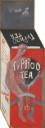
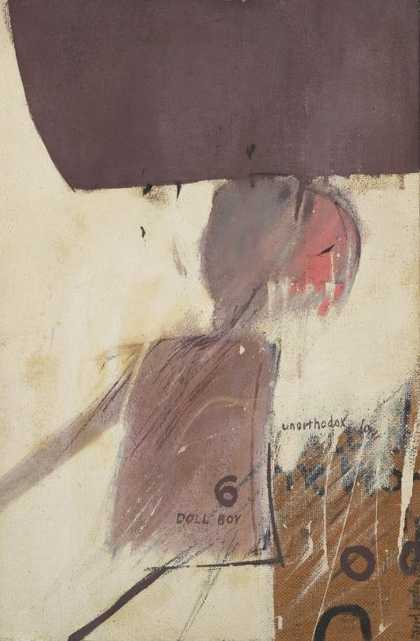
Also known as The Third Tea Painting, this is the last of a series of three paintings based on Typhoo Tea packets, made while Hockney was still a student at the Royal College of Art. The tea paintings marked a return to the depiction of recognisable images, after Hockney's early attempts at abstraction. In his studio at the College he was surrounded by tea packets:
I used to go into the Royal College of Art very early in the morning ... before Lyons had opened in South Kensington, and I used to make my own tea in there ... it was always Typhoo tea, my mother's favourite ... The tea packets piled up with the cans and tubes of paint ... and I just thought, in a way it's like still-life paintings for me ... There was a packet of Typhoo tea, a very ordinary popular brand of tea, so I used it as a motif. This is as close to pop art as I ever came.This painting shows a figure apparently seated within the confines of a narrow cubicle ( the Typhoo Tea box, complete with painted inscriptions including the misspelt 'TAE'. 'I am a bad speller, but to spell a three-letter word wrong!! But it's drawn in perspective and it was quite difficult to do. I took so long planning it that in my concern for flatness or abstraction I spelt it wrong.' (Stangos p.64.)
(Stangos, pp.63-4)
The picture employed a shaped canvas, the first work by a Royal College student in which the stretcher departed from the traditional rectangle. Hockney made the stretcher himself. His intention was that, if the blank canvas was already illusionistic, he 'could ignore the concept of illusionistic space and paint merrily in a flat style - people were always talking about flatness in painting in those days' (Stangos, p.64). He soon abandoned the device, although it was taken up by other artists, notably Allen Jones in his 1962 Bus paintings.
Further reading:
Nikos Stangos (ed.), David Hockney by David Hockney, London 1976, pp.20, 63-64, 66, reproduced p.35 in colourMarco Livingstone, David Hockney, revised edition, London 1987, pp.41, 43-4, reproduced pl.36 in colour
Terry Riggs
November 1997