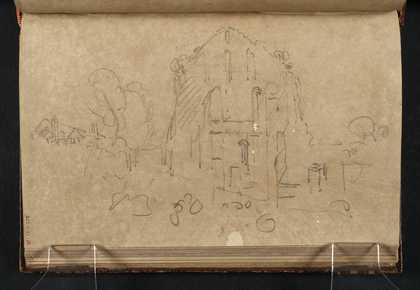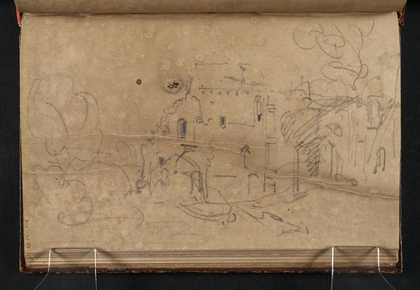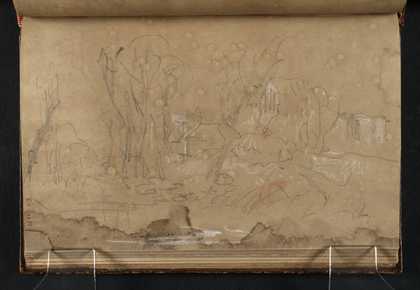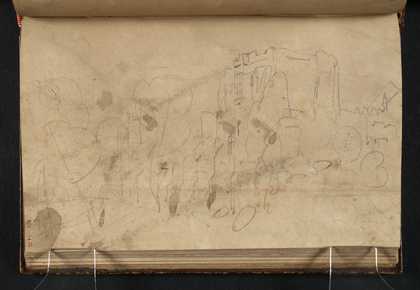
Joseph Mallord William TurnerA Wall near Battle Abbey c.1810-16

Share this artwork

Artwork details

Artist
Title
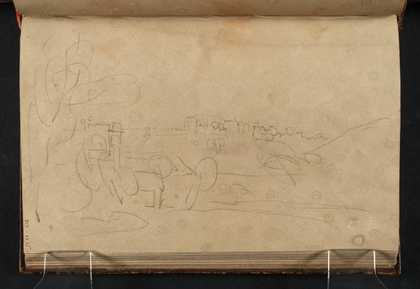
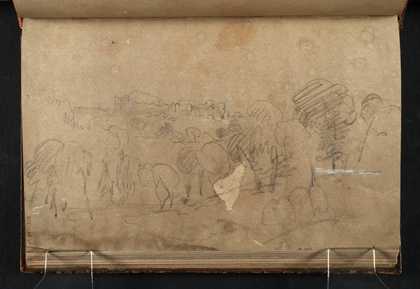
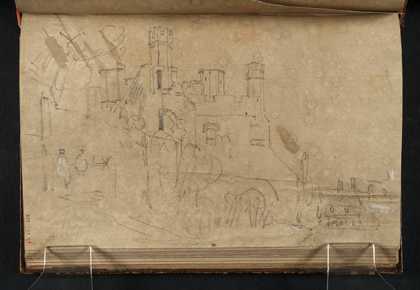
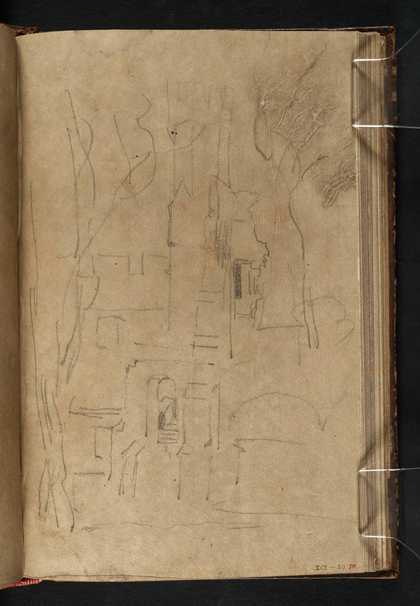
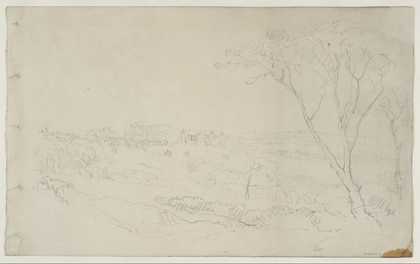
A Wall near Battle Abbey
From Views in Sussex Sketchbook
Turner Bequest CXXXVIII
Date c.1810-16
MediumGraphite on paper
Dimensionssupport: 200 x 325 mm
Collection
Tate
Acquisition Accepted by the nation as part of the Turner Bequest 1856
Reference
D10331
Turner Bequest CXXXVIII 11
View this artwork by appointment, at Tate Britain's Prints and Drawings Rooms

Catalogue entry

Joseph Mallord William Turner 1775–1851
A Wall near Battle Abbey circa 1810–16
D10331
Turner Bequest CXXXVIII 11
Pencil on white wove paper, 200 x 325 mm
Stamped in black ‘CXXXVIII 11’ bottom right
Blind-stamped with the Turner bequest monogram lower right of centre
 
Accepted by the nation as part of the Turner Bequest 1856
Probably a right-hand page from the sketchbook, with stitch holes on the left.
As Finberg surmised, the view is near Battle Abbey, and was used as the basis for the watercolour Battle Abbey, the Spot where Harold Fell (currently untraced)1 made for John Fuller circa 1816 and engraved by William Bernard Cooke in 1819 for Views in Sussex. In the engraved design, the site is figured as the place where King Harold Godwinson was slain in the Battle of Hastings in 1066. Turner introduced a hare as a ‘bit of sentiment’, having allegedly confused this King Harold II with Harold I, Harold Harefoot, who had died some years earlier.2
In his letterpress for Views in Sussex Ramsay Richard Reinagle wrote of this plate that ‘A more scanty assemblage of materials for a landscape composition could hardly be presented to an artist ... [but] Mr. Turner has achieved a prodigy’.
There is a stain of oil or varnish in the bottom right corner, and damage on the left near the stitch holes.

David Blayney Brown
April 2011

1
Wilton 1979, p.348 no.423.
2
For discussion of this, see Eric Shanes, Turner in 1066 Country, exhibition catalogue, Hastings Museum and Art Gallery, Hastings 1998, p.4.

About this artwork