Joseph Mallord William TurnerBuildings and a Fountain; ?Terni 1819

Share this artwork

Artwork details

Artist
Title
Buildings and a Fountain; ?Terni
From Ancona to Rome Sketchbook
Turner Bequest CLXXVII
Date 1819
MediumGraphite on paper
Dimensionssupport: 110 x 186 mm
Collection
Tate
Acquisition Accepted by the nation as part of the Turner Bequest 1856
Reference
D14740
Turner Bequest CLXXVII 45
View this artwork by appointment, at Tate Britain's Prints and Drawings Rooms

Catalogue entry

Joseph Mallord William Turner 1775–1851
Folio 45 Recto:
Buildings and a Fountain; ?Terni 1819
D14740
Turner Bequest CLXXVII 45
Pencil on white wove paper, 110 x 186 mm
Inscribed by John Ruskin in red ink ‘45’ bottom right
Stamped in black ‘CLXXVII 45’ bottom right
 
Accepted by the nation as part of the Turner Bequest 1856
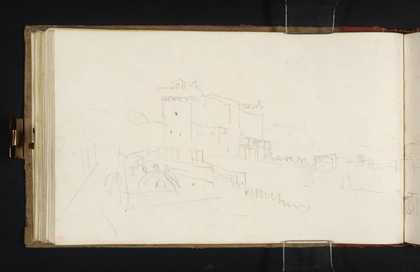
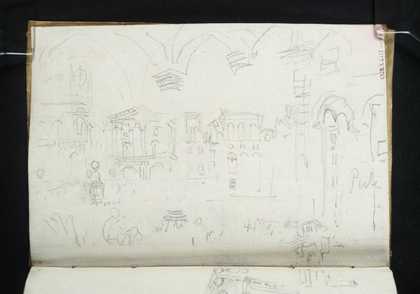
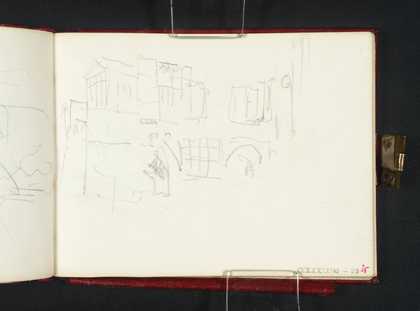
This sketch represents an Italian street or piazza observed by Turner en routeto Rome from Ancona. Despite the wealth of detail recorded by the artist, including the elaborate baroque façade of the principal building, the fountain and the distant line of mountains, the subject has yet to be identified. However, it is highly likely that it depicts part of Terni, an Umbrian town approximately eighteen miles south of Spoleto. The adjacent views within the sketchbook depict geographical locations on either side of the town, for example the Pass of the Somma, see folios 43 verso–44 (D14737–8) and Lake Piediluco and the Cascata della Marmore, see folios 45 verso–57 (D14741–D14763). Terni was transformed into a major industrial centre during the second half of the nineteenth century. Furthermore, around eighty per cent of the town was destroyed by Allied bombing during the Second World War.1 If this view therefore does indeed depict Terni, it is entirely possible that the buildings recorded by Turner now no longer survive.

Nicola Moorby
November 2008

1
Ros Belford, Martin Dunford, Celia Woolfrey et al, Rough Guide to Italy, New York, London and Delhi 2007, 8th edition, p.669.

About this artwork