Joseph Mallord William TurnerLecture Diagram 59: Pulteney Bridge, Bath, in Perspective (after Thomas Malton Junior) c.1810

Share this artwork

Artwork details

Artist
Title
Lecture Diagram 59: Pulteney Bridge, Bath, in Perspective (after Thomas Malton Junior)
Date c.1810
MediumGraphite, watercolour and tracing on paper
Dimensionssupport: 672 x 999 mm
Collection
Tate
Acquisition Accepted by the nation as part of the Turner Bequest 1856
Reference
D17084
Turner Bequest CXCV 114
View this artwork by appointment, at Tate Britain's Prints and Drawings Rooms

Catalogue entry

Joseph Mallord William Turner 1775–1851
Lecture Diagram 59: Pulteney Bridge, Bath, in Perspective (after Thomas Malton Junior) circa 1810
D17084
Turner Bequest CXCV 114
Watercolour with some pen and stopping-out over transfer ink on white wove paper, 672 x 999 mm
Watermarked ‘J WHATMAN |1808’
Inscribed by John Ruskin in red in ink ‘114’ bottom right
 
Accepted by the nation as part of the Turner Bequest 1856
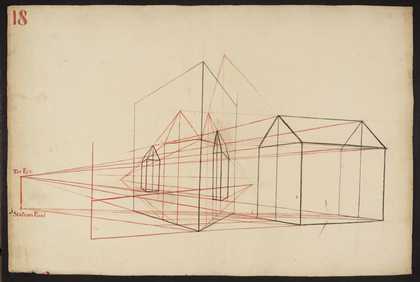
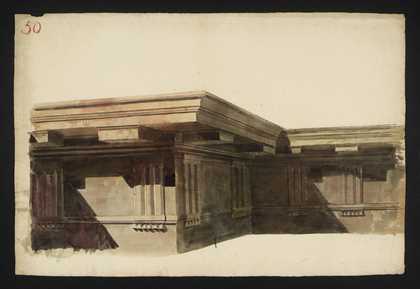
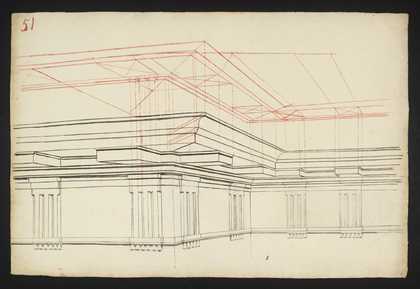
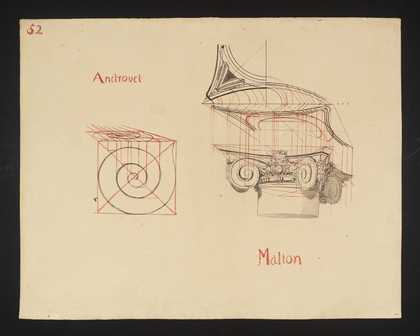
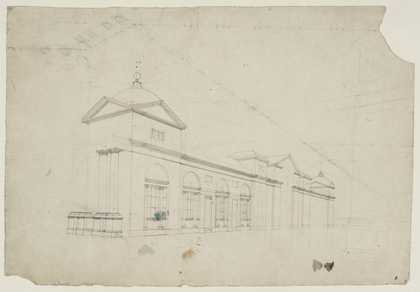
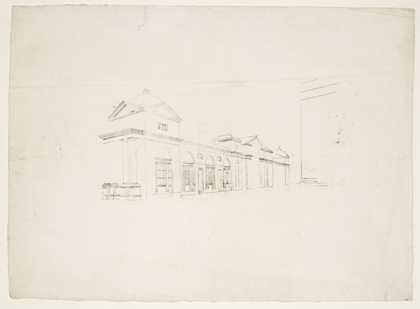
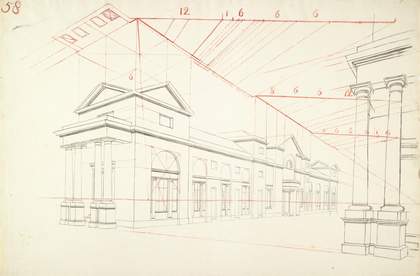
This is the second and more eleborate of two depictions of Robert Adam’s Pulteney Bridge, Bath which Turner presented during Lecture 4 as Professor of Perspective at the Royal Academy. They were shown to demonstrate the application of parts of the architectural orders to ‘constitute a building’. For Turner’s source in a work by the younger Thomas Malton (1748–1804), and remarks on the subject, see notes to Diagram 58 (Tate D17083; Turner Bequest CXCV 113) which shows the method underpinning the perspective construction and which Turner traced to make the outline of the present drawing. See Tate D17081 (Turner Bequest CXCV 111) for a small perspective study of the same bridge; for tracings, see also Tate D17082 (Turner Bequest CXCV 112) and Tate D40007.
In this coloured version, there is strong light and shadow and Turner makes play with the reflections in the windows of the shops at street level.
Technical notes:
Peter Bower states that the sheet is Double Elephant size Whatman paper made by William Balston, at Springfield Mill, Maidstone, Kent. The largest group within the perspective drawings, this batch of paper shows a ‘grid-like series of shadows that can be seen within the sheet in transmitted light. This appears to have been caused by a trial method of supporting the woven wire mould cover on the mould’. Because this is the only batch he has seen with such a feature, Bower believes that ‘it may have been tried on one pair of moulds and for some reason never tried again’. He also writes that it is ‘not the best Whatman paper by any means; the weight of this group is also very variable and the moulds have not been kept clean during use’.1
1
Notes in Tate catalogue files.
Verso:
Blank, save for an inscription in red watercolour ‘59’ top right.

Andrea Fredericksen
June 2004

Supported by The Samuel H. Kress Foundation

Revised by David Blayney Brown
January 2010

About this artwork