Illustrated companion
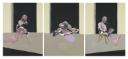
The centre panel shows two male figures apparently wrestling or, as is strongly suggested, copulating. This image occurs in previous paintings by Bacon and its origin lies in his interest in the work of the pioneer photographer Eadweard Muybridge who, in the early 1880s. made the first stop-action photographs, publishing the results in two celebrated books Animals in Motion and The Human Figure in Motion. The image here is based on one of a sequence of Muybridge photographs showing two naked men wrestling. Bacon's treatment of this image, and of the two portraits, is characteristic of his intuitive, improvisatory way of painting in which the human figure is restructured into highly expressive, often distorted or abstracted forms, which nevertheless retain a powerful sense of reality. Bacon has described his images as coming from 'what we call the unconscious' and has said that this process 'is a form of accident, to me'. This approach relates Bacon to the well-established tradition in modern painting which runs back through his much more abstract contemporary Jackson Pollock to Picasso and the Surrealists. In a recorded conversation with the organiser of his 1985 Tate Gallery retrospective Bacon said of the centre panel of this work 'those two images just came around by accident really'. But an important part of the 'accident' of creating his images lies in Bacon's manipulation of the paint: in the same conversation he said 'painting is such a very fluid medium that if you're using large brushes - if you turn a brush one way or another it [the resulting brush mark] has a different implication. And you use the implication which is nearest to your nervous system'. In other words Bacon's way of applying paint with heavily loaded house painter's brushes (not artist's, he has stressed) results in marks which are suggestive to him, which trigger unconscious associations and can be developed into images. Bacon uses various media and a wide and inventive range of techniques of application, with brushes and other things such as combs and textured cloth, such as corduroy, to achieve his effects. The foregrounds of this triptych are in household emulsion, the black areas in very thin oil and the figures in thick oil (impasto). Bacon also often uses pastel to highlight parts of the image. The curved white form in the centre panel, which appears to have been made with a single violent brushstroke, has had sand added to it while wet to enhance its texture and therefore its distinctly phallic presence.
Published in:
Simon Wilson, Tate Gallery: An Illustrated Companion, Tate Gallery, London, revised edition 1991, p.247