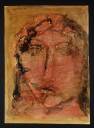
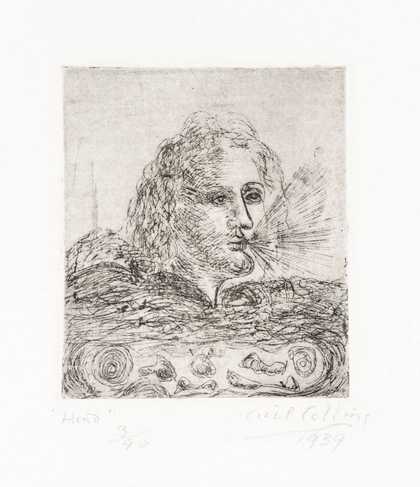
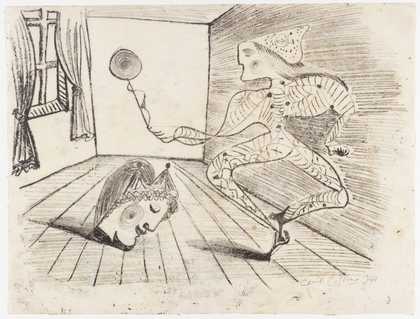
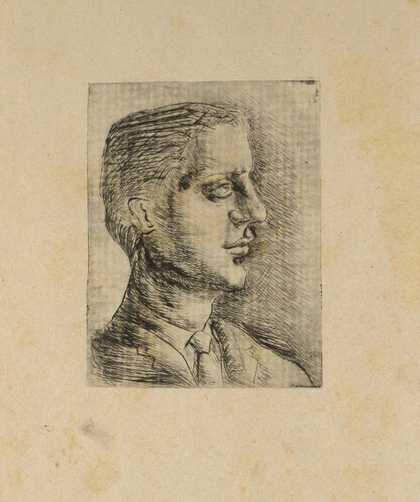
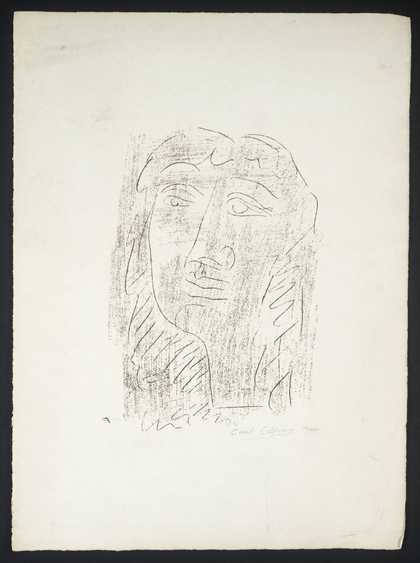
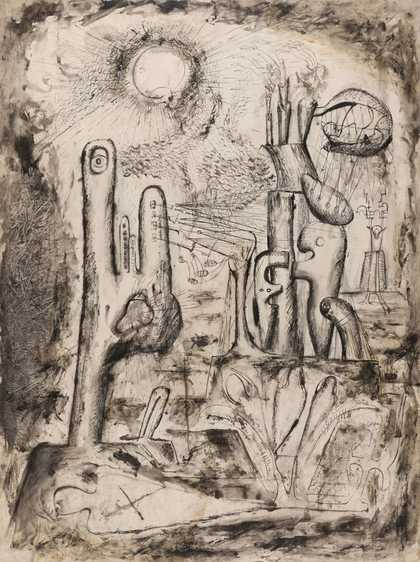
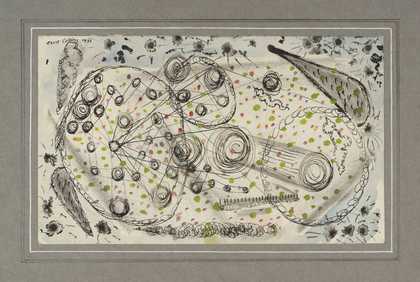
Cecil Collins, Head 1936
© Tate
Summary
Collins pursued his vision of a lost paradise, destroyed by the mechanisation of the modern world, throughout his lifetime. Creating his own version of archetypal figures, such as the Fool and the Angel, he attempted to reveal to us our innermost selves. These figures, he believed, represented an innocence that had ceased to exist in the ‘Machine Age’ (Keeble, p.73). Many of Collins’s aims and beliefs were published in an essay he titled The Vision of the Fool which was first published in 1947. Throughout the essay Collins compares the Fool with the ‘Saint, the artist, the Poet’ (Keeble, p.81). He explains, ‘modern society has succeeded very well in rendering poetic imagination, Art, and Religion, the three magical representatives of life, an heresy; and the living symbol of that heresy is the Fool. The Fool is the poetic imagination of life, as inexplicable as the essence of life itself’ (Keeble, p.73)… (read more)
Find similar artworks
Artist
Cecil Collins
(75)
Category
On paper, unique
(48,609)
Decade
1930-9
(979)
Subject
abstraction
(8,371)
non-representational
(6,320)
colour
(2,895)
people
(21,186)
body
(2,881)
head / face
(1,696)