Summary
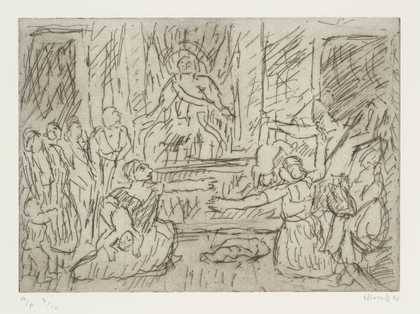
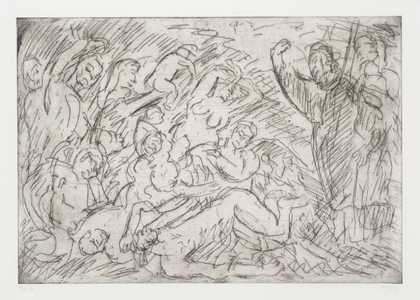
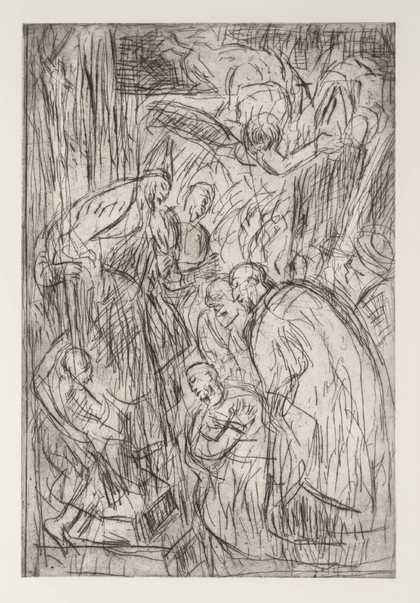
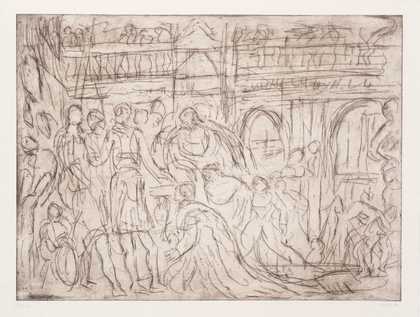
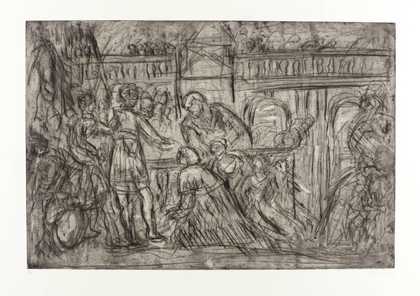
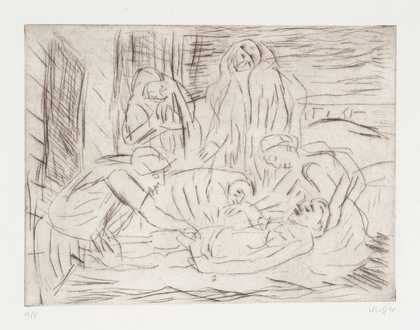
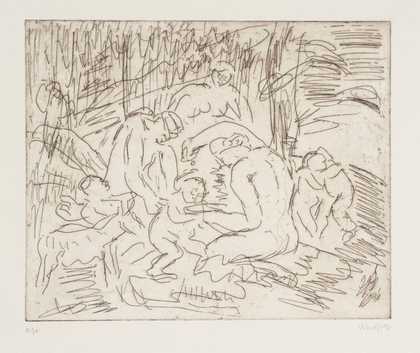
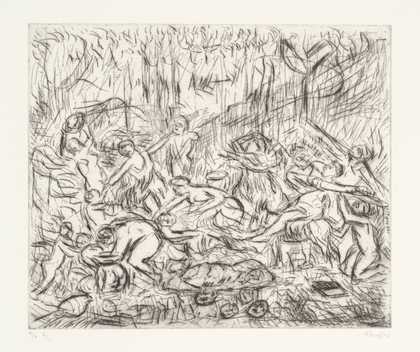
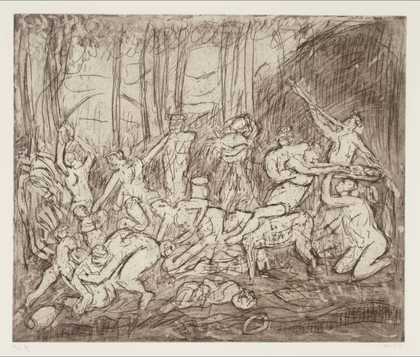
This print is one of many etchings executed by Leon Kossoff in response to, and literally in the presence of, oil paintings by old masters; in this case The Consecration of Saint Nicholas, around 1562, by Paulo Veronese (c.1528-88), owned by the National Gallery, London. Tate owns two prints by Kossoff after this Veronese painting (Tate P11713-14). The artist’s ability to explore a number of separate responses while making drawings and prints from a single subject is illustrated in these etchings. This print was never published as an edition; Tate owns the eighth of fifteen trial proofs.
Veronese’s painting depicts a scene from the life of Saint Nicholas, as told in the thirteenth-century book The Golden Legend. On the eve of the election of the archbishop of Myra in Lycia (Asia Minor) in the 4th century AD, it was revealed to one of the bishops that a young man called Nicholas had been divinely chosen. When Saint Nicholas presented himself at the cathedral the following day he was elected and immediately installed as archbishop. Veronese has portrayed the moment of Nicholas's recognition, or subsequent consecration. Nicholas approaches the altar while an angel descends from the sky, bearing the vestments of office: a bishop’s stole, crozier (staff) and mitre. Kossoff’s response to this painting is densely drawn. Aquatint and drypoint have been added to give tonal depth and variation… (read more)