Summary
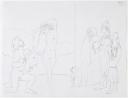
Picasso made Dance of the Banderillas on 14 February 1954 in Vallauris. Having made a drawing on transfer paper with a lithographic crayon, he then had it transferred onto lithographic stone by the Paris printer Fernand Mourlot. The lithograph was produced in an edition of five artist’s proofs and fifty signed and numbered prints on white Arches wove paper, of which this is number forty-eight, and published by the Galerie Louise Leiris, Paris.
Dance of the Banderillas depicts a play-bullfight between a beautiful woman and a classical-looking man. The bullfight was a subject Picasso returned to frequently, particularly from the mid-1950s (see also Tate T06803). It was also a favourite spectator sport for the artist from an early age, when he enjoyed regular visits to the Malaga bullring with his family. Picasso’s biographer Roland Penrose has written that, apart from his enjoyment of the action, ‘the main involvement for Picasso was not so much with the parade and the skill of the participants but with the ancient ceremony of the precarious triumph of man over beast ... The man, his obedient ally the horse, and the bull were all victims of an inextricable cycle of life and death.’ (Roland Penrose, ‘Beauty and the Monster’, in Penrose and Golding 1973, p.170… (read more)