Illustrated companion
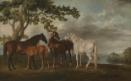
But a closer look at this group of mares and foals reveals that beneath the scientific anatomy and the seeming naturalness of both the individual poses and the whole arrangement of the group, lies a complex compositional structure in which Stubbs's knowledge of classical principles gained on his trip to Italy in 1754, as well as his highly personal sense of pattern and rhythm are in evidence. The three mares and their foals are placed so as to form very roughly a cone, with their rumps marking the perimeter and their heads the apex. This is a 'classical' composition, which gives an overall symmetry and balance to the group. Within this structure, which also gives unity to the group, holding it together, Stubbs beautifully judges the spacing of the mares' heads so that they are just far enough apart to make distinctively individual outlines against the sky but not so far apart that the unity of the composition is lost. He also exploits the beauty of the curves of their necks and backs by silhouetting them against the sky. The spectator's eye is drawn over the whole group in a slow revolving rhythm, across the four rumps, up to the heads and down and round again. The fact that both the foals are feeding looks entirely natural, but it is also, of course, essential to Stubbs's composition.
Published in:
Simon Wilson, Tate Gallery: An Illustrated Companion, Tate Gallery, London, revised edition 1991, p.41