Catalogue entry
Dorothea Tanning 1910–2012
Eine Kleine Nachtmusik
1943
Oil on canvas
410 x 610 mm
Purchased with assistance from The Art Fund and the American Fund for the Tate Gallery 1997
T07346
Ownership history:
Purchased from the artist by Roland Penrose, Chiddingly, Sussex, in September 1946; inherited by Anthony Penrose, Chiddingly, Sussex, by whom sold to Tate in 1997.
Exhibition history:
References:
Eine Kleine Nachtmusik was produced early in Dorothea Tanning’s long career, during a period in which the artist used the stylistic conventions of surrealism to portray enigmatic and highly fantastical images rendered with precise realism. Born in Galesburg, Illinois in 1910, where Tanning has complained that ‘nothing ever happened but the wallpaper’, she was seduced by the psychologically charged escapism of fantasy fiction and gothic terror novels early in her childhood. She was already a convert to the drama inherent in surrealism by the time she saw the Fantastic Art, Dada and Surrealism exhibition at the Museum of Modern Art in New York in 1936, the effect of which she describes in her memoir Between Lives as the recognition of an ‘infinitely faceted world I must have been waiting for … the limitless expanse of possibility’.1 Eine Kleine Nachtmusik is an excellent example of the way in which Tanning utilises the language of surrealism to explore her own personal pre-occupations and obsessions.
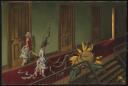
The picture depicts a shabby hotel corridor with cracked plaster, peeling wallpaper and numbered doors, the farthest of which is ajar allowing an unidentifiable, glowing light to pour out into the dimly lit, narrow space. The image of doors and doorways is a constant one throughout Tanning’s work, serving as a metaphorical threshold through which one can enter unknown other worlds or the unconscious. The opening here suggests a gateway between one reality and another, alerting the viewer to the possibility of the unexpected, which here takes the form of a giant sunflower lying broken and twisted on the blood-red carpet. Its petals are torn and its yellow centre faces upwards like an unblinking eye. Two figures also inhabit the scene, both of which appear to be young girls. One leans against a doorway, eyes closed, head back, clothing torn, her chest and stomach exposed; she appears to be exhausted and on closer inspection her face is actually a mask. In her hand she clutches a limp petal from the flower. The other girl stands defiantly, back to the viewer, fists clenched, her hair streaming wildly upwards into the air. The tattered state of the flower and the figures’ clothing suggest that there has been a struggle or encounter and that the flower has possibly been vanquished. In a letter to Tate in 1999 about the painting, Tanning stated:
It’s about confrontation. Everyone believes he/she is his/her drama. While they don’t always have giant sunflowers (most aggressive of flowers) to contend with, there are always stairways, hallways, even very private theatres where the suffocations and the finalities are being played out, the blood red carpet or cruel yellows, the attacker, the delighted victim.2
Melodrama, sado-masochism, desire and death all form part of Tanning’s lifelong preoccupation with the gothic sensibility she first encountered as a child. Transformed by the intensity of childhood imagination, Tanning escaped into a world of fatal desires, psychological terrors and supernatural battles between good and evil. This picture is, she has stated, ‘like a dream, anything can happen. You might be confronted by your worst fears or greatest joys but you are awake … so you must be vigilant’.3
Eine Kleine Nachtmusik was made while Tanning was visiting Sedona, in the Arizona desert. She and her companion, Max Ernst went there from the urban landscape and artistic milieu of New York. Later, in 1946, she would marry Ernst and move to Sedona where they remained for many years. The German title, which translates into English as A Little Night Music, is taken from the popular title for Wolfgang Amadeus Mozart’s Serenade No.13 for Strings in G Major of 1787. In her book Women Artists and the Surrealist Movement Whitney Chadwick, who provided one of the earliest discussions of this picture, suggests that the image is highly autobiographical and inspired by the composition of Danger on the Stairs 1927 (Museum of Modern Art, New York) by the Belgian surrealist Pierre Roy (1880–1950), a painting which featured a large snake descending a staircase. Chadwick points out that Tanning ‘removes the snake with its Freudian symbolic content and replaces it with a torn and writhing sunflower, an image strongly identified with Tanning’s mid-western origins, close to nature and capable of both fecundity and menace’.4 However, Tanning strongly contests the link between the two paintings. In a letter to Tate in 1998, she stated that to ‘compare my vision with the perfectly proportioned and very photographic depiction of a snake (anaconda) on the stairs, neatly painted, somewhat in the manner of Magritte, is simple-minded. The scene, though infrequent, is possible in the natural outside world. Mine is not’. Nevertheless, Tanning openly states that the sunflower in this picture ‘is a symbol of all things that youth has to face and deal with … representing the never-ending battle we wage with unknown forces that were there before our civilization’.5
Tanning was already obsessed with ‘this most aggressive of flowers’ when in 1943, a year after meeting Ernst, she painted Sunflower Landscape, one of only two existing portraits of Ernst by Tanning.6 Curiously, the picture portrays an imagined Ernst of about ten years old, exploring a rather sensuous stand of huge anthropomorphic sunflowers most of which are over twice his height, the stems and faces of the flowers forming a tangled throng of naked, mostly female bodies. The young Ernst strolls through the moonlit scene arm in arm with one of the shorter flowers; smiling enigmatically he glances towards his companion’s large, round, green breasts and into the darkness of a thicket of large-leafed flora. The tone is suggestive of secrecy and sexual exploration. According to Tanning, the flowers in this picture are both menacing and alluring at the same time. They are metaphors for the forces that can, at once, seduce and destroy.
In Eine Kleine Nachtmusik, instead of the conspiratorial and adventurous atmosphere of Sunflower Landscape, the sunflower lies vanquished, implying that a more violent sexual struggle or event has already taken place, leaving one of the figures in a swoon, her clothing torn and her face a doll-like mask. Tanning has suggested that that these two paintings, both painted in the same year:
to some extent reflect the vastly different ways boys and girls experience early childhood desire and the relationships they have with their changing bodies which are primarily dictated by moralistic and religious views. Boys are encouraged to be sexually experienced and girls are taught to be passive … or frightened by sexual behaviour [as it could lead to the shame of unwanted pregnancy].7
In other words, if the sunflowers represent, at some level, initiation into the world of desire, the young Ernst’s experience is one of mystery and seduction, whereas for the girls in Eine Kleine Nachtmusik there is much more incipient threat and violence, ‘a [thing] that youth has to face and deal with’.8
Tanning has described this and other paintings made during the period when the she and Ernst had first moved to Sedona as ‘a series of chilly, secretive, confined and domestic paintings that typifies my response to the brash, crushing, diabolically red landscape outside the studio’.9 She has further explained that these works contain:
an almost primitive, fundamental acceptance of a primarily sensorial world, one in which powerful supernatural forces inhabit the eerie landscapes of both the natural environment and in the recesses of the imagination, particularly the childhood imagination, where the extraordinary can exist unhampered by disbelief or logic. Eine Kleine Nachtmusik depicts a confrontation between the forces of grown-up logic and the bottomless psyche of a child.10
These words rightly contextualise the works within the world of fairytales and fables. When asked to elucidate on her choice of title, Tanning responded, ‘did anybody ask Mozart what he meant by Eine Kleine Nachtmusik? Could it be his own playful sense of the absurd just pulled it out of the air – as I did, in the same mood, when I borrowed it for a picture?’11 While a strong connection with music is a recurrent feature throughout her career, she later conceded that Mozart’s popular tune ‘seems very simple but hints at something darker … it’s like a lullaby, it can be both naive and sinister, like the dreams of children’.12 In 2003, Tanning returned to these early images by completing a novel entitled Chasm. It is a gothic fairy story begun in Sedona in 1946, in which the central protagonist, a highly-strung young girl, is caught in between a recognisable theatre of airless, overly cultivated interiors and the freedom of a vast magical desert, symbolic of the landscape of the unconscious.
From early on, Eine Kleine Nachtmusik was recognised as one of Tanning’s strongest works. It was exhibited in 1944 at the artist’s first show with the Julien Levy Gallery and later at the Museum of Modern Art, New York. It was selected by the surrealists André Breton (1896–1966) and Marcel Duchamp (1887–1968) for inclusion in Le Surrealisme en 1947; both Breton and Duchamp, who remained a life-long friend of Tanning’s until his death in 1968, highly praised the work. On a visit to Sedona in 1946, the British surrealist artist and collector Roland Penrose bought the painting, alongside several others. Upon his death, it remained in the collection of his son Anthony Penrose until it was acquired by Tate in 1997.
Victoria Carruthers
March 2010, revised July 2012
Supported by The AHRC Research Centre for the Study of Surrealism and its Legacies.
Notes: