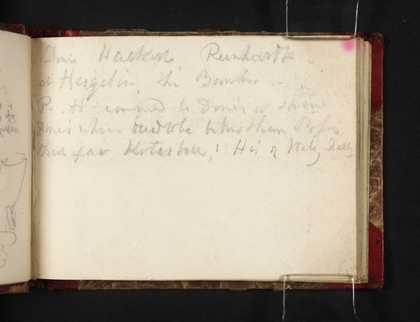
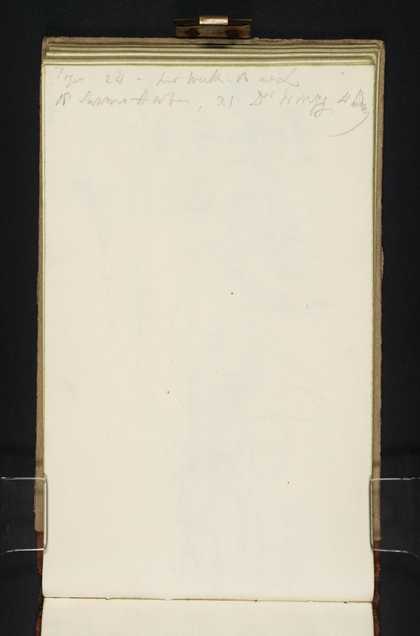
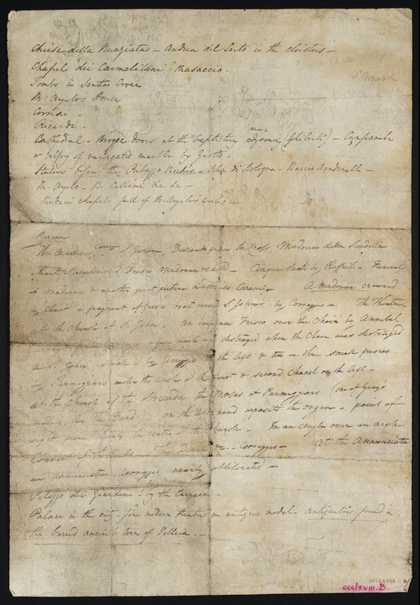
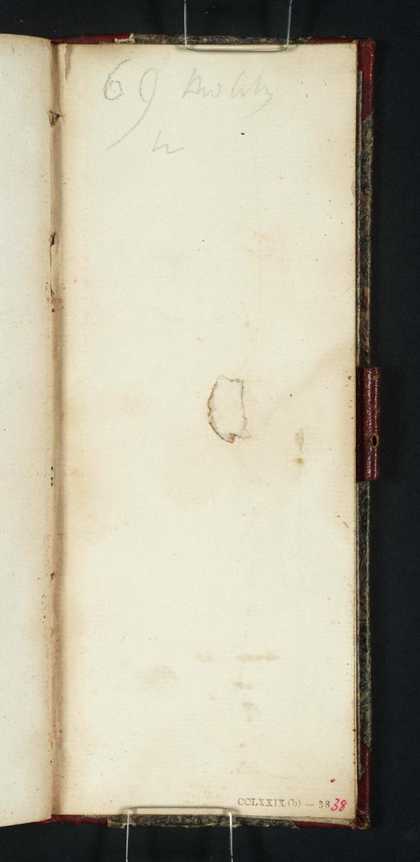
Turner first opened the current sketchbook at Abbotsford, the home of Sir Walter Scott, where the artist stayed with the author and his publisher Robert Cadell from 4–9 August 1831. These inscriptions, written at the top of the page with the sketchbook turned to the right, were probably the first thing that Turner wrote in the book:
Melrose
Edinburgh – Mar – Ashestiel
Loch Katrine Lady Lake Loch Achray
Loch Corisk – Lord of the Isles, Staffa
Berwick --------------------------- Abbotsford
S[k]iddaw – Bridal of Triermain Maybro
The inscriptions were no doubt made during or shortly after his conversation with Scott and Cadell on the morning of 5 August, which was about the subjects to be illustrated by the artist for Scott’s
Poetical Works. Many of the subjects had already been fixed upon by Scott and Cadell during previous meetings and through correspondence; however, with the artist now present, adjustments were made.
1 Cadell wrote about the meeting in his diary entry for that day.
2Turner’s notes list some of the subjects and the volumes which they were to be illustrated for, with the frontispiece in the left column, the book in the centre, and the vignette at the right. Therefore ‘Edinburgh’ and ‘Ashestiel’ are the frontispiece and vignette to the ‘Mar[mion]’ volume (7); ‘Loch Katrine’ and ‘Loch Achray’ illustrate ‘Lady of the Lake’ (8); ‘Loch Cor[u]isk’ and the Isle of ‘Staffa’ illustrate ‘Lord of the Isles’ (10); ‘Berwick’ and ‘Abbotsford’ illustrate the Dramas (12); and ‘Skiddaw’ and ‘Maybro’ (Mayburgh)
3 illustrate the ‘Bridal of Triermain’ (11). Turner also notes ‘Melrose’, but makes no mention of the remaining thirteen subjects.
4At the bottom of this page is the slight continuation of a sketch of the River Tweed with Dryburgh Abbey from folio 1 (
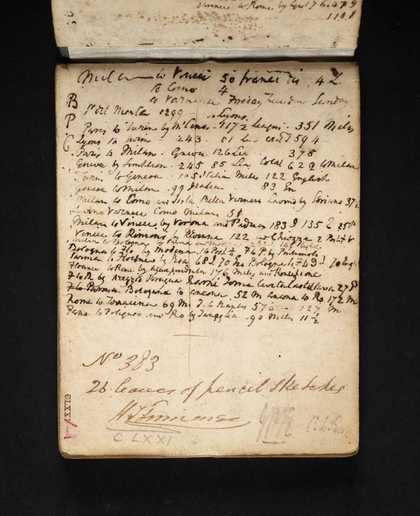
D25929; CCLXVII 1). Other inscriptions on the present page are the endorsements of Turner’s executors: H.S. Trimmer, Charles Lock Eastlake and John Prescott Knight. These inscriptions were written in 1856, and the stamp and Turner Bequest number were added by A.J. Finberg around 1909.
Thomas Ardill
September 2009