Archives Atelier Le Parc
Who is he?
Julio Le Parc is an artist from South America who makes colourful, light-filled sculptures and pictures that are both eye-catching and mind-bending.
Le Parc was born in Argentina in 1928. As a child he was very good at drawing so, when his family moved to the capital city, Buenos Aires, he went to study at the School of Fine Arts. He was really interested in art that wasn’t still and didn’t always look the same. He loved movement, or things that looked like they were moving.
When he grew up he went to Paris and kept on experimenting with making art in different ways. He started to experiment with making art out of transparent pieces of plastic that made colourful patterns when the light shone through them. And he made friends with other artists who were interested in the same things as him! They formed a group called Groupe de Recherche d'Art Visuel (This means Research Group for Visual Art and they were known as GRAV. No not gravy, GRAV! The group shared their ideas and worked on things together. Do you enjoy working on things with your friends?
Le Parc and his groovy GRAV friends made Op Art (Optical Art) and Kinetic Art. Op Art uses optical illusions to make it look like the art is moving and changing. Kinetic Art is made of materials that really do move. These are both really playful types of art!
How did Le Parc make Kinetic Art?
Some of Le Parc’s first kinetic art was made with mobiles a bit like the ones you might have in your bedroom. Think about how they move and twist whenever there is even a small breeze.

Julio Le Parc
Continual Mobile, Continual Light
(1963)
Tate
Continual Mobile, Continual Light 1963 is made of seven suspended nylon strings each with seven squares of mirrored metal hanging from them in front of a white background. Whenever the strings are moved by the air, the mirrors reflect the light and cast shadows which constantly twist and change shape. It looks different all the time and, because it is 3D and keeps moving, the people who see it experience it in completely different ways at the same time.
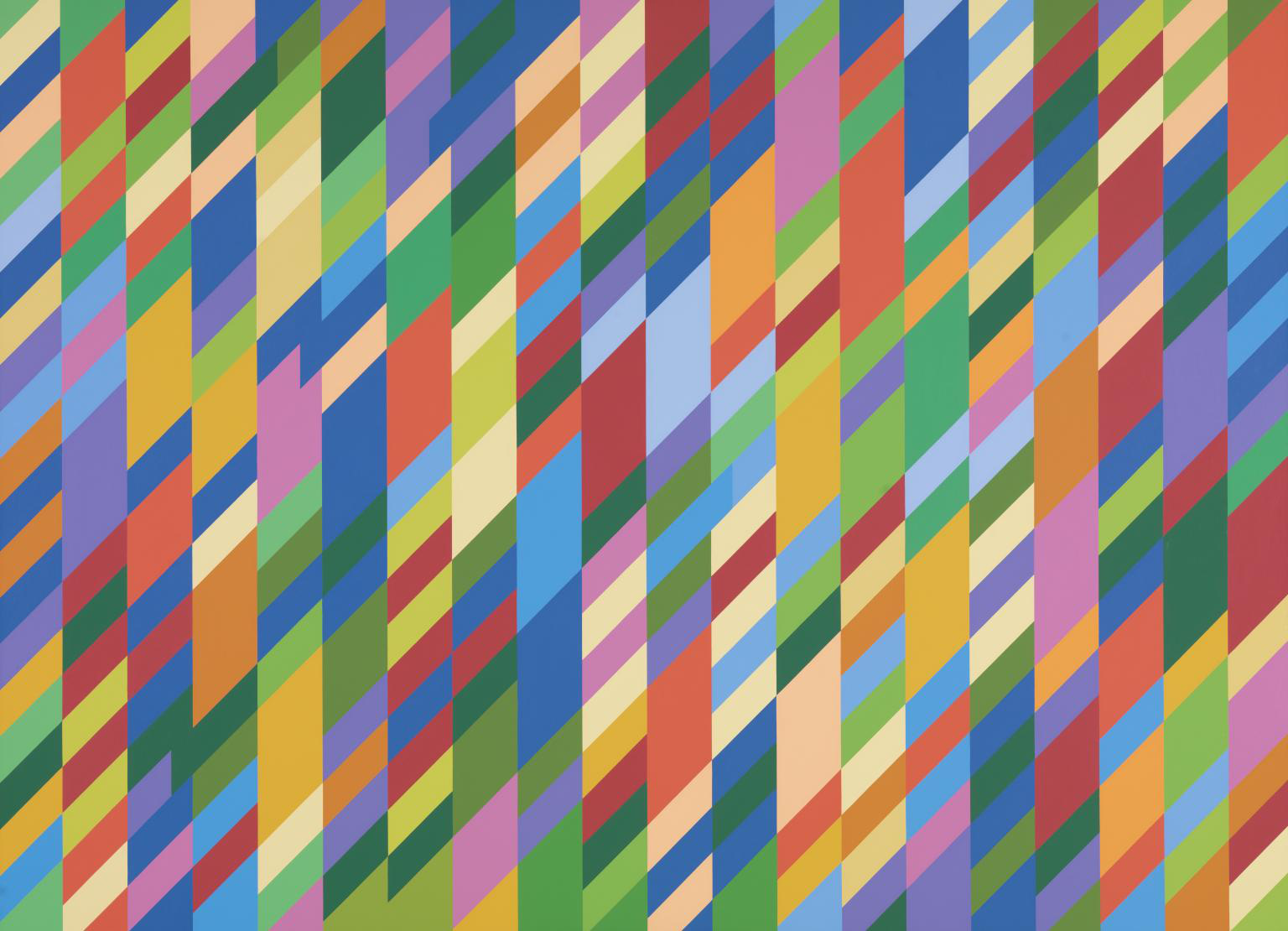
Le Parc also made Op Art. This is art that uses patterns and colours to make a flat piece of art look like it is moving or is three-dimensional. They trick your brain into understanding something different from what your eyes actually see. Isn’t that fun? Le Parc’s early Op Art used black, white and grey but, from 1959 he also started a series using only 14 very specific colours to make a rainbow of different patterns that seem to move in front of your eyes.

Julio Le Parc Waves 125 Series 3 n°1 1972 © ADAGP, Paris and DACS, London 2025
So, who did he make art for?
Le Parc believed that art should be for everybody and that it should be more than just something to look at. He realised that his art was different for everyone who saw it and that this made people an active part of his creations too. This idea inspired Le Parc to keep making art that was full of light and movement that could be seen in different ways by everyone who looked it. Have you ever felt that you are a part of a piece of art just because you are looking at it?

Julio Le Parc Blue Sphere 2013 Lent by the Tate Americas Foundation, courtesy of the Latin American Acquisitions Committee 2023 © ADAGP, Paris and DACS, Lon
Le Parc also loved to use colours and shapes to make eye-catching sculptures. Blue Sphere 2022 is a beautiful structure made from squares of clear blue acrylic hanging from nylon thread. The different lengths of the threads help to give the illusion that the sculpture is an enormous ball that hangs from the ceiling. The small pieces all work together to form a three-dimensional mosaic that shimmers as it reflects the light. Isn’t that clever? But light doesn’t just bounce off the sculpture, it also shines through it and casts colourful patterns on the surrounding walls.
During the 1960s, Le Parc took part in protests against the French government and he was kicked out of France soon after. He was allowed to return after just five months and lived just outside Paris, where he continued creating art for the rest of his life. Even at ninety years old, he was still making artworks that moved and changed before your eyes!