Artist biography
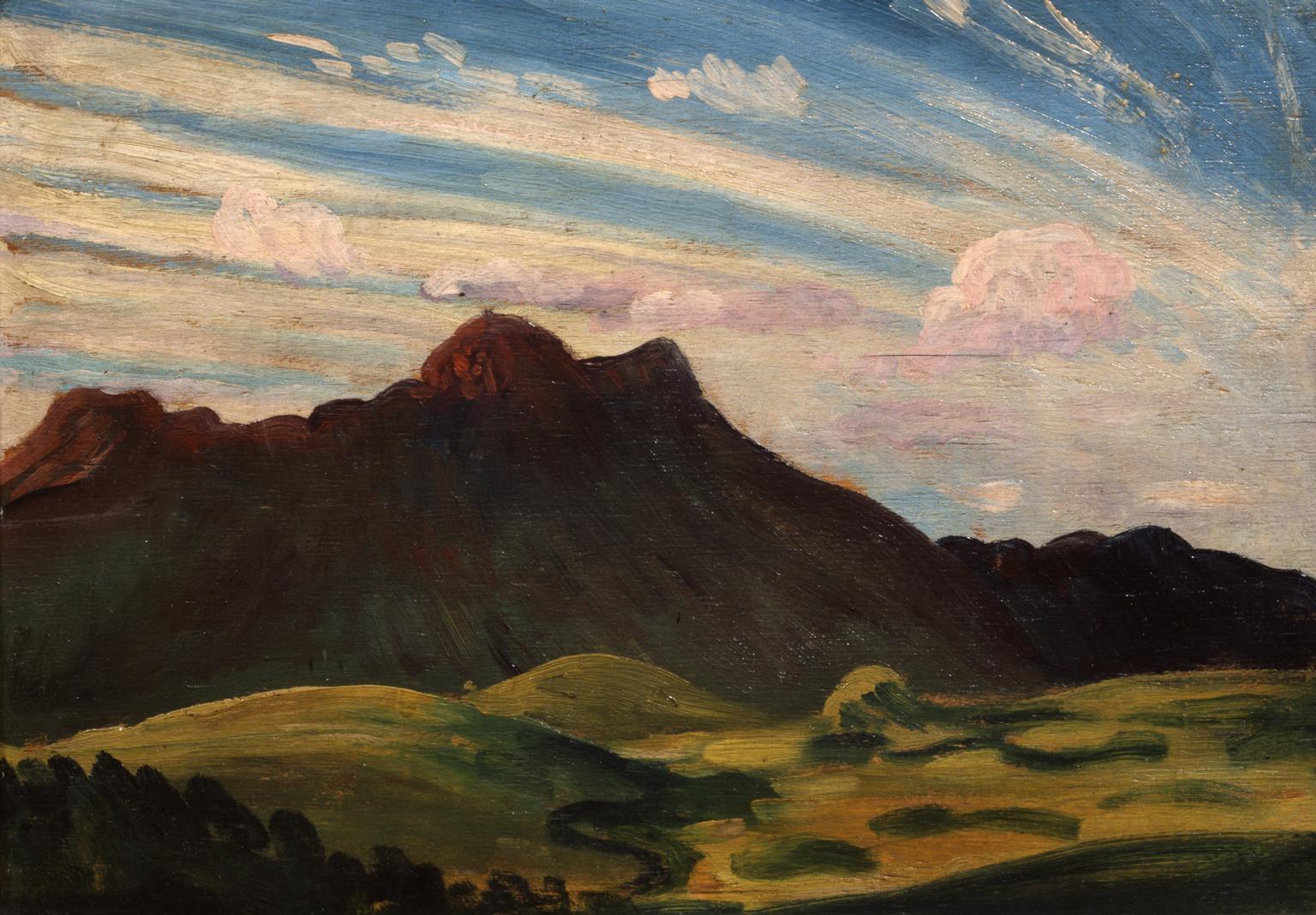
In works in an essentially Post-Impressionist style such as Portrait of a Gypsy (c. 1912; Aberdeen, A.G.) Innes developed a poetic intensity comparable to that found in Samuel Palmer's work. Using a notational method and painting for the most part on a small scale, as in Bala Lake (c. 1911; Manchester, C.A.G.), he developed a style notable for its lucidity and immediacy of touch. He is most often associated with the mountain he painted repeatedly, Arenig (c. 1911–13; Cambridge, Fitzwilliam), on the top of which he buried a casket of love letters from Euphemia Lamb. He painted at speed, using chopped brushstrokes to render foliage, clouds or light reflections on water. His career was cut short by his tuberculosis.
Bibliography
James Dickson Innes (exh. cat., intro. J. Hoole; Southampton, C.A.G.; Cardiff, N. Mus.; London, F.A. Soc.; Manchester, C.A.G.; 1978)
Some Miraculous Promised Land: J. D. Innes, Augustus John and Derwent Lees in North Wales, 1910–12 (exh. cat., Llandudno, Mostyn A.G., 1982)
J. D. Innes, 1887–1914 (exh. cat., essay by C. Hampton; Llanelli, Pub. Lib., Nevill Mem. Gal., 1987)
FRANCES SPALDING
Article provided by Grove Art Online www.groveart.com
Copyright material reproduced courtesy of Oxford University Press, New York