Artist biography
Queen Victoria's admiration of Boehm's statuettes led to an association with the royal family that lasted from 1869 until his death. He received over 40 royal commissions and was created a baronet in 1889.
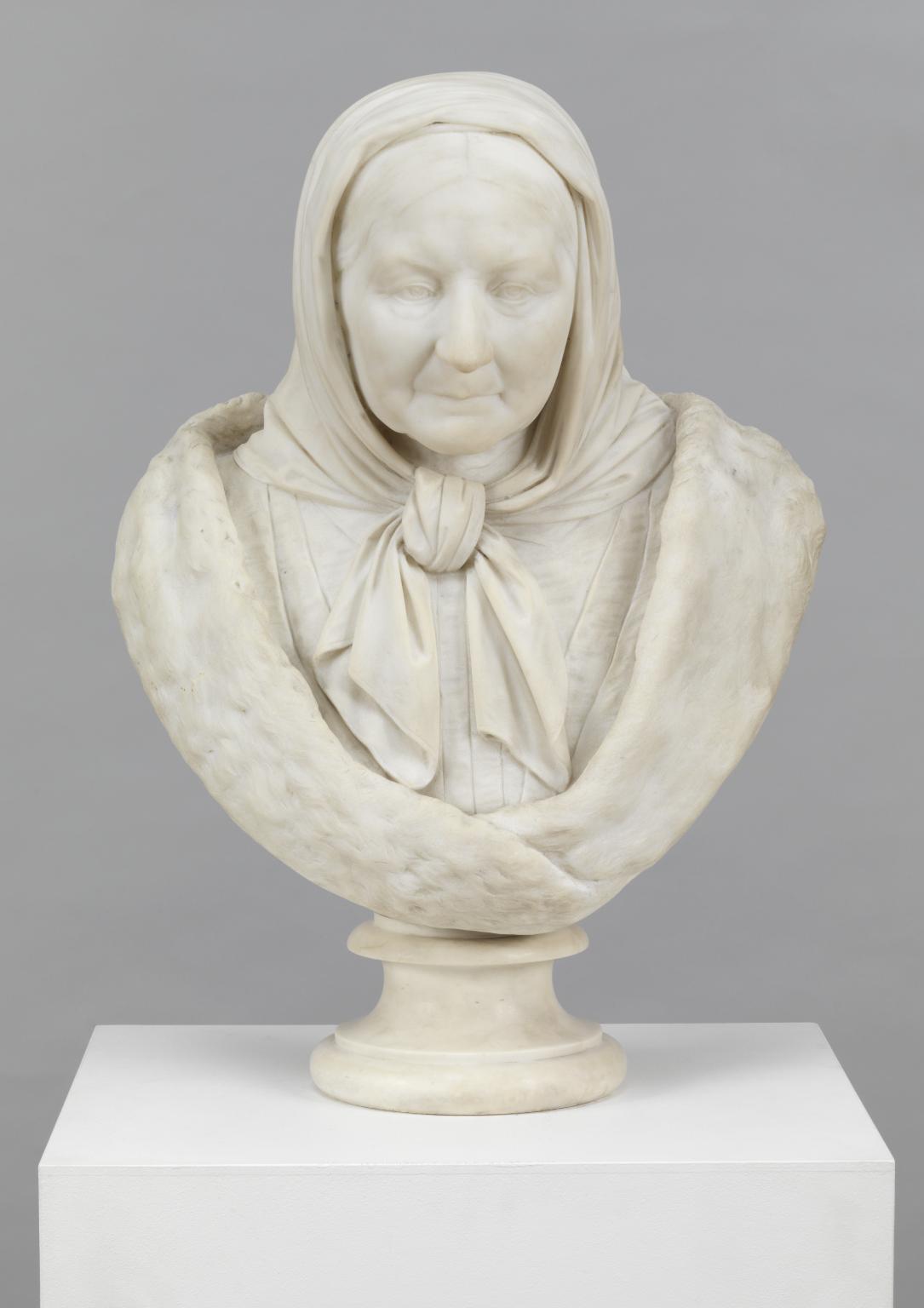
Most of Boehm's works are portrait busts. His masterpiece is a life-size statue of Thomas Carlyle (plaster, 1875, destr. 1940; bronze, 1882, London, Chelsea Embankment Gardens). It combines realism with intelligent use of precedent (Houdon's Voltaire; Paris, Comédie Française) and his personal admiration for the sitter. Two late works were prominent failures. More successful was the Cupid and Mermaid (1889–91; Woburn Abbey, Beds), which shows the influence of the New sculpture. However, Boehm neither received sufficient commissions for ideal sculpture nor had enough artistic courage to execute many such works.
Boehm was immensely prolific: some 360 different works are documented, a huge total even allowing for the part played by Boehm's talented studio assistants. Boehm was a highly consistent sculptor, rarely deviating from his brand of realism. He was modest about his immense popularity and aware of his imaginative shortcomings.
Bibliography
W. Meynell: ‘Our Living Artists: Joseph Edgar Boehm, A.R.A.', Mag. A., iii (1880), pp. 333–8
B. Read: Victorian Sculpture (London and New Haven, 1982), pp. 194–5, 296–8, 335–7
G. P. Dyer and M. Stocker: ‘Edgar Boehm and the Jubilee Coinage', Brit. Numi. J., 54 (1984), pp. 274–88
M. Stocker: ‘Joseph Edgar Boehm and Thomas Carlyle', Carlyle Newslett., 6 (1985), pp. 11–22
——: Royalist and Realist: The Life and Work of Sir Joseph Edgar Boehm (New York and London, 1988)
——: ‘The Church Monuments of Joseph Edgar Boehm', Ch. Mnmts, 2 (1988), pp. 61–75
MARK STOCKER
Article provided by Grove Art Online www.groveart.com
Copyright material reproduced courtesy of Oxford University Press, New York