Catalogue entry
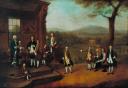
T03103 BREAKING-UP DAY AT DR CLAYTON'S SCHOOL IN SALFORD c.1738–40
Inscribed ‘-Nunc adbibe puro/Pectore Verba Puer-’ on scroll held by Dr Clayton. A now illegible inscription was on the cartouche on the wall to the left of him
Oil on canvas, 47 3/8 × 68 1/8 (120.5 × 174.5)
Purchased from Mr Paul Anstee (Grant-in-Aid) 1980
Prov: Presumably in the Byrom family since painted; by descent to Miss Eleonora Atherton of Byrom, Kersall Cell and Manchester; on her death in 1870 willed to her godson Edward Vigor Fox (who adopted the name Byrom to qualify for the inheritance); thence by descent to his great-grand-daughter Rose Effie Jerardine Eden, who gave the picture to Manchester Grammar School 1946–7, a cousin of hers being the wife of Lord James of Rusholme, High Master of the School 1945–61; sold by the School at Christie's 21 March 1975 (58, repr.), bt Peters; Paul Anstee.
Exh: Preston, and National Portrait Gallery, London, 1983–4 (9, repr.in colour).
Lit: R. Parkinson (ed.), ‘The Private Journals and Literary Remains of John Byrom’ in The Chetham Society, 1855, 1, ii, p.509, no.1; Rev. F.R. Raines, ‘The Rectors of Manchester and the Wardens of the Collegiate Church’ in The Chetham Society, 1885, 11, p.172, and ‘The Fellows of Manchester’ in ditto, 1891, 11, pp.257, 266 and frontispiece; Dictionary of National Biography, 1908, for Clayton and Byrom;
A.A. Mumford, Manchester Grammar School 1515–1919, [1919], pp.160–2, 174, repr.; Frank Davis, ‘A School for Jacobites’ in Country Life, 24 April 1975, repr.p.1038; John H. Bell, ‘Breaking-Up Day at Dr. Clayton's School, Salford’ in Ulula (Manchester Grammar School Magazine), no.549, September 1976, pp.91–2, repr.; Ellen D'Oench, Arthur Devis, Master of the Georgian Conversation Piece, Yale Doctoral Thesis, 1979, University Microfilms International, Ann Arbor, 1983, cat.no.33, pp.298–9; Ellen D'Oench, exh.cat., Devis, Yale, 1980 (33).
The picture is first mentioned as being at Kersall Cell, the seat of the Byrom family, by Parkinson (1855), who describes it as ‘representing the interior of his [Dr Clayton's] school in Salford and a full length portrait of Mr Clayton in a blue velvet gown lined with white silk, surrounded by his scholars’. Raines (1885) adds that one of the pupils is said to be Richard Assheton (1727–1800), later Warden of Manchester. Later still Raines (1891) repeats a tradition that Clayton is shown ‘hearing the boys recite their pieces, previous to the breaking up for the holidays’, that the boy seated on the steps, fiddling with a top, is Edward Byrom (1724–1774), son of the poet and stenographer Dr John Byrom (who is known to have been a pupil of Clayton's School), and that the boy standing before Clayton is reciting Byrom's poem ‘The Three Black Crows’. Apart from that he admits that the identities have been lost.
In spite of this paucity of documented material on the picture to date, there can be little doubt that the basic identification is correct, and that it does indeed represent Dr John Clayton (1709–1773) and ten of his pupils. A waist-length portrait of Clayton reproduced as a frontis-piece to Raines' ‘Fellows of Manchester’ (1891) is quite compatible with this as a likeness. Although unattributed, judging from the photograph it is quite likely to be also by Devis. The identity of the man in a pink gown seated under the tree is unknown, but in view of the provenance of the painting, it could be Dr John Byrom (1692–1763) himself, who inherited Kersall Cell from his brother in 1740, and who shared his friend Clayton's Jacobite and High Church views.
The recitation of poems by both masters and pupils was part of the usual training for public declamation, and Byrom wrote several poems for this purpose for the Manchester Grammar School, of which he was a trustee. One of them, ‘Three Black Crows’ - a slapstick fable on the dangers of propagating unfounded rumours - was ‘Spoken at the Free Grammar School Manchester, On the Commencement of a Vacation’ (Byrom's Poems, Leeds, 1814, 1, p.31). Mrs J.E. Hancox of Salford has kindly pointed out to the compiler that a version of this poem exists (in the 1894 edition of Byrom's works) where references to the Manchester School have been slightly altered to make it suitable for recitation at Salford.
Dr John Clayton founded his school, called St Cyprian's, but better known as Salford Grammar School, in about 1735, for the sons of well-to-do local families with Jacobite leanings, who desired a more religious and exclusive atmosphere than that which prevailed at the more lax Manchester Grammar School. Clayton's School closed on his death in 1773, but his pupils continued to meet as the Cyprianites' dining club for many years. They also paid for a handsome memorial in Manchester Cathedral for their master, whom they appear to have held in great affection.
The painting, which went unrecognised as a Devis until recently, is one of his largest and most ambitious works. It is also an unusual elaboration of the conversation piece format to meet the challenge of a subject that requires both indoor and outdoor treatment. Originally one would have started reading the composition from the left-hand side, with the notice - still showing traces of a now illegible script - affixed to the wall, which probably described the scene and occasion. The scroll in Dr Clayton's hand, with a quotation from Horace's ‘Exhortation to the young Lollius’ - ‘Now drink in these Words with a pure heart, boy ...’ (Epistles, 1, ep.2, 1.67, translation kindly supplied by Fabia Egerton) - sets the tone for this part of the picture, with the Doctor, severely framed by the window, standing in an extremely well-appointed school-room, surrounded by attentive pupils. Clayton is known to have recommended Horace as suitable reading for ‘the afternoon's amusement’ (Raines, 1891, p.258). Appropriately, the sundial high up on the cornice of this entirely fanciful and theatrical structure stands at four o'clock, and the boys spill out of the class-room into the outdoors in progressively more relaxed holiday mood. A boy sitting astride the balustrade (his legs have been extensively repainted by the artist and the original red breeches are now visible through the overpaint) is picking honeysuckle from the wall and putting it into the hat held out by the boy below. On the meadow below the terrace other boys can be seen skipping, fishing, practising archery, flying a kite or just strolling around arm-in-arm, all details which incline one to accept the tradition that the painting is indeed the representation of the commencement of a holiday.
Published in:
The Tate Gallery 1980-82: Illustrated Catalogue of Acquisitions, London 1984