Summary
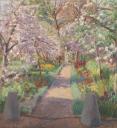
Writing in 1930, the art critic Roger Fry (1886-1934) discerned 'a certain lyrical joyousness of mood' in Duncan Grant's work, which 'leads him to affect and enjoy what is beautiful in nature, and to express that delight in beauty in his work' (Introduction to Living Painters: Duncan Grant, London 1930, p.v). Nature, landscapes and flowers were a lifelong passion of Grant's and a central subject-matter in his work. Yet while such 'Neo-Romantic' artists as John Piper (1903-92), Graham Sutherland (1903-80) and John Craxton (born 1922) were creating Arcadian landscapes inflected by nostalgia, anxiety and fantasy, Grant's primary concern in works like Garden Path in Spring was with colour, harmony and unity of design. In addition, while they sought to define a distinctly national style, Grant's treatment of landscape was consistently influenced by the European aesthetics of Post-Impressionism and was strongly anti-nationalist, even when his subject-matter was most conspicuously British… (read more)