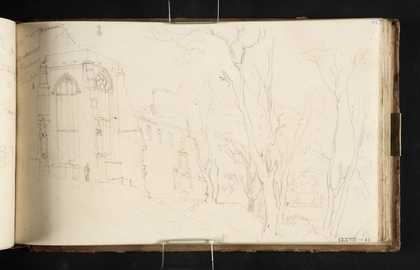
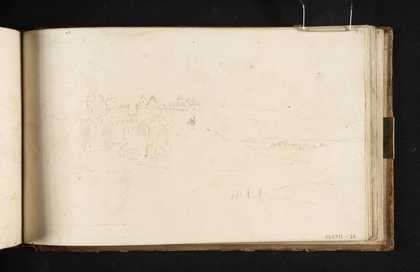
Joseph Mallord William TurnerLinlithgow 1818

Share this artwork

Artwork details

Artist
Title
Linlithgow
From Scotch Antiquities Sketchbook
Turner Bequest CLXVII
Date 1818
MediumGraphite on paper
Dimensionssupport: 112 x 186 mm
Collection
Tate
Acquisition Accepted by the nation as part of the Turner Bequest 1856
Reference
D13677
Turner Bequest CLXVII 52
View this artwork by appointment, at Tate Britain's Prints and Drawings Rooms

Catalogue entry

Joseph Mallord William Turner 1775–1851
Folio 55 Recto:
Linlithgow 1818
D13677
Turner Bequest CLXVII 52
Pencil on white wove paper, 112 x 186 mm
Inscribed in pencil by Turner ‘Road’ bottom left
Inscribed in blue ink ‘52’ top right
Stamped in black ‘CLXVII 52’ bottom left
 
Accepted by the nation as part of the Turner Bequest 1856
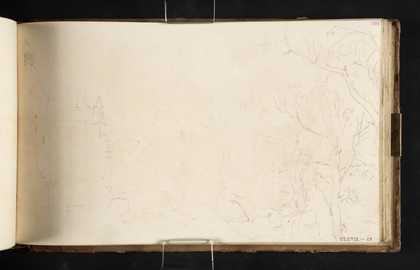
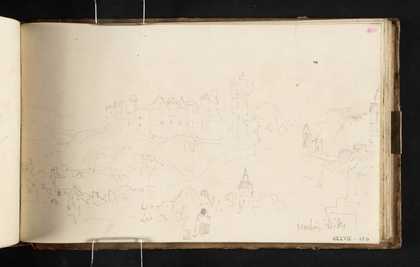
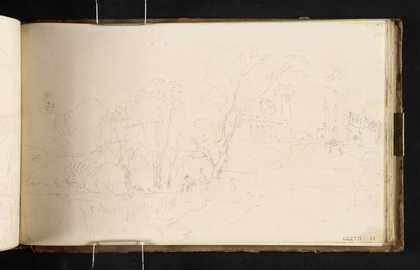
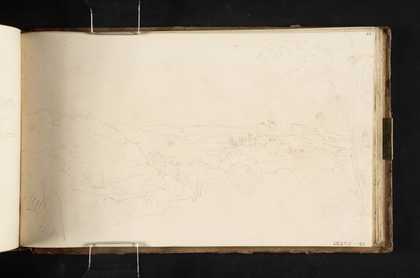
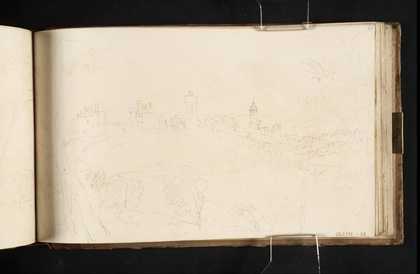
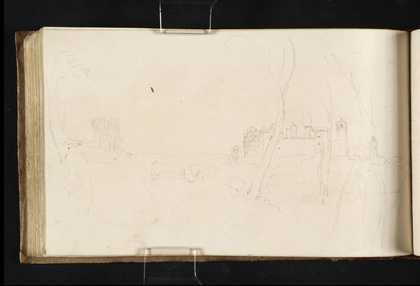
This is the second sketch of Linlithgow Palace from the north-west in the current sketchbook (see folio 54 verso; D13676; CLXVII 51a). The north and west sides of the building are seen from across Linlithgow Loch with the tower of St Michael’s Church to the right, topped by its crown spire (see folio 43 verso; D13656; CLXVII 41a). Part of the town of Linlithgow can be seen at the far right of the page, with the tower of the old Town House (see folio 52; D13663; CLXVII 45b).
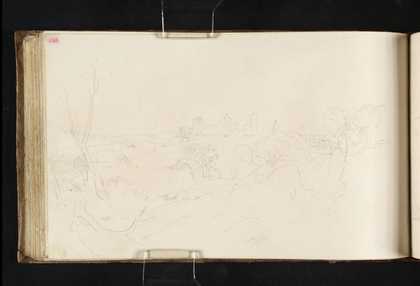
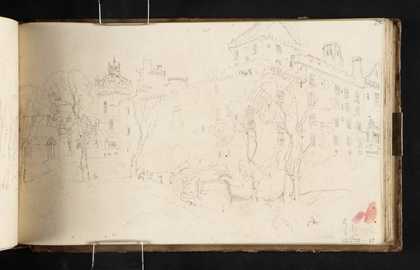
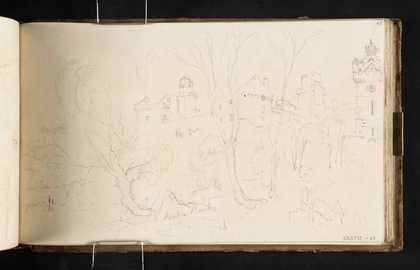
Andrew Wilton has regarded this sketch as one of the five views of Linlithgow from the current sketchbook that formed the basis of Turner’s 1821 watercolour of Linlithgow Palace (Manchester City Galleries):1 folios 55–57 (D13677–D13681; CLXVII 52–54). Although that painting in fact shows the palace from the north-east, there are similarities between the sketch and the watercolour that indicate that he had begun to conceive of the final design as he made this drawing. The palace occupies the same central position in the composition, as does the loch, and other features such as trees in the foreground and to the left of Linlithgow Palace. The distant hills are also preserved in the final design, although in altered positions.
See folio 56 for more information about the sketches used for the watercolour (D13679; CLXVII 53).

Thomas Ardill
March 2008

1
Wilton p.426 under no.1068.

About this artwork