Joseph Mallord William TurnerNotes by James Hakewill on Travelling in Italy; and a Sketch of a Straw Hat by Turner 1819

Share this artwork

Artwork details

Artist
Title
Notes by James Hakewill on Travelling in Italy; and a Sketch of a Straw Hat by Turner
From Route to Rome Sketchbook
Turner Bequest CLXXI
Date 1819
MediumPen and ink on paper
Dimensionssupport: 88 x 114 mm
Collection
Tate
Acquisition Accepted by the nation as part of the Turner Bequest 1856
Reference
D13875
Turner Bequest CLXXI 9
View this artwork by appointment, at Tate Britain's Prints and Drawings Rooms

Catalogue entry

Joseph Mallord William Turner 1775–1851
Folio 9 Recto:
Notes by James Hakewill on Travelling in Italy; and a Sketch of a Straw Hat by Turner 1819
D13875
Turner Bequest CLXXI 9
Pencil on white wove paper, 88 x 114 mm
Inscribed by the artist in pencil ‘Straw Hat | [?head] and 9' [...] | S[...]’ bottom right, parallel with right-hand edge
Inscribed by James Hakewill in black ink (see main catalogue entry)
Inscribed by John Ruskin in red ink ‘9’ bottom right
Stamped in black ‘CLXXI 9’ bottom right
 
Accepted by the nation as part of the Turner Bequest 1856
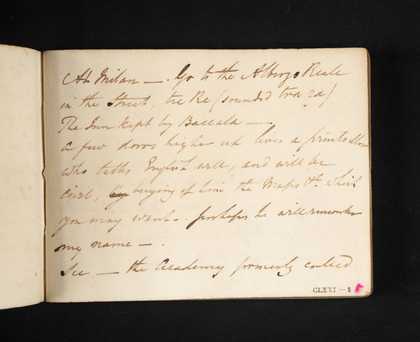
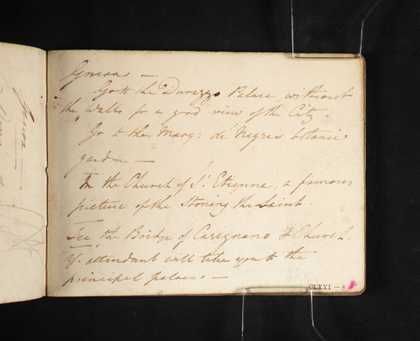
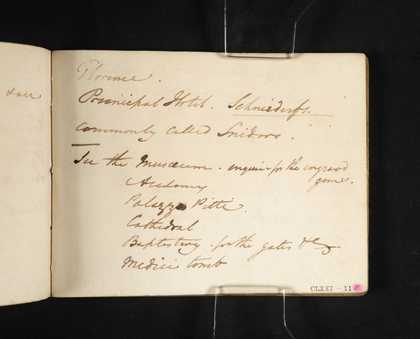
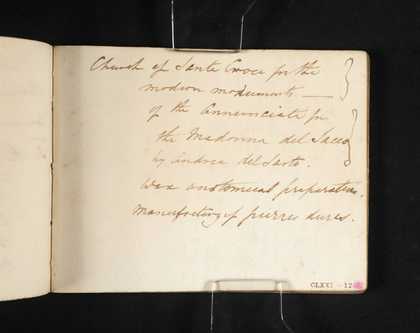
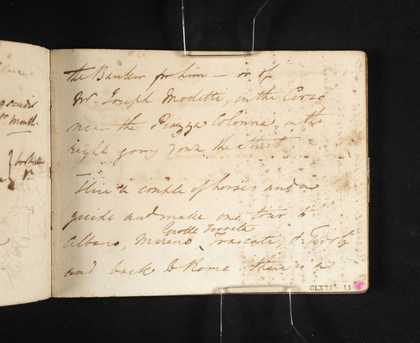
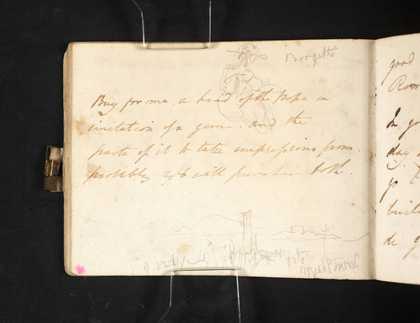
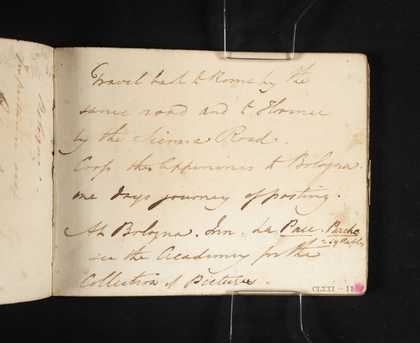
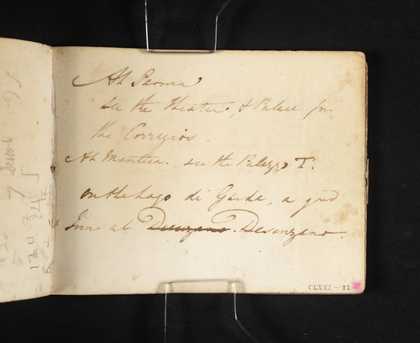
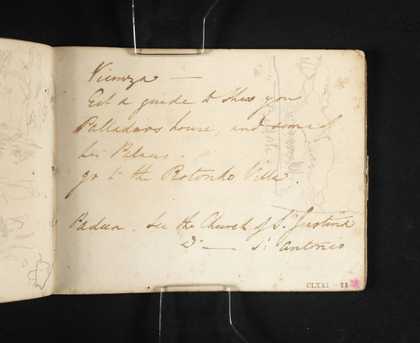
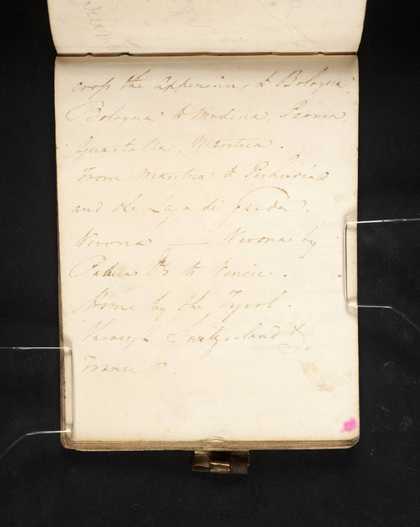
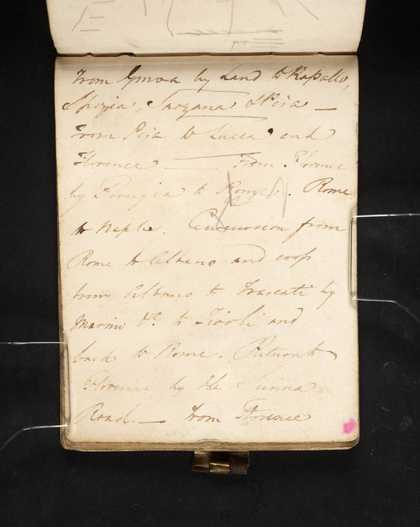
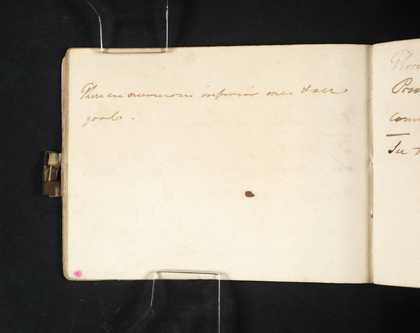
This page contains advice to Turner on travelling in Italy in preparation for the artist’s first tour of the country in 1819. The author of the inscription is James Hakewill (1778–1843), with whom Turner collaborated on the engraved print project, Picturesque Tour of Italy, published 1820 (see the introduction to the sketchbook). The text was first transcribed by Finberg,1 and is repeated here:
On no account trust yourself in a | felucca –. But hire horses & guides | to Spezia. The remainder may be | posted. – Before you arrive at | Massa visit the quarries of the | Carrara marble. | – Inn. The Dongella. dear but good. | Pisa – The great mass of buildings | is all that is worth visiting.
Hakewill had himself visited Italy in 1816–17, and views of Spezia and Pisa can be found amidst his drawings from this time (British School at Rome Library).2 He naturally recommended that Turner follow the same itinerary, travelling to Rome via Genoa and Florence. However, Turner ultimately opted for a different route, entering Italy via the Pass of Mont Cenis and proceeded first to Venice via Milan and the Italian Lakes, before continuing onto Rome via Ancona. Hakewill’s advice would only have become relevant to him during his second tour of Italy in 1828 when he returned to Rome, this time choosing the road (and sometimes the sea) along the west coast, see the Coast of Genoa sketchbook (Tate; Turner Bequest CCXXXII). He reported in a letter to the painter George Jones (1786–1869) that ‘Genoa, and all the sea-coast from Nice to Spezzia is remarkably rugged and fine; so is Massa’.3 He also followed Hakewill’s advice and visited the marble quarries of Carrara, commenting wryly to Jones that all he got out of them was ‘a sour bottle of wine and a sketch’, compared to the ‘thousands’ of profit made from their yield by the sculptor, Francis Chantrey (1781–1841).4 Hakewill’s notes to Turner continue on folio 10 (D13877) and the content is also repeated to some extent on folio 37 verso (D13931).
Turner has also used the bottom right-hand corner of this page to make a small sketch of a straw hat which he has accompanied with written notes.

Nicola Moorby
March 2010

1
Finberg 1909, p.496.
2
See Tony Cubberley and Luke Herrmann, Twilight of the Grand Tour: A Catalogue of the drawings by James Hakewill in the British School at Rome Library, Rome 1992, nos.2.28–2.29 and 2.32–2.34, pp.144–5 and 148–50, reproduced.
3
Letter from Turner to George Jones, 13 October 1828. Quoted in John Gage (ed.), Collected Correspondence of J.M.W. Turner with an Early Diary and a Memoir by George Jones, Oxford 1980, no.141, p.119.
4
Ibid.

About this artwork