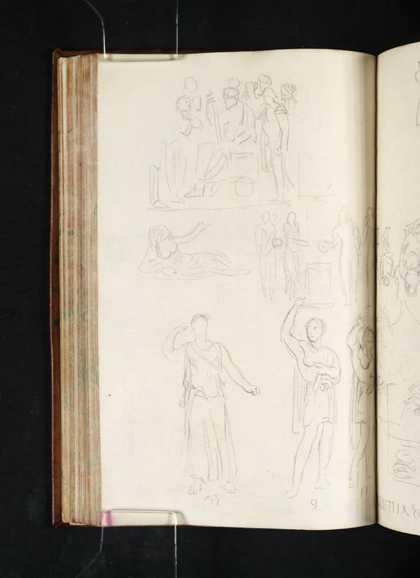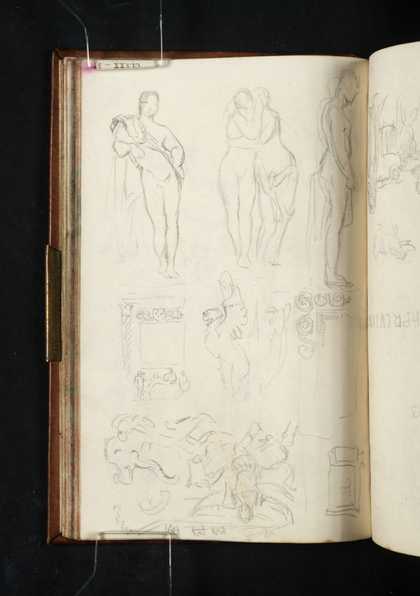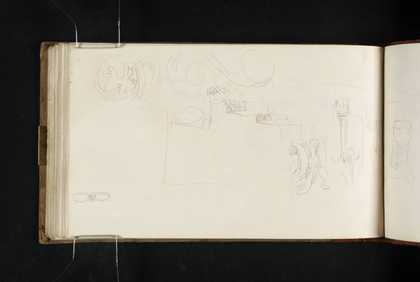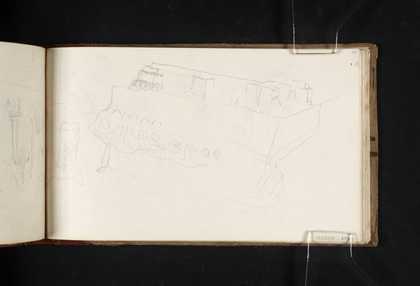
Joseph Mallord William TurnerStudies of Sculptural Fragments from the Palazzo Corsini, Rome 1819

Share this artwork

Artwork details

Artist
Title
Studies of Sculptural Fragments from the Palazzo Corsini, Rome
From Vatican Fragments Sketchbook
Turner Bequest CLXXX
Date 1819
MediumGraphite on paper
Dimensionssupport: 161 x 101 mm
Collection
Tate
Acquisition Accepted by the nation as part of the Turner Bequest 1856
Reference
D15105
Turner Bequest CLXXX 1
View this artwork by appointment, at Tate Britain's Prints and Drawings Rooms

Catalogue entry

Joseph Mallord William Turner 1775–1851
Folio 1 Recto:
Studies of Sculptural Fragments from the Palazzo Corsini, Rome 1819
D15105
Turner Bequest CLXXX 1
Pencil on white wove paper, 161 x 101 mm
Inscribed by the artist in pencil ‘[?Pazzia] [...] artists in the [...] St Church Maggiore O | the [?Innocence]’ across top, and ‘[?Ire di F...] to right of sketch top right, and ‘End of the S’ to right of third sketch from top and ‘Val[...] | C[...] | Pl[...]’ bottom left, inverted
Inscribed by John Ruskin in red ink ‘1’ bottom right
Stamped in black ‘CLXXX 1’ bottom right
 
Accepted by the nation as part of the Turner Bequest 1856
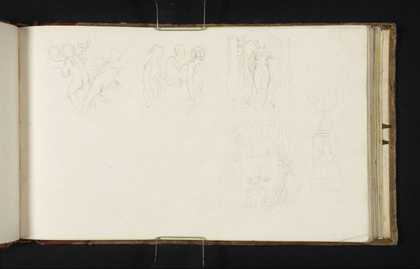
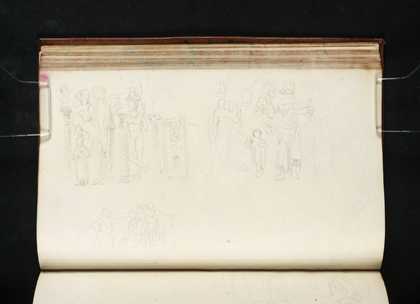
Cecilia Powell has identified the sketches on this page as studies of sculptural fragments from the Palazzo Corsini in Rome. This fifteenth-century palace, rebuilt in the eighteenth century, stands in the Trastevere district near the Villa Farnesina, at the foot of the Janiculum Hill. Today it houses the National Gallery of Ancient Art, a collection largely comprised of works amassed by the Corsini family. The drawings are numbered from top left to bottom right:
a.
The sketch in the top left hand corner represents the tombstone of L. Camurtius Punicus from the stairs of the Palazzo.1
b.
The detail in the top right-hand corner is unidentified.
c.
The sketch in the centre of the page depicts the front panel of a sarcophagus decorated with sculptural reliefs of tritons, nereids and sea-monsters.2 Turner has also recorded the end panel of the same sarcophagus, decorated with a marine figure blowing a conch.3
d.
The sketch at the bottom represents the Sedia Corsini, an antique chair or throne decorated with marble reliefs.4 This was the most important antiquity in the palazzo.5
Notes about paintings in the Palazzo Corsini can be found on folio 1 verso (D15106) and in the Route to Rome sketchbook (Tate D13881; Turner Bequest CLXXI 13).

Nicola Moorby
December 2009

1
Powell 1984, p.411.
2
Powell 1984, p.411; Salomon Reinach Répertoire de Reliefs Grecs et Romains, vol.3, Paris 1912, p.223 no.1, reproduced.
3
Powell 1984, p.411; Reinach 1912, p.223 no.3, reproduced.
4
Powell 1984, p.411; Reinach 1912, p.224 no.5, reproduced.
5
Powell 1984, p.477 note 11.

About this artwork