
Joseph Mallord William Turner Folkestone c.1822-3
Joseph Mallord William Turner,
Folkestone
c.1822-3
Folkestone c.1822–3
D17760
Turner Bequest CCIII C
Pencil and watercolour on white wove paper, 206 x 252 mm
Blind-stamped with Turner Bequest monogram bottom right
Accepted by the nation as part of the Turner Bequest 1856
Exhibition history
1869
First Loan Collection selected from the Turner Bequest, various venues and dates, 1869–1905 (no catalogue but numbered 31, as ‘Coast Scene’).
1922
Original Drawings in Watercolour, Etc., by J.M.W. Turner, R.A., T. Girtin and E. Dayes. Lent by the Trustees of the National Gallery, Laing Art Gallery and Museum, Newcastle 1922 (53, as ‘Coast Scene, Folkestone’).
1959
[Display of watercolours from the Turner Bequest], Tate Gallery, London, June/July 1959–January 1965 (no catalogue).
References
1909
A.J. Finberg, A Complete Inventory of the Drawings of the Turner Bequest, London 1909, vol.I, p.616, as ‘Folkestone.’.
1991
Ian Warrell, ‘R.N. Wornum and the First Three Loan Collections: A History of the Early Display of the Turner Bequest Outside London’, Turner Studies, vol.11, no.1, Summer 1991, p.40 no.31, as ‘Coast Scene’.
1997
Eric Shanes, Turner’s Watercolour Explorations 1810–1842, exhibition catalogue, Tate Gallery, London 1997, pp.100, Appendix I, under ‘Ports of England Series’, 102, Appendix I, under ‘Southern Coast of England Series’.
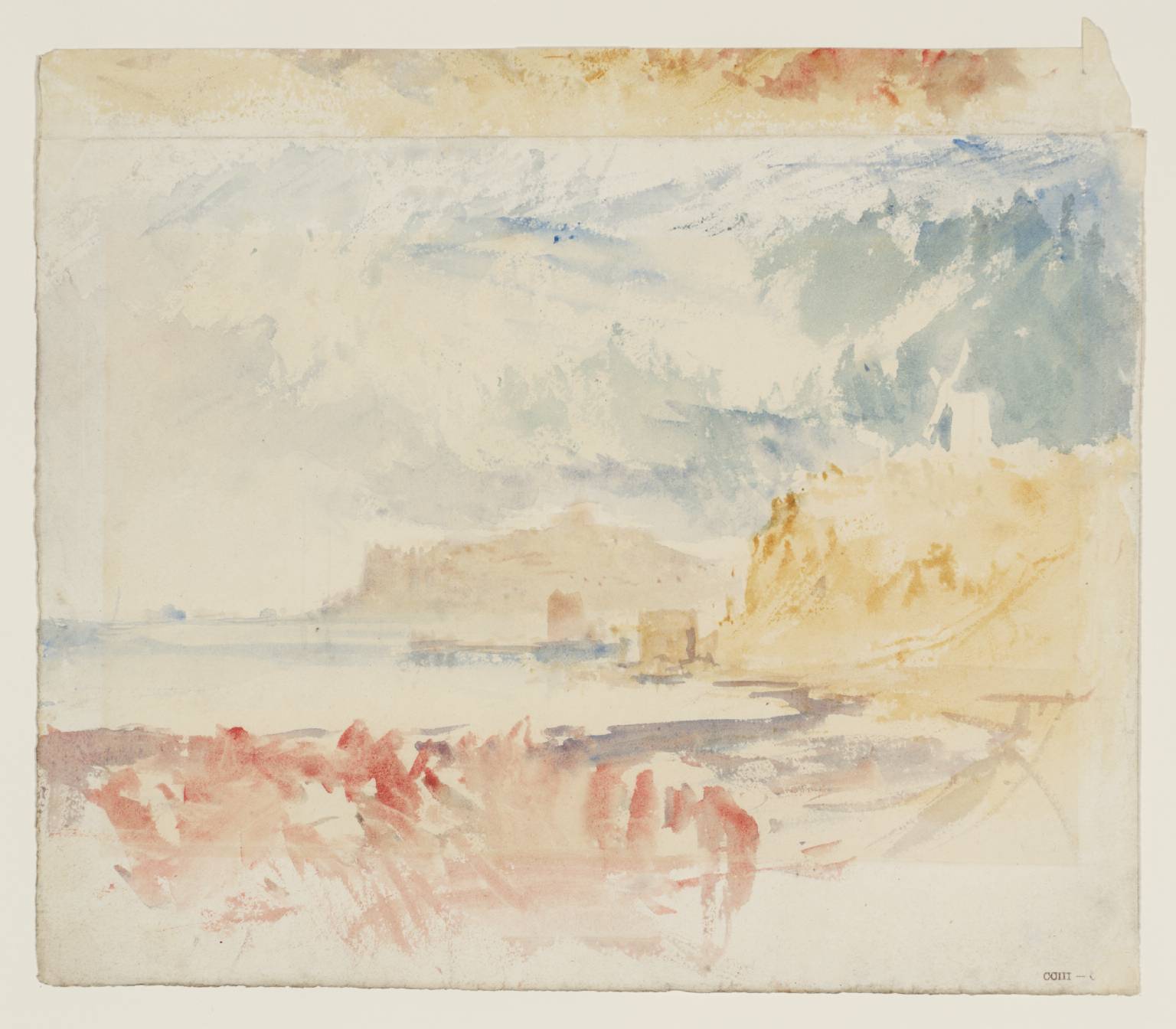
This colour sketch could relate to the finished watercolour Fishing Boats on Folkestone Beach of around 1828 (National Gallery of Ireland, Dublin). Turner scholar Eric Shanes proposes that the Dublin drawing was most probably produced at an earlier date for the Ports of England series, though no view of this location was finalised for the project.1 The Dublin watercolour was executed using a stippling technique, a notable feature of all the Ports works, and is almost identical in size to the design for Sidmouth of that series. The present preparatory study is closest in composition to the Dublin watercolour, though it encompasses more of the coast than the final design.
The study is roughly wrought in vivid watercolour wash. Turner employs the three primary colours (red for the foreground incident, blue for the sky, and yellow for the headland) interspersed with areas of unpainted paper. The sea, for example, is largely left bare, highlighted sparingly with blue. The windmill atop the closest headland is also pictured in negative, silhouetted in reverse against the blue sky.
Wash is applied in swift gestural strokes and daubs of the brush. Specific forms such as boats or buildings are loosely implied in dashes of wash. This is particularly apparent in the rather amorphous assemblage of short dashes and daubs of red wash in the foreground, perhaps some form of shorthand for boats or figures.
Technical notes:
A tab of about twenty millimetres in length and of the same white wove paper as the main drawing is at the top of the sheet. It has been painted with wash in a similar colour range and handling to the main drawing. The tab appears to be a fold meaning that the present drawing was executed on a larger sheet of paper. The drawing has also discoloured, probably from overexposure.
Verso:
The sheet is stamped in black with the Turner Bequest monogram at top right and with ‘CCIII–C’ at bottom right and inscribed in pencil ‘33 ?L’ at centre left.
Alice Rylance-Watson
March 2013
How to cite
Alice Rylance-Watson, ‘Folkestone c.1822–3’, catalogue entry, March 2013, in David Blayney Brown (ed.), J.M.W. Turner: Sketchbooks, Drawings and Watercolours, Tate Research Publication, September 2014, https://www
