
J.M.W. Turner: Sketchbooks, Drawings and Watercolours

ISBN 978-1-84976-386-8

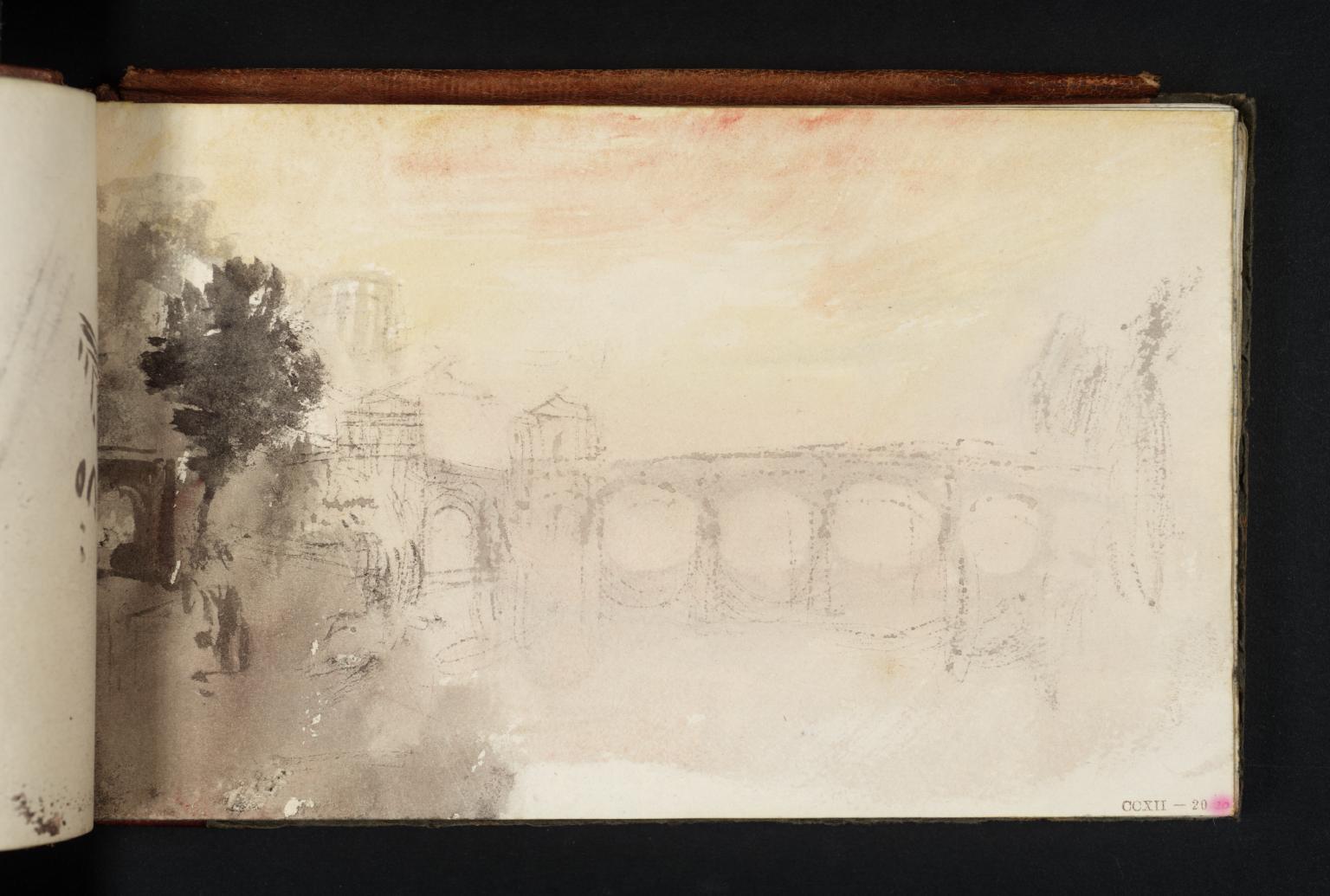
Joseph Mallord William Turner A Classical Bridge and Buildings at Dawn or Sunset c.1825
Joseph Mallord William Turner 1775–1851
Folio 20 Recto:
A Classical Bridge and Buildings at Dawn or Sunset c.1825
D18623
Turner Bequest CCXII 20
Watercolour on white wove paper, 114 x 188 mm
Inscribed by John Ruskin in red ink ‘20’ bottom right
Stamped in black ‘CCXII – 20’ bottom right
 
Accepted by the nation as part of the Turner Bequest 1856
This is one of a sequence of twenty-five recto pages of watercolour landscape, sea and sky compositions between folio 9 recto (D18609) and folio 34 recto (D18638), many of which evoke quiet Thames Valley scenes with water in the foreground; for a checklist and general comments, see the sketchbook’s Introduction. The present page is different, presenting a capriccio with a grand bridge and classical buildings rising beyond in the manner of Turner’s harbour scenes influenced by Claude Lorrain (c.1604–1682), such as the painting The Decline of the Carthaginian Empire, exhibited at the Royal Academy in 1817 (Tate N00499);1 the composition continues a little way across folio 19 verso opposite (D40970).
In the 1800s, Turner’s experience of the Thames around Richmond, with grand neo-classical houses in picturesque wooded settings, had often evoked spontaneous studies for the historical or mythological compositions of the sort he painted on a large scale.2 As Ian Warrell has suggested,3 Turner may have had Richmond Bridge in mind here; compare his painting View of Richmond Hill and Bridge, exhibited in 1808 (Tate N00557).4 See also the slight pencil composition sketch on folio 47 verso (D40971).
The rosy sky might equally represent Finberg’s ‘sunset’5 or a dawn. The outlines defining the bridge and other features were drawn with the tip of the brush, and the rapidly applied pigment has been skimmed across the paper surface and gathered in globules as it dried; Eric Shanes has noted of the colour studies in this sequence: ‘In many of them Turner took advantage of the slight resistance of the paper to certain pigments’ to create ‘speckling effects’,6 here giving an impression of variety and detail; compare the effect in the foreground of folio 18 recto (D18621).
1
Martin Butlin and Evelyn Joll, The Paintings of J.M.W. Turner, revised ed., New Haven and London 1984, pp.100–1 no.135, pl.137 (colour).
2
See David Hill, Turner on the Thames: River Journeys in the Year 1805, New Haven and London 1993; see also Warrell 2002, p.194, and his captions for the Tate Britain exhibition in 2000, preserved in the Tate Britain Prints and Drawings Room.
3
See Warrell 2014, p.136.
4
Butlin and Joll 1984, p.56 no.73, pl.83.
5
Finberg 1909, II, p.647.
6
Eric Shanes, Turner’s Watercolour Explorations 1810–1842, exhibition catalogue, Tate Gallery, London 1997, p.65 under no.48.
Verso:
Blank

Matthew Imms
December 2014

How to cite

Matthew Imms, ‘A Classical Bridge and Buildings at Dawn or Sunset c.1825 by Joseph Mallord William Turner’, catalogue entry, December 2014, in David Blayney Brown (ed.), J.M.W. Turner: Sketchbooks, Drawings and Watercolours, Tate Research Publication, April 2015, https://www.tate.org.uk/art/research-publications/jmw-turner/joseph-mallord-william-turner-a-classical-bridge-and-buildings-at-dawn-or-sunset-r1172741, accessed 05 April 2026.