J.M.W. Turner: Sketchbooks, Drawings and Watercolours

ISBN 978-1-84976-386-8

Joseph Mallord William Turner Boats on the Leuvehaven, Rotterdam, with the Zeevismarkt and Lutheran Church Flanking the Houtbrug over the Blaak; the Soetenbrug over the Steigersgracht; the Leuvehaven; the Church's Dome and Clock; the Statue of Erasmus 1825

Joseph Mallord William Turner 1775–1851
Folio 72 Recto:
Boats on the Leuvehaven, Rotterdam, with the Zeevismarkt and Lutheran Church Flanking the Houtbrug over the Blaak; the Soetenbrug over the Steigersgracht; the Leuvehaven; the Church’s Dome and Clock; the Statue of Erasmus 1825
D18981
Turner Bequest CCXIV 72
Pencil on white wove paper, 95 x 155 mm
Inscribed by John Ruskin in red ink ‘72’ top right, ascending vertically
Stamped in black ‘CCXIV – 72’ top right, ascending vertically
 
Accepted by the nation as part of the Turner Bequest 1856
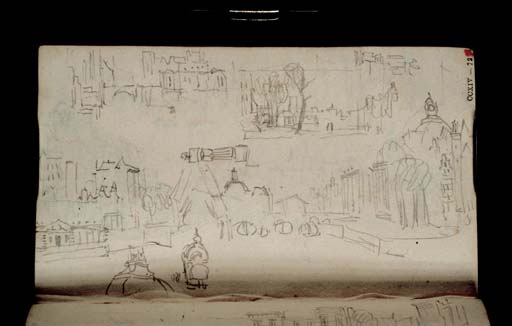
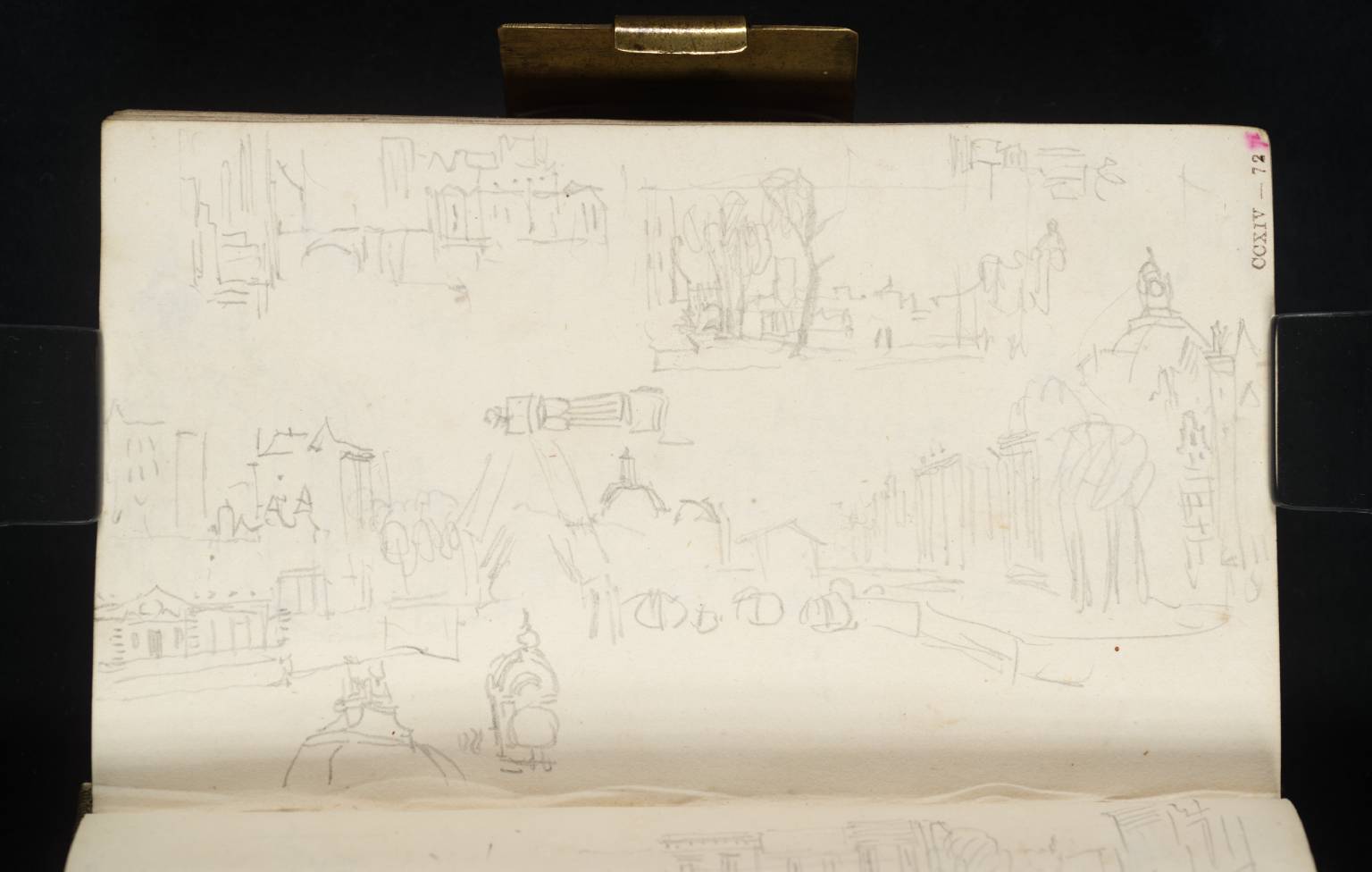
Used largely horizontally, this busy page comprises three related Rotterdam views1 together with other studies, as identified by the Dutch Turner scholar Fred Bachrach.2 The subject spanning the page shows the entrance to the Blaak basin from the north end of the Leuvehaven, with the pedimented Zeevismarkt (‘sea fish market’), the elevating ophaalbrug-type Houtbrug and the domed Lutheran Church in the foreground. In the distance to the east-north-east is the similar shallow dome of the Beurs (stock exchange) beside the Gapersbrug (Beursbrug). As Bachrach noted, the prospect is complementary to the full-page view back towards the present viewpoint from near the Beurs on folio 71 verso opposite (D18980).
At the top left is a continuation to the left, with the Soetenbrug over the narrow Steigersgracht canal, with the square tower of St Lawrence’s Church (the Sint-Laurenskerk), inconspicuous on this scale, to the north. The small view framed by pencil lines at the top right is a thumbnail sketch from further back on the tree-lined west side of the Leuvehaven, looking north towards the turn. At the bottom right there is a two-stage study of the dome and clock-tower of the Lutheran Church, relating to the main view. There are various views from around this point on folios 37 recto and verso and 38 recto (D18912–D18914), and on the verso and folios 73 recto and verso (D18982–D18984).
Somewhat randomly, the pillar-like, fluted horizontal form near the centre is a schematic study of the statue of Erasmus, then on the Grote Markt, mid-way between the Beurs and St Lawrence’s and thus a few blocks away from the other subjects here. The bronze figure of the humanist scholar Desiderius Erasmus (1466–1536), Rotterdam’s most famous citizen, is by Hendrick de Keyser (1565–1621), and was installed in 1622.3 It shows him in flowing robes, turning the pages of a large book, and is seen as a tiny silhouette in its original setting in the 1833 Rotterdam and Rhine sketchbook (Tate D32621; Turner Bequest CCCXXII 42a), and again in the 1835 Rotterdam book (D32444, D32446; CCCXXI 1, 2). Today, Erasmus stands among trees and modern buildings on the Grotekerkplein below the west end of St Lawrence’s.
Although the layout of the city’s central streets and harbours has been broadly preserved, the north end of the Leuvehaven has since been filled in, along with the nearest section of the Steigersgracht and the whole of the Blaak; the area is characterised by tower blocks near the Maritime Museum. Very few buildings (notably St Lawrence’s) survived destruction in May 1940, and identification is based largely on earlier visual documentation; see under folio 35 recto (D18908) for other views in and around the city in this book and elsewhere.

Matthew Imms and Quirine van der Meer Mohr
September 2020

1
Among a sequence identified in Finberg 1909, II, p.653, as simply ‘Views on river, Rotterdam’.
2
See Bachrach 1974, p.65, and map, p.[46], showing viewpoint and sightline; see also Wilton 2006, p.76.
3
See ‘Erasmus’, Sculpture International Rotterdam, accessed 6 March 2020, https://www.sculptureinternationalrotterdam.nl/en/collectie/erasmus-en.

How to cite

Matthew Imms and Quirine van der Meer Mohr, ‘Boats on the Leuvehaven, Rotterdam, with the Zeevismarkt and Lutheran Church Flanking the Houtbrug over the Blaak; the Soetenbrug over the Steigersgracht; the Leuvehaven; the Church’s Dome and Clock; the Statue of Erasmus 1825 by Joseph Mallord William Turner’, catalogue entry, September 2020, in David Blayney Brown (ed.), J.M.W. Turner: Sketchbooks, Drawings and Watercolours, Tate Research Publication, March 2023, https://www.tate.org.uk/art/research-publications/jmw-turner/joseph-mallord-william-turner-boats-on-the-leuvehaven-rotterdam-with-the-zeevismarkt-and-r1202333, accessed 05 April 2026.