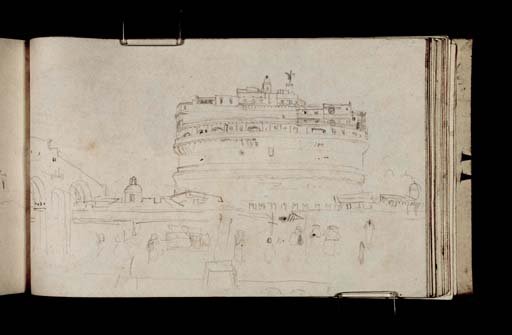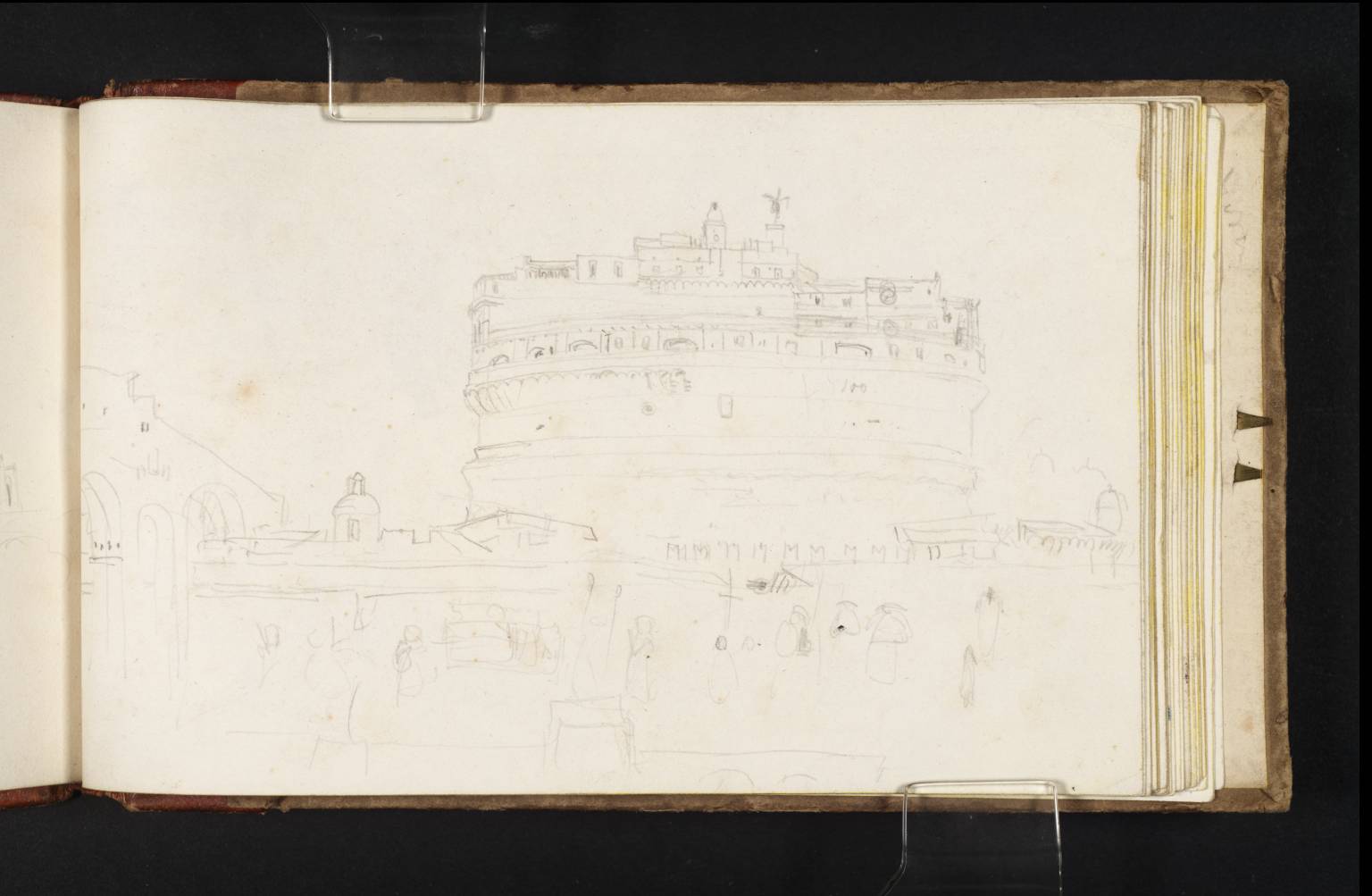
Joseph Mallord William Turner Castel Sant'Angelo, Rome, from the West 1819
Image 1 of 2
Joseph Mallord William Turner,
Castel Sant'Angelo, Rome, from the West
1819
Joseph Mallord William Turner 1775–1851
Folio 26 Verso:
Castel Sant’Angelo, Rome, from the West 1819
D14973
Turner Bequest CLXXIX 26 a
Pencil on white wove paper, 112 x 186 mm
Inscribed by the artist in pencil ‘100’ within band of machicolations on castle
Accepted by the nation as part of the Turner Bequest 1856
References
1909
A.J. Finberg, A Complete Inventory of the Drawings of the Turner Bequest, London 1909, vol.I, p.527 as ‘Castle of St. Angelo’.
1974
Gerald Wilkinson, The Sketches of Turner, R.A. 1802–20: Genius of the Romantic, London 1974, reproduced p.188, centre right.
2011
Nicola Moorby, ‘Turner’s Sketches for “Rome from the Vatican”: Some Recent Discoveries’, Turner Society News, no.115, Spring 2011, p.5, reproduced fig.2.
The vast size, striking shape and prominent location of the Castel Sant’Angelo, located on the banks of the Tiber near St Peter’s and the Vatican, make the castle one of the most prominent landmarks in Rome. Originally the mausoleum of the Emperor Hadrian, the cylindrical building dates from AD 139 but was later converted from a tomb to a fortress, acting as part of the military defenses of the city until the end of the nineteenth century. The name derives from a legendary vision of the Archangel Michael who reportedly appeared above the building sheathing his sword as a symbol of the end of a great plague in 590 AD. Since 1753, a massive bronze statue of the angel by the Flemish sculptor Peter Anton Verschaeffelt (1710–93) has crowned the top, replacing an earlier one in marble by Raffaelo da Montelupo (circa 1504/5–circa 1566/7). The castle is linked across the Tiber to the centre of the city by the Ponte Sant’Angelo, a bridge built by Hadrian and formerly known as the Pons Aelius.
This sketch depicts the Castel Sant’Angelo from the west, from a point near present-day Piazza Pia and the Passetto di Borgo (the elevated corridor which links the castle with the Vatican). The page is in close proximity to the series of studies which evolved into his vast finished oil painting, Rome from the Vatican. Raffaelle Accompanied by La Fornarina, Preparing his Pictures for the Decoration of the Loggia exhibited 1820 (Tate, N00503),1 (see folio 26, D14792), and is therefore perhaps also related to the development of the picture. The angle of Turner’s viewpoint of the Castel Sant’Angelo, for example, is almost identical to that seen in the view from the Vatican loggia, albeit at a much closer distance. Furthermore, Turner appears to have referenced the line of figures, one of whom is carrying a cross, visible across the foreground of this sketch. In the painting, he has depicted a similar religious procession entering St Peter’s Square, near the centre of the composition from the direction of Castel Sant’Angelo.
Further views of the Castel Sant’Angelo can be found on folios 23–3 (D14967–D14968), as well as in the St Peter’s sketchbook (Tate D16215 and D16216; Turner Bequest CLXXXVIII 33a and 34); the Rome: C. Studies sketchbook (Tate D16336 and D16358; Turner Bequest CLXXXIX 10 and 32); and the Small Roman C. Studies sketchbook (Tate D16405; Turner Bequest CXC 9). The fortress also forms the subject for two vignette watercolour illustrations related to literary projects: Rome, Castle of St. Angelo for Rogers’s Italy circa 1826–7 (see Tate D27677; Turner Bequest CCLXXX 160); and The Castle of St. Angelo for Byron’s Life and Works, circa 1832 (Tate, N05243).
Nicola Moorby
January 2010
How to cite
Nicola Moorby, ‘Castel Sant’Angelo, Rome, from the West 1819 by Joseph Mallord William Turner’, catalogue entry, January 2010, in David Blayney Brown (ed.), J.M.W. Turner: Sketchbooks, Drawings and Watercolours, Tate Research Publication, December 2012, https://www