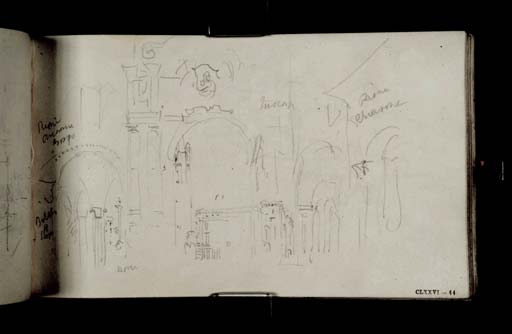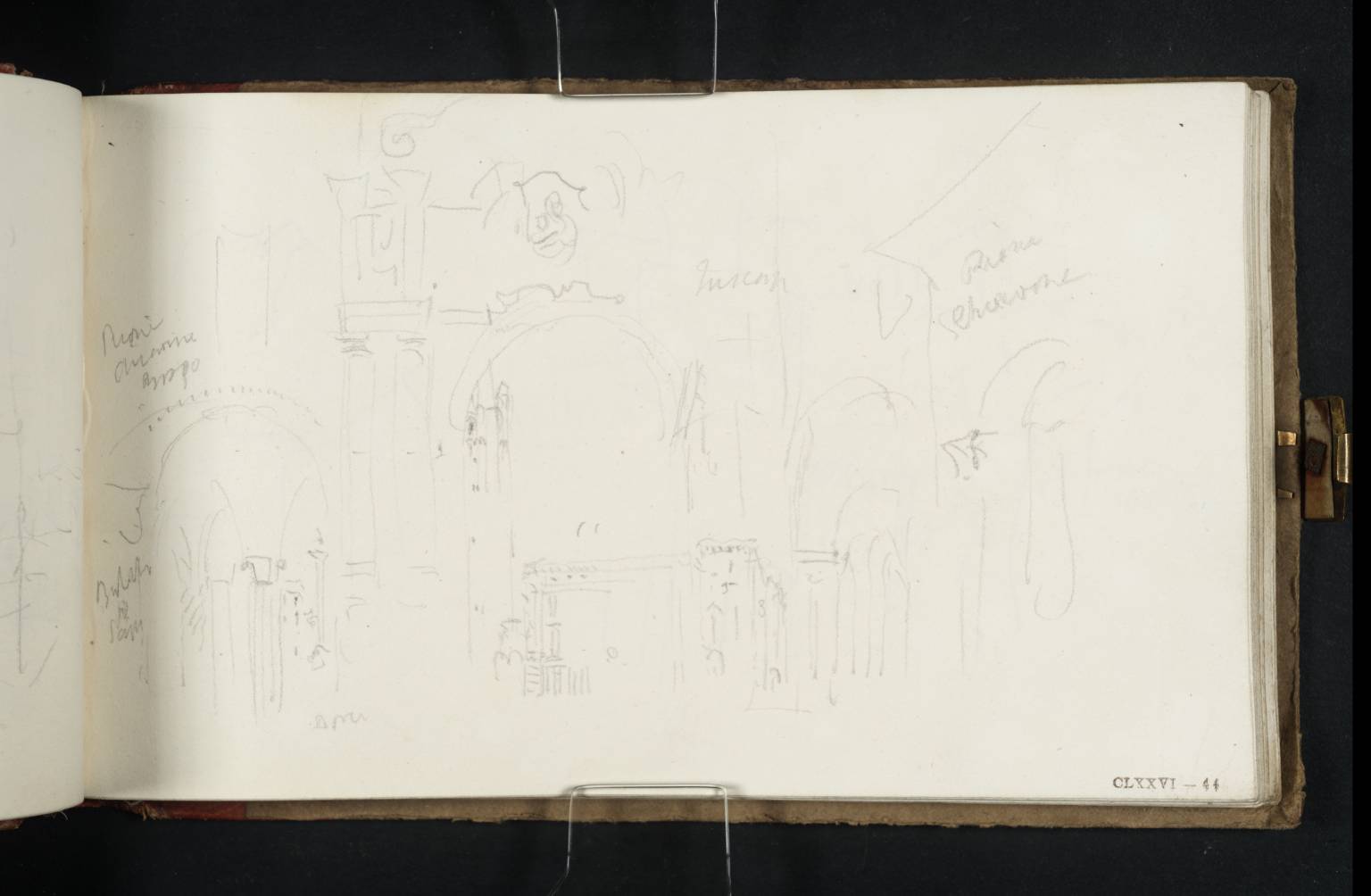
Joseph Mallord William Turner ?Forlì: The Present-Day Piazza Aurelio Saffi through a Baroque Archway 1819
Image 1 of 2
Joseph Mallord William Turner,
?Forlì: The Present-Day Piazza Aurelio Saffi through a Baroque Archway
1819
Joseph Mallord William Turner 1775–1851
Folio 48 Recto:
?Forlì: The Present-Day Piazza Aurelio Saffi through a Baroque Archway 1819
D14576
Turner Bequest CLXXVI 44
Pencil on white wove paper, 111 x 184 mm
Inscribed by Turner in pencil ‘Rioni | A[...] | B[...]’ centre left, ‘B[...] | S[...]’ and ‘Doric’ towards bottom left, ‘Tuscan’ above centre, and ‘Rioni | [?Schiavoni]’ towards top right, on and around buildings
Inscribed by John Ruskin in red ink ‘44’ bottom right (now faint)
Stamped in black ‘CLXXVI – 44’ bottom right
Inscribed by Turner in pencil ‘Rioni | A[...] | B[...]’ centre left, ‘B[...] | S[...]’ and ‘Doric’ towards bottom left, ‘Tuscan’ above centre, and ‘Rioni | [?Schiavoni]’ towards top right, on and around buildings
Inscribed by John Ruskin in red ink ‘44’ bottom right (now faint)
Stamped in black ‘CLXXVI – 44’ bottom right
Accepted by the nation as part of the Turner Bequest 1856
References
1909
A.J. Finberg, A Complete Inventory of the Drawings of the Turner Bequest, London 1909, vol.I, p.518, CLXXVI 44, as ‘Triumphal arch’.
1984
Cecilia Powell, ‘Turner on Classic Ground: His Visits to Central and Southern Italy and Related Paintings and Drawings’, unpublished Ph.D thesis, Courtauld Institute of Art, University of London 1984, pp.89–90, 465 note 98.
The Turner scholar C.F. Bell tentatively annotated Finberg’s 1909 Inventory entry (‘Triumphal arch’): ‘Rimini?’.1 Bell was presumably thinking of that city’s Roman remains; see under folio 57 verso (D14492; Turner Bequest CLXXVI 53a). With numerous detailed elements and extensive annotations regarding architectural orders and street signage, this urban ensemble, with what seems rather a Baroque arch flanked by arcades framing an impressive Renaissance building, a tower and a column across an open space in the distance, has eluded identification.2
Although as yet unconfirmed on account of topographical anomalies, the subject seems to be what is now the Piazza Aurelio Saffi in Forlì from its south-western corner, with the campanile of San Mercuriale to the east, its spire and corner turrets half-obscured by the central arch which appears to have linked the arcades at the junction of the streets now known as the Corso Giuseppe Garibaldi and the Corso Armando Diaz. Though recognisable in its essential outlines, the setting has undergone much rebuilding, but an old postcard shows it as the Piazza Vittorio Emanuele, with a building (since replaced) to the right of the campanile conforming to the selective articulation of Turner’s rendering, and a column with a statue of the Virgin Mary instead of the heavy, neo-Baroque base of the statue of Saffi now dominating the square.3 There are confirmed views of Forlì on adjacent pages; see under folio 44 verso (D14569; Turner Bequest CLXXVI 40a).
Cecilia Powell has commented on the relatively uneventful phase of Turner’s journey between leaving Bologna and reaching Rimini (folios 43 recto–60 verso; D14566–D14598; Turner Bequest CLXXVI 39a–56a), between which this page falls;4 for the artist’s overall route south-east between Bologna and Ancona, see the sketchbook’s Introduction.
Matthew Imms
March 2017
Undated MS note by C.F. Bell (died 1966) in copy of Finberg 1909, Tate Britain Prints and Drawings Room, I, p.518.
It is not mentioned in the sequence of new identifications and commentary on individual drawings in Powell 1984, p.406.
Reproduced at Alessandra Catania, ‘800 Years: Forlì and Piazza Saffi, Where the Story Began’, 21grammy, accessed 6 March 2017, http://www.21grammy.com/800-hundred-years-forli-and-piazza-saffi-where-the-story-began/ .
How to cite
Matthew Imms, ‘?Forlì: The Present-Day Piazza Aurelio Saffi through a Baroque Archway 1819 by Joseph Mallord William Turner’, catalogue entry, March 2017, in David Blayney Brown (ed.), J.M.W. Turner: Sketchbooks, Drawings and Watercolours, Tate Research Publication, July 2017, https://www