
Joseph Mallord William Turner Inscription by Turner: A Financial Summary c.1810
Joseph Mallord William Turner,
Inscription by Turner: A Financial Summary
c.1810
Joseph Mallord William Turner 1775–1851
Folio 36 Recto:
Inscription by Turner: A Financial Summary c.1810
D08340
Turner Bequest CXXII 36
Turner Bequest CXXII 36
Pen and ink and pencil on white wove paper, 69 x 112 mm
Inscribed by Turner in pen and ink and pencil (see main catalogue entry)
Inscribed by John Ruskin in red ink ‘36’ bottom right
Stamped in black ‘CXXII – 36’ bottom right
Inscribed by Turner in pen and ink and pencil (see main catalogue entry)
Inscribed by John Ruskin in red ink ‘36’ bottom right
Stamped in black ‘CXXII – 36’ bottom right
Accepted by the nation as part of the Turner Bequest 1856
References
1909
A.J. Finberg, A Complete Inventory of the Drawings of the Turner Bequest, London 1909, vol.I, p.341, CXXII 36, with transcription.
1912
Alex[ander] J. Finberg, Turner’s Water-Colours at Farnley Hall, London 1912, p.4.
1961
Alexander J. Finberg, The Life of J.M.W. Turner, R.A. Second Edition, Revised, with a Supplement, by Hilda F. Finberg, revised ed., Oxford 1961, pp.171–2, as 1810.
1983
Evelyn Joll in John Gage, Jerrold Ziff, Nicholas Alfrey and others, J.M.W. Turner, à l’occasion du cinquantième anniversaire du British Council, exhibition catalogue, Galeries nationales du Grand Palais, Paris 1983, p.80 under no.21.
1984
Martin Butlin and Evelyn Joll, The Paintings of J.M.W. Turner, revised ed., New Haven and London 1984, pp.17 under no.17, 38 under no.48, 39 under no.49, 42 under no.53, 43 under no.54, 44 under nos.55 and 56, 46 under nos.57 and 58, 56 under no.73, 61 under no.80, 62 under no.83, 66 under no.89.
1991
Martin Butlin, ‘A Hitherto Unnoticed Sale from the Collection of Sir John Leicester’, Turner Studies, vol.11, no.1, Summer 1991, p.31.
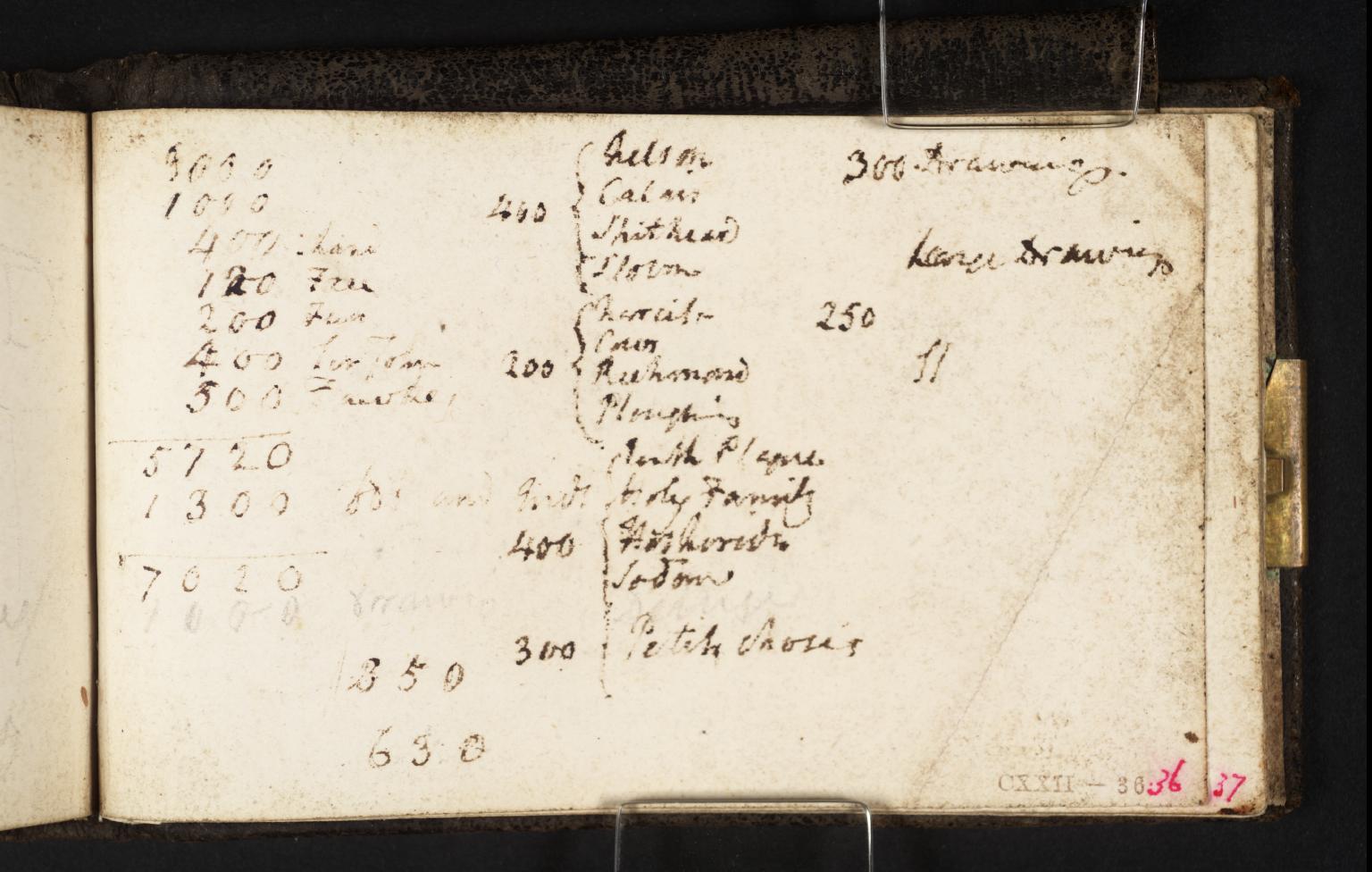
The whole page is taken up with the following notes, in ink except for ‘1000 Drawings’ and ‘Deluge’ in pencil:
3000 {Nelson 300 Drawings
1000 400 {Calais
400 Land {Spithead
120 Free {Storm Large Drawings
200 F[...] {Narciss 250
400 Sir John 200 {Cows
500 Fawkes {Richmond [?11]
{Ploughing
5720 {Tenth Plague
1300 Odds and Ends {Holy Family
400 {Hesperides
7020 {Sodom
1000 Drawings {Deluge
300 {Petits Choses
350
630
1000 400 {Calais
400 Land {Spithead
120 Free {Storm Large Drawings
200 F[...] {Narciss 250
400 Sir John 200 {Cows
500 Fawkes {Richmond [?11]
{Ploughing
5720 {Tenth Plague
1300 Odds and Ends {Holy Family
400 {Hesperides
7020 {Sodom
1000 Drawings {Deluge
300 {Petits Choses
350
630
The first four titles are linked by a curly bracket to their left, as are the next four, beginning with ‘Narciss’, the four after that, beginning with ‘Tenth Plague’, and the last two (for clarity a blank line has been inserted between each grouping in the transcription above). The extent of the brackets in the column beginning ‘Nelson’ is nevertheless approximate, as Turner’s scratchy pen makes the divisions less absolute in the original. He seems to have extended the first bracket to include ‘Storm’, while ‘Deluge’ was inserted on the cusp of the brackets for ‘400’ and ‘300’. There is a discrepancy of £100 in the first subtotal of ‘5720’, which should be 5620; this in turn affects the second total of ‘7020’, which should be 6920.
Finberg assumed this list was drawn up in 1810, at a time when Turner had long-term commitments to London properties in Harley Street and the adjacent Queen Anne Street West, including his own gallery, so he needed to see ‘what other assets he possessed’.1 These named oil paintings are fully identified below. Finberg has interpreted the figures as estimated totals for each grouping rather than individual works, as Turner ‘evidently felt that these had all missed their market’ by 1810 and ‘wrote them down severely, knocking off about 75 per cent. of the prices that had been placed upon them’, showing that he was ‘a shrewd judge of these matters’, since all except Narcissus and Echo remained in his studio to form part of the Turner Bequest.2
Butlin and Joll, in their entries for the works as cited below, generally give the figures as prices for single items, and suggest that Turner would not have reduced his rates for the more recent pictures so soon, assuming the list was drawn up in about 1810; but in relation to the one work that was sold, Narcissus and Echo, they consider it ‘less likely’ that the figures are for individual pieces.3 The entry ‘1300 Odds and Ends’ also appears in a comparable list of assets on the separate sheet associated with this sketchbook (D40900; [Turner Bequest CXXII (4) verso]). Since 1300 happens to be the total of the ‘400’, ‘200’, ‘400’ and ‘300’ bracketed against the groupings here, this may confirm Finberg’s sense that the four figures were the considerably reduced prices for these overall batches rather than the rates for individual works.
Listed at ‘400’:
‘Nelson’: The Battle of Trafalgar, as Seen from the Mizen Starboard Shrouds of the Victory, first exhibited in 1806 (Tate N00480);4 Butlin and Joll assume this single work to be ‘priced at £400’.5
‘Calais’: identified by Finberg as ‘“Calais Pier”’,6 i.e. Calais Per, with French Poissards Preparing for Sea: An English Packet Arriving, exhibited in 1803 (National Gallery, London);7 Butlin and Joll assume it was ‘priced at £400’.8
‘Spithead’: Spithead: Boat’s Crew Recovering an Anchor, exhibited in 1808 (Tate N00481);9 Butlin and Joll assume it was ‘priced at £400’.10
‘Storm’: identified by Finberg as ‘“Shipwreck”’,11 i.e. The Shipwreck, exhibited in 1805 (Tate N00476);12 Butlin and Joll assume this single work, which had already been sold to Sir John Leicester (see below, concerning the note ‘400 Sir John’) by 1806 and returned in 1807 in exchange for another (and referred to as ‘the Storm’ in the related correspondence), was ‘priced at £400’.13 Butlin subsequently noted that it was apparently offered as lot 3, ‘Boats endeavouring to save the Crew of a Ship in Distress’, in the catalogue of ‘Ten Modern Pictures’ from Leicester’s collection at Harry Phillips’s London auction room on 15 March 1809, when it was bought in at £294; despite already having relinquished it, Leicester may have included it in the sale as a favour to Turner, but it evidently ended up back in the artist’s possession when the present list was made ‘about a year later’.14
‘Calais’: identified by Finberg as ‘“Calais Pier”’,6 i.e. Calais Per, with French Poissards Preparing for Sea: An English Packet Arriving, exhibited in 1803 (National Gallery, London);7 Butlin and Joll assume it was ‘priced at £400’.8
‘Spithead’: Spithead: Boat’s Crew Recovering an Anchor, exhibited in 1808 (Tate N00481);9 Butlin and Joll assume it was ‘priced at £400’.10
‘Storm’: identified by Finberg as ‘“Shipwreck”’,11 i.e. The Shipwreck, exhibited in 1805 (Tate N00476);12 Butlin and Joll assume this single work, which had already been sold to Sir John Leicester (see below, concerning the note ‘400 Sir John’) by 1806 and returned in 1807 in exchange for another (and referred to as ‘the Storm’ in the related correspondence), was ‘priced at £400’.13 Butlin subsequently noted that it was apparently offered as lot 3, ‘Boats endeavouring to save the Crew of a Ship in Distress’, in the catalogue of ‘Ten Modern Pictures’ from Leicester’s collection at Harry Phillips’s London auction room on 15 March 1809, when it was bought in at £294; despite already having relinquished it, Leicester may have included it in the sale as a favour to Turner, but it evidently ended up back in the artist’s possession when the present list was made ‘about a year later’.14
Listed at ‘200’:
‘Narciss’: Narcissus and Echo, exhibited in 1804 (Tate T03869, displayed at Petworth House);15 as discussed above, since this is one of four works bracketed at ‘200’ in Turner’s note, Butlin and Joll are ambivalent as to whether it was offered individually at £200, or at a quarter of that rate, suggesting ‘[Lord] Egremont may have been tempted ... by the reduction’ if so.16
‘Cows’: identified by Finberg as ‘perhaps “Abingdon”’,17 by which he presumably meant the painting traditionally and presently known as such, possibly exhibited at Turner’s Gallery in 1806, but identified by Butlin and Joll in 1984 as Dorchester Mead, Oxfordshire (Tate N00485).18 However, Butlin and Joll instead suggest The Quiet Ruin, Cattle in Water; A Sketch, Evening, possibly exhibited in 1809 as ‘Sketch of Cows, &c.’ (Tate N00487), 19 individually priced here at £200.20
‘Richmond’: View of Richmond Hill and Bridge, exhibited in 1808 (Tate N00557);21 Butlin and Joll assume it was ‘priced at £200’.22
‘Ploughing’: identified by Finberg as ‘“Windsor”’,23 a traditional title for Ploughing up Turnips, near Slough, exhibited in 1809 (Tate N00486);24 Butlin and Joll assume it was ‘priced at £200’.25
‘Cows’: identified by Finberg as ‘perhaps “Abingdon”’,17 by which he presumably meant the painting traditionally and presently known as such, possibly exhibited at Turner’s Gallery in 1806, but identified by Butlin and Joll in 1984 as Dorchester Mead, Oxfordshire (Tate N00485).18 However, Butlin and Joll instead suggest The Quiet Ruin, Cattle in Water; A Sketch, Evening, possibly exhibited in 1809 as ‘Sketch of Cows, &c.’ (Tate N00487), 19 individually priced here at £200.20
‘Richmond’: View of Richmond Hill and Bridge, exhibited in 1808 (Tate N00557);21 Butlin and Joll assume it was ‘priced at £200’.22
‘Ploughing’: identified by Finberg as ‘“Windsor”’,23 a traditional title for Ploughing up Turnips, near Slough, exhibited in 1809 (Tate N00486);24 Butlin and Joll assume it was ‘priced at £200’.25
Listed at ‘400’:
‘Tenth Plague’: The Tenth Plague of Egypt, exhibited in 1802 (Tate N00470);26 Butlin and Joll assume it was individually ‘priced at £400’.27
‘Holy Family’: Holy Family, exhibited in 1803 (Tate N00473);28 Butlin and Joll assume it was ‘priced at £400’.29
‘Hesperides’: The Goddess of Discord Choosing the Apple of Contention in the Garden of the Hesperides, exhibited in 1806 (Tate N00477);30 Butlin and Joll assume it was ‘priced at £400’.31
‘Sodom’: The Destruction of Sodom, possibly exhibited in 1805 (Tate N00474);32 Butlin and Joll assume it was ‘priced at £400’.33
‘Holy Family’: Holy Family, exhibited in 1803 (Tate N00473);28 Butlin and Joll assume it was ‘priced at £400’.29
‘Hesperides’: The Goddess of Discord Choosing the Apple of Contention in the Garden of the Hesperides, exhibited in 1806 (Tate N00477);30 Butlin and Joll assume it was ‘priced at £400’.31
‘Sodom’: The Destruction of Sodom, possibly exhibited in 1805 (Tate N00474);32 Butlin and Joll assume it was ‘priced at £400’.33
Listed at ‘300’:
Two amounts are given in the left-hand column as currently due from important patrons. ‘Sir John’ Leicester (later Lord de Tabley)37 also appears on folio 7 verso (D08294) and the sheet of accounts associated with this sketchbook (D40900; [Turner Bequest CXXII (4) verso]). Walter ‘Fawkes’38 ended up owing his friend Turner large sums for the many pictures he acquired, the debt current here being £500; see also under D08294, and D40900, where the amount is ‘1000’.39
Matthew Imms
September 2013
Finberg 1961, p.171; see also James Hamilton, ‘Harley Street’ and ‘Queen Anne Street West’, and Luke Herrmann, ‘Turner’s Gallery and Exhibitions’ in Evelyn Joll, Martin Butlin and Herrmann (eds.), The Oxford Companion to J.M.W. Turner, Oxford 2001, pp.135, [252] and 349–50 respectively.
Ibid., p.38; see also Judy Egerton, The British School, National Gallery Catalogues, London 1998, p.265, with a note of Finberg’s alternative interpretation.
Ibid., p.42; for Turner’s note as the terminus post quem of the transaction, see also Evelyn Joll, ‘Painter and Patron: Turner and the Third Earl of Egremont’, Apollo, vol.105, May 1977, p.376.
Butlin and Joll 1984, p.77 no.107, pl.114 (colour); the painting currently identified as the ‘Dorchester Mead’ subject is Union of the Thames and Isis (‘Dorchester Mead, Oxfordshire’) (Tate N00462), listed in Butlin and Joll 1984, p.54 no.70, pl.80 as simply ‘Union of the Thames and Isis’.
How to cite
Matthew Imms, ‘Inscription by Turner: A Financial Summary c.1810 by Joseph Mallord William Turner’, catalogue entry, September 2013, in David Blayney Brown (ed.), J.M.W. Turner: Sketchbooks, Drawings and Watercolours, Tate Research Publication, September 2014, https://www