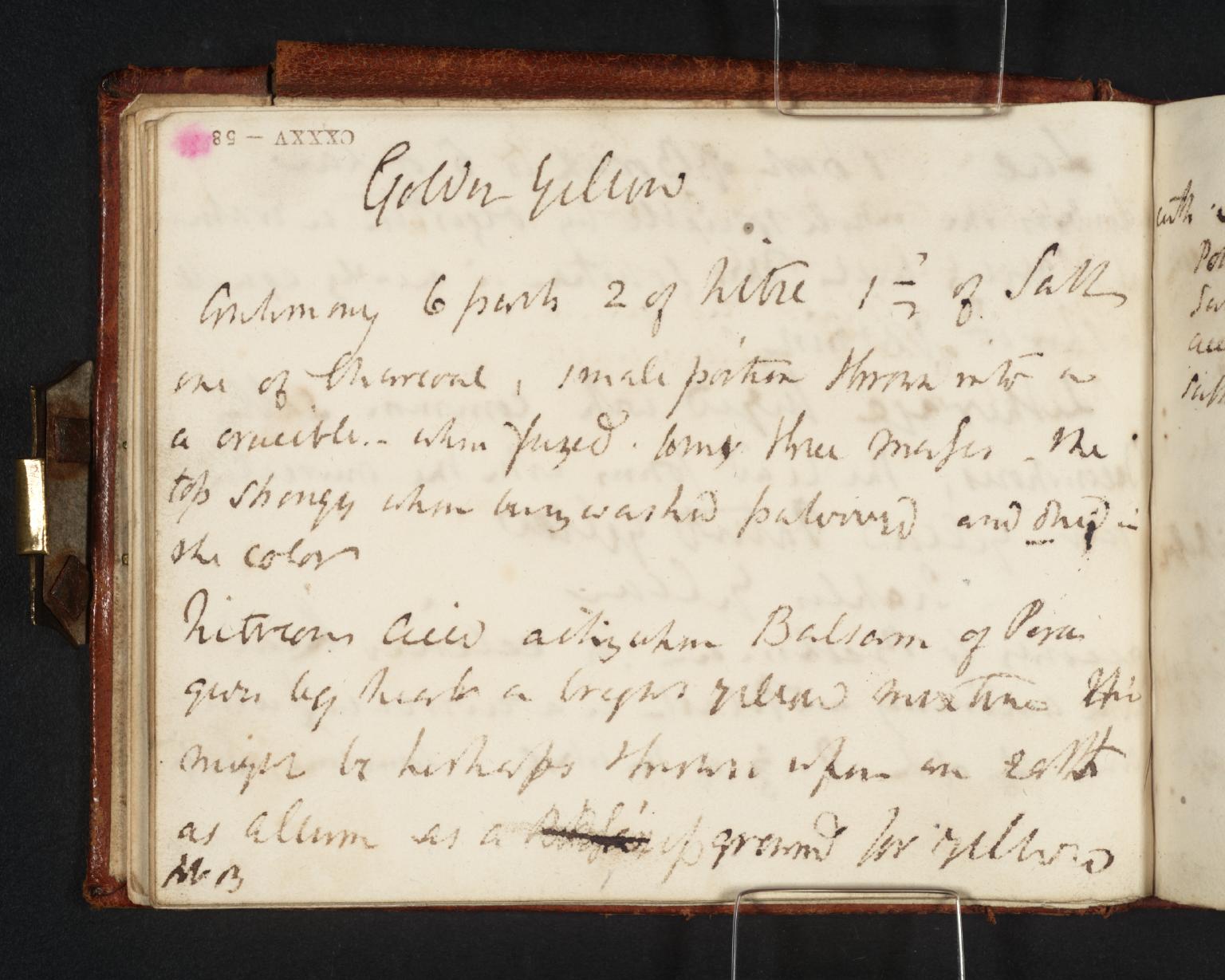
The whole page is taken up with notes on chemistry in relation to colour:
Antimony 6 parts 2 of Nitre 1 ½ of Salt | one of Charcoal, small portion thrown into a | a crucible.- when fuzed form three mases -the | top spongy when being washed pulverised and dried in | the color
Nitrious Acid acting upon Balsam of Peru | gives by heat a bright yellow mixture this | might be perhaps thrown upon an earth | as alum as a <B...> ground for yellow
Without establishing their origin, Joyce Townsend has explained these notes as relating to the ‘production of a yellow antimony-based pigment, and an organic yellow, laked’.
1This is one of fourteen pages of notes on varnishes and colours resulting from chemical reactions between folio 62 verso (
D09974) and folio 55 recto (
D09959), working from the back of the sketchbook as now foliated. As discussed in the sketchbook’s Introduction,
2 most are taken from William Nicholson’s 1808
Dictionary of Practical and Theoretical Chemistry; here the source of Turner’s heading and first paragraph is the unpaginated entry on ‘Panacea’, in which the promising words ‘golden yellow’ rather than any medical properties caught Turner’s eye:
This name, which signifies universal remedy, has been given to various preparations. The panacea of antimony was formed by detonating in small portions at a time, in a red-hot crucible, a mixture of six parts, by weight, of antimony, two of nitre, one and a half of common salt, and one of charcoal. The mass when fused and poured out consists of antimony at bottom; an hepatic compound in the next place; and at top, a spongy mass. This last, when pulverized, washed, and dried, is of a golden yellow colour, and is the panacea. It was given in pills containing from one tenth to one third of a grain of the powder, and is said to operate gently as a cathartic and emetic.
The remaining notes are from the entry on ‘Peru (Balsam of)’, describing the resin obtained from the South American Myroxylon peruiferum tree:
Nitric acid acts upon balsam of Peru with energy, and gives it an orange yellow colour when assisted by heat. ...When supersaturated with carbonat of potash, and mixed with a solution of iron, a precipitate falls, which, when treated with muriatic acid, leaves Prussian blue, and indicates the presence of prussic acid. ... The residue in the retort has a crystalline appearance, is light yellow, dissolves sparingly in boiling water, and precipitates on cooling in the state of a yellow powder.
Turner only notes the yellow rather than the blue resulting from these processes. The last two lines are not immediately traceable to Nicholson, and are perhaps Turner’s own comments. ‘Mr B’ may indicate ‘Beckmann’, mentioned in further notes from Nicholson on the verso (
D09966).