Joseph Mallord William Turner Landscape Sketches, Including Grottaferrata, the Circus of Maxentius, and Castel Gandolfo 1819
Image 1 of 2
Joseph Mallord William Turner,
Landscape Sketches, Including Grottaferrata, the Circus of Maxentius, and Castel Gandolfo
1819
Joseph Mallord William Turner 1775–1851
Folio 28 Verso:
Landscape Sketches, Including Grottaferrata, the Circus of Maxentius, and Castel Gandolfo 1819
D15158
Turner Bequest CLXXX 27 a
Pencil on white wove paper, 161 x 101 mm
Inscribed by the artist in pencil ‘Grotto F’ and ‘Fr. Dominis’ top left and ‘Latina via’ top right. Also ‘Sea’ right-hand side of fourth sketch from bottom
Accepted by the nation as part of the Turner Bequest 1856
References
1909
A.J. Finberg, A Complete Inventory of the Drawings of the Turner Bequest, London 1909, vol.I, p.532, as ‘A number of small landscape sketches’.
1984
Cecilia Powell, ‘Turner on Classic Ground: His Visits to Central and Southern Italy and Related Paintings and Drawings’, unpublished Ph.D thesis, Courtauld Institute of Art, University of London 1984, p.414, as ‘The first is labelled Grotta F (i.e. Grottaferrata)’.
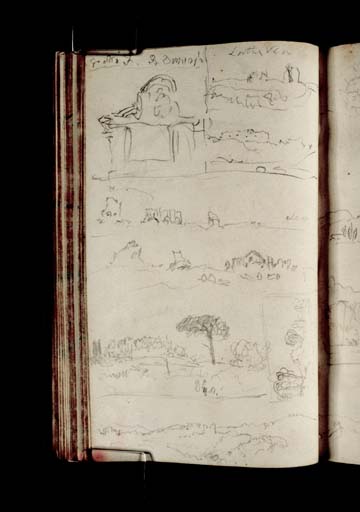
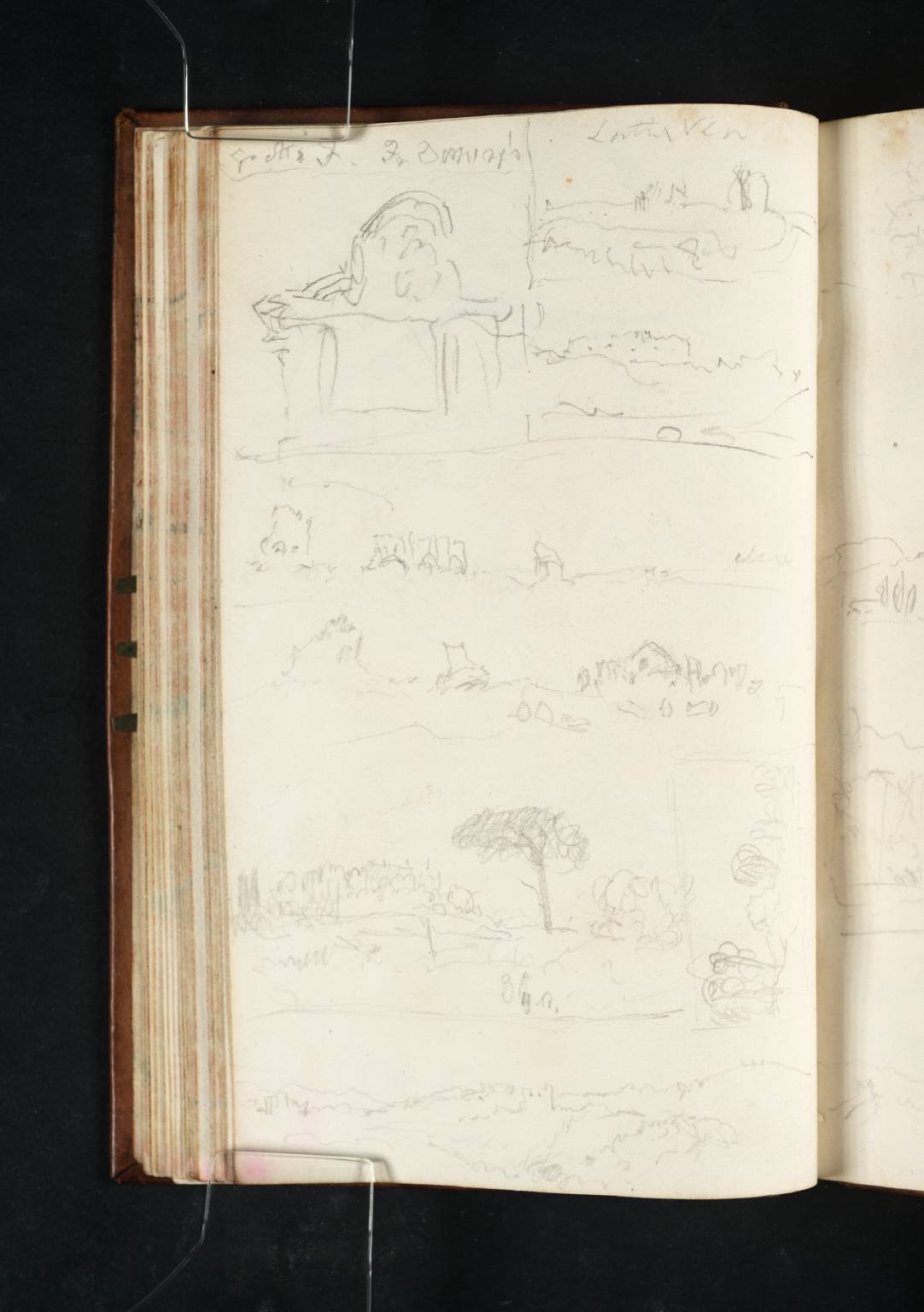
In addition to using the Vatican Fragments sketchbook to record details of art and architecture in Rome, Turner also appears to have employed it on several occasions during his journey to or from Naples. This page contains several landscape views, some of which appear to depict sites on or near the Via Appia, the road which leads south out of Rome. The rough nature of Turner’s draughtsmanship, and the way in which the artist has crammed the drawings onto a single page, suggests that they must have been executed at speed, probably from a moving carriage.
On the basis of Turner’s inscription, Cecilia Powell has identified the sketch in the top left-hand corner as depicting Grottaferrata, a town near Frascati in the Alban Hills, to the south-east of Rome.1
Thomas Ashby identified the two sketches in the top right-hand corner and in the centre of the page as depicting the Circus of Maxentius.2 This ruined complex on the Via Appia approximately two miles south-east of Rome, dates from the fourth century and comprises an imperial villa, a mausoleum and a large arena for racing and other games.3 The uppermost view is annotated ‘Latina Via’ which perhaps refers to the Via Latina, an ancient road which led south-east from Rome near the Via Appia. Further studies of the Circus of Maxentius can be seen in the Albano, Nemi, Rome sketchbook (Tate D15384; Turner Bequest CLXXXII 47).
The second sketch from the bottom depicts Castel Gandolfo from the lower shores of Lake Albano, see folio 29 (D15159; Turner Bequest CLXXX 28). The two remaining views at the bottom are unidentified but probably represent views of the Alban Hills.
Nicola Moorby
December 2009
How to cite
Nicola Moorby, ‘Landscape Sketches, Including Grottaferrata, the Circus of Maxentius, and Castel Gandolfo 1819 by Joseph Mallord William Turner’, catalogue entry, December 2009, in David Blayney Brown (ed.), J.M.W. Turner: Sketchbooks, Drawings and Watercolours, Tate Research Publication, December 2012, https://www