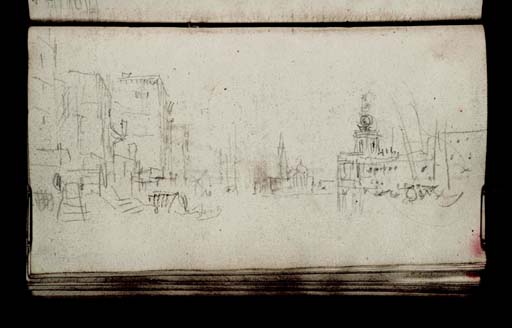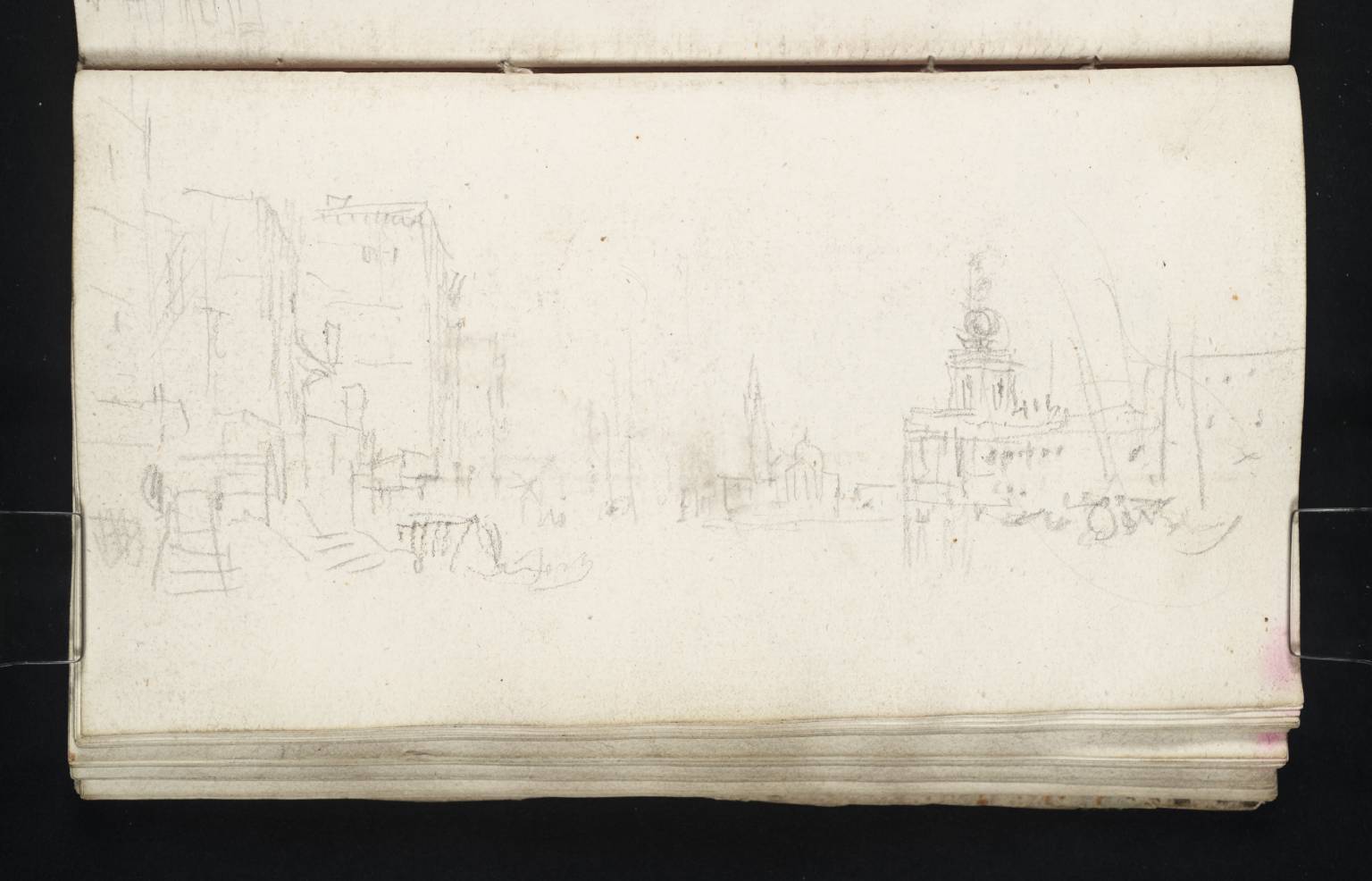
Joseph Mallord William Turner Palaces and the Porch of the Dogana, Venice, at the Entrance to the Grand Canal, with San Giorgio Maggiore across the Bacino in the Distance 1833
Image 1 of 2
-
Joseph Mallord William Turner, Palaces and the Porch of the Dogana, Venice, at the Entrance to the Grand Canal, with San Giorgio Maggiore across the Bacino in the Distance 1833 -
Joseph Mallord William Turner, Palaces and the Porch of the Dogana, Venice, at the Entrance to the Grand Canal, with San Giorgio Maggiore across the Bacino in the Distance 1833 (Enhanced image)Enhanced image
Joseph Mallord William Turner,
Palaces and the Porch of the Dogana, Venice, at the Entrance to the Grand Canal, with San Giorgio Maggiore across the Bacino in the Distance
1833
Joseph Mallord William Turner 1775–1851
Folio 80 Verso:
Palaces and the Porch of the Dogana, Venice, at the Entrance to the Grand Canal, with San Giorgio Maggiore across the Bacino in the Distance 1833
D32078
Turner Bequest CCCXIV 80a
Pencil on white laid paper, 109 x 203 mm
Partial watermark ‘C G’ (countermark)
Accepted by the nation as part of the Turner Bequest 1856
References
1909
A.J. Finberg, A Complete Inventory of the Drawings of the Turner Bequest, London 1909, vol.II, p.1015, CCCXIV 80a, as ‘View from entrance to Grand Canal: Dogana on right’.
1984
Hardy George, ‘Turner in Europe in 1833’, Turner Studies, vol.4, no.1, Summer 1984, p.14.
1985
Lindsay Stainton, Turner’s Venice, London 1985, p.22, fig.8, as ‘CCCXIV–80’, ‘The Grand Canal, looking towards the Dogana and S. Giorgio Maggiore’.
The drawing was made with the page turned horizontally. As recognised by Finberg and Lindsay Stainton,1 the view is from near the Grand Canal’s south-eastern entrance, with the porch of the Dogana overlooking the Bacino on the right, and the church of San Giorgio Maggiore on its island on the far side at the centre, to the east-south-east. Stainton gave this page as an example of Turner’s 1833 (and 1840) pencil drawings of Venice being ‘more summary than those of 1819 and ... executed with a blunter point’,2 although, as discussed under the detailed study on folio 47 recto (D32017), the level of precision and attention in the present book (and indeed in those of 1819 and 1840) can vary widely according to the interest and familiarity of the subject.
Turner had first studied the Dogana in careful detail from a little further east, with the porch shown in elevation rather than diagonally, in his 1819 Milan to Venice sketchbook (Tate D14389; Turner Bequest CLXXV 40), when his viewpoint was outside the Palazzo Giustinian (subsequently the Hotel Europa, where he was likely staying on the present occasion, as noted in this sketchbook’s Introduction). He had also made a companion study of the neighbouring Seminario Patriarcale and church of Santa Maria della Salute from that same point on his first visit (D14417; CLXXV 54). Typically, he truncated the long, low north flank of the Dogana in the present drawing, lightly indicating the seminary at its near end on the right. Both buildings appear in summary form on the left of the drawing on the recto (D32077), where the main focus is the church, seen from the north. Together, the sketches form a rough panorama, extended here to take in an oblique view of the palaces opposite.
Characteristically, there is significant lateral compression, in order to fit in both sides of the canal. Assuming the relative proportions and juxtapositions of the Dogana and San Giorgio were set down accurately, as seen from the north side of the canal about level with the Salute, then the space to the church’s left (effectively blank save for cursory indications of masts), should be three or four times wider to allow for the whole of the long arc of the Riva degli Schiavoni waterfront out to the Giardini Pubblici at the eastern end of the city. Instead, Turner brought in a run of palaces and landing stages, indicated in selective detail. In the immediate foreground appears to be what is now the main frontage of the Westin Europa & Regina Hotel, with two shallow wings flanking the central entrance, with the side of the Palazzo Badoer Tiepolo (also part of the hotel) beyond, leading on to light indications of the next group of palaces (including the Giustinian).
Ian Warrell has noted3 that this study likely informed the oil painting of Venice, exhibited at the Royal Academy in 1834 (National Gallery of Art, Washington, DC),4 with its exaggeratedly close juxtaposition of San Giorgio as if just beyond the Dogana; see also under folio 2 recto (D31930). Of numerous sketches made in the vicinity of the Dogana during Turner’s three visits, Tate D14434 (Turner Bequest CLXXV 62a), from the 1819 Milan to Venice sketchbook is comparable to this one, as is a slighter two-part study in the 1840 Venice and Botzen book (Tate D31894; Turner Bequest CCCXIII 53). See also folios 27 verso, 38 recto, 75 verso and 76 recto (D31979, D31999, D32068–D32069) for variants from further back, including the Salute.
See under folio 74 verso (D32066), for the long series of Grand Canal views in this part of the sketchbook; several immediately to either side show the opposite, north-western end, so the two sides of the present leaf must have been filled beforehand or afterwards. For the book’s somewhat convoluted general sequence, including Hardy George’s broad overview,5 see the Introduction.
Matthew Imms
May 2019
How to cite
Matthew Imms, ‘Palaces and the Porch of the Dogana, Venice, at the Entrance to the Grand Canal, with San Giorgio Maggiore across the Bacino in the Distance 1833 by Joseph Mallord William Turner’, catalogue entry, May 2019, in David Blayney Brown (ed.), J.M.W. Turner: Sketchbooks, Drawings and Watercolours, Tate Research Publication, March 2023, https://www