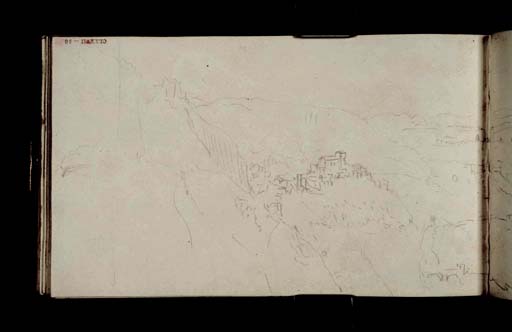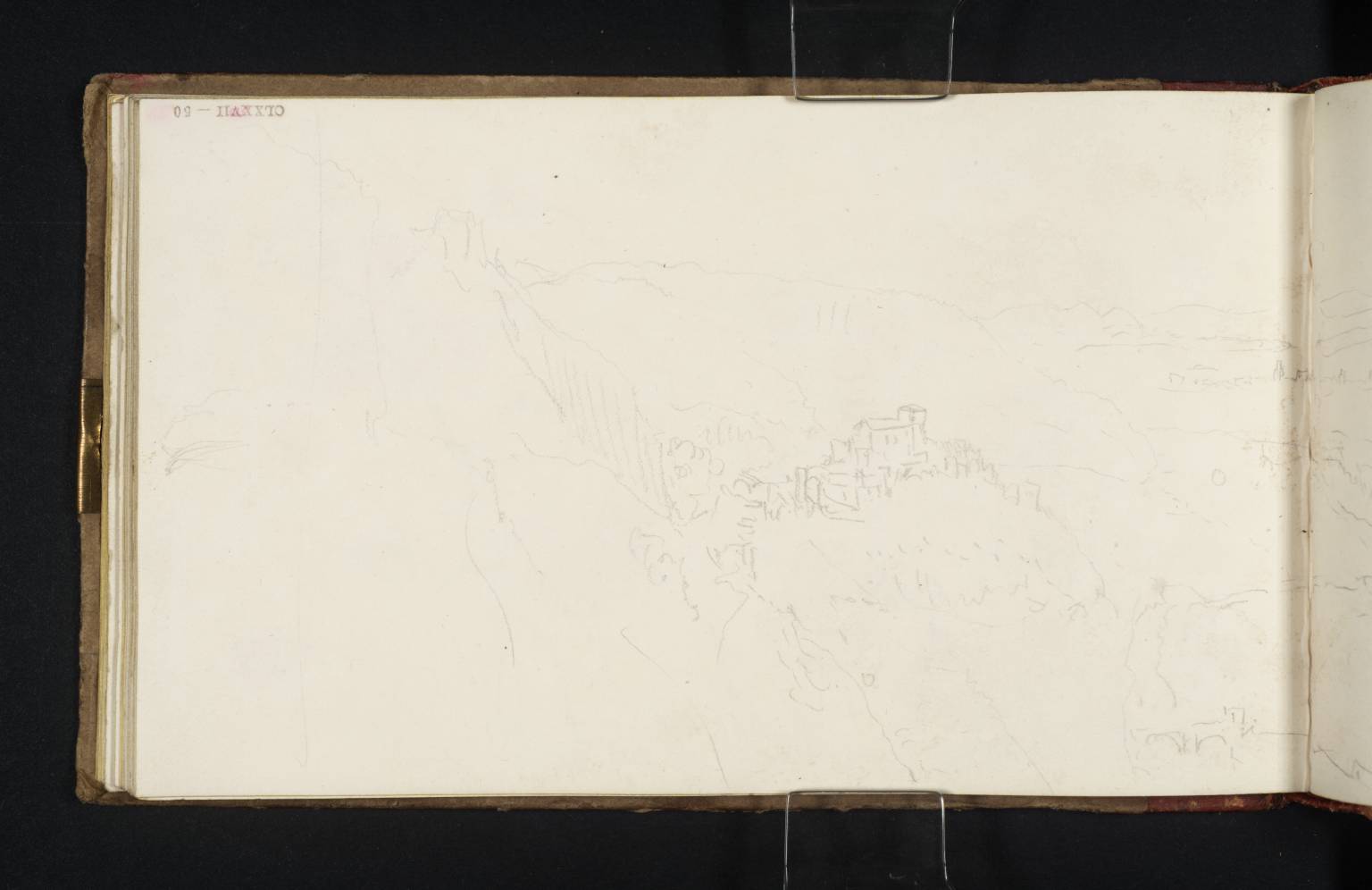
Joseph Mallord William Turner Papigno with Distant View of Terni 1819
Image 1 of 2
Joseph Mallord William Turner,
Papigno with Distant View of Terni
1819
Joseph Mallord William Turner 1775–1851
Folio 50 Recto:
Papigno with Distant View of Terni 1819
D14750
Turner Bequest CLXXVII 50
Pencil on white wove paper, 110 x 186 mm
Inscribed by John Ruskin in red ink ‘50’ top left, inverted
Stamped in black ‘CLXXVII 50’ top left, inverted
Inscribed by John Ruskin in red ink ‘50’ top left, inverted
Stamped in black ‘CLXXVII 50’ top left, inverted
Accepted by the nation as part of the Turner Bequest 1856
References
1909
A.J. Finberg, A Complete Inventory of the Drawings of the Turner Bequest, London 1909, vol.I, p.522, as ‘Narni (?)’.
1984
Cecilia Powell, ‘Turner on Classic Ground: His Visits to Central and Southern Italy and Related Paintings and Drawings’, unpublished Ph.D thesis, Courtauld Institute of Art, University of London 1984, pp. 101, 469 note 143.
1987
Cecilia Powell, Turner in the South: Rome, Naples, Florence, New Haven and London 1987, p.34.
2008
James Hamilton, Nicola Moorby, Christopher Baker and others, Turner e l’Italia, exhibition catalogue, Palazzo dei Diamanti, Ferrara 2008, pp.44, 90 note 29.
2009
James Hamilton, Nicola Moorby, Christopher Baker and others, Turner & Italy, exhibition catalogue, National Galleries of Scotland, Edinburgh 2009, pp.42, 150–1 note 29.
At Terni, Turner made a short detour from his route in order to visit the nearby Cascata, or Caduta delle Marmore, an impressive waterfall created by the descent of the River Velino into the valley below. This sketch depicts Papigno, a small village on a rocky outcrop en routebetween Terni and the Falls. On the slopes of the hill above to the left is a ruined medieval castle, the Rocca Sant’Angelo, whilst in the background on the right is a distant view of the skyline of Terni. The view continues on the opposite sheet of the double-page spread, see folio 49 verso (D14749) and further sketches can be found on folios 52 verso (D14755) and 58 (D14765). The composition corresponds to Eustace’s description of the site in A Classical Tour Through Italy:
The upper road to the Caduta crosses a plain varied with olives, vines, and corn fields, and climbs the mountain through a defile, whose sides are clad with vines below, and with box and ilex above ... In the centre of the defile rises an isolated eminence, topped with the ruins of the village of Papignia destroyed by the French. Ascending still higher, you come to an angle, where the road is worked through the rock, and forming a very elevated terrace, gives you a view of Terni and its plain; of the dell below with the Nar; of the mountains around with their woods; and of the Velino itself, at a considerable distance, just bursting from the shade, and throwing itself down the steep.1
Turner made notes from this passage in the Italian Guide Book sketchbook (see Tate D13940; Turner Bequest CLXXII 5).
The picturesque properties of Papigno made it an attractive subject for artists during the eighteenth and nineteenth centuries, for example Samuel Palmer’s watercolour, Papigno, on the River Nar, Umbria 1839 (Victoria and Albert Museum, London) and Jean-Baptiste-Camille Corot’s (1796–1875) en plein-air oil studies of 1826.2 However, the area was completely transformed during the early twentieth century by the building of an industrial plant for the production of calcium carbide.
Nicola Moorby
November 2008
How to cite
Nicola Moorby, ‘Papigno with Distant View of Terni 1819 by Joseph Mallord William Turner’, catalogue entry, November 2008, in David Blayney Brown (ed.), J.M.W. Turner: Sketchbooks, Drawings and Watercolours, Tate Research Publication, December 2012, https://www