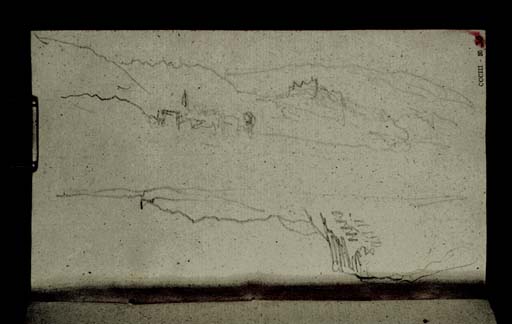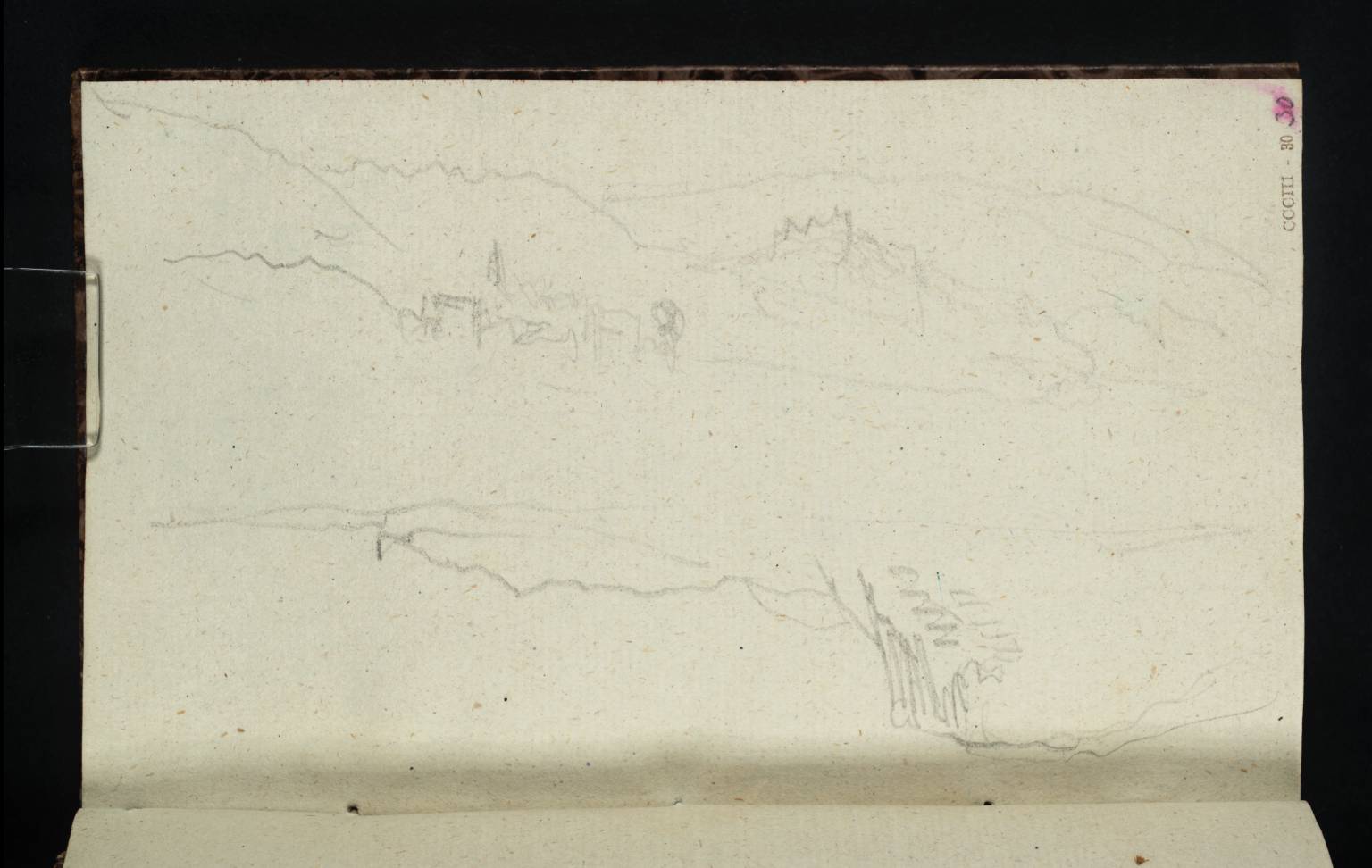
Joseph Mallord William Turner Remagen and the Apollinariskirche, Looking down the River Rhine; the Erpeler Ley Rock, Looking Upstream 1840
Image 1 of 2
-
Joseph Mallord William Turner, Remagen and the Apollinariskirche, Looking down the River Rhine; the Erpeler Ley Rock, Looking Upstream 1840 -
Joseph Mallord William Turner, Remagen and the Apollinariskirche, Looking down the River Rhine; the Erpeler Ley Rock, Looking Upstream 1840 (Enhanced image)Enhanced image
Joseph Mallord William Turner,
Remagen and the Apollinariskirche, Looking down the River Rhine; the Erpeler Ley Rock, Looking Upstream
1840
Joseph Mallord William Turner 1775–1851
Folio 31 Recto:
Remagen and the Apollinariskirche, Looking down the River Rhine; the Erpeler Ley Rock, Looking Upstream 1840
D30516
Turner Bequest CCCIII 30
Pencil on flecked pale blue laid paper, 104 x 170 mm
Partial watermark: Tree of Liberty
Inscribed by John Ruskin in red ink ‘30’ top right, ascending vertically
Stamped in black ‘CCCIII – 30’ top right, ascending vertically
Partial watermark: Tree of Liberty
Inscribed by John Ruskin in red ink ‘30’ top right, ascending vertically
Stamped in black ‘CCCIII – 30’ top right, ascending vertically
Accepted by the nation as part of the Turner Bequest 1856
References
1909
A.J. Finberg, A Complete Inventory of the Drawings of the Turner Bequest, London 1909, vol.II, p.979, CCCIII 30, as ‘Do. [i.e. ditto: River scene]’.
1995
Cecilia Powell, Turner in Germany, exhibition catalogue, Tate Gallery, London 1995, p.245, as ‘(1) Remagen and the Apollinaris Chapel, looking downstream | (2) The Erpeler Lei [sic], looking upstream’.
There are two drawing here, made with the page turned horizontally opposite ways, and identified by Cecilia Powell.1 The one at the gutter shows the Erpeler Ley, a towering basalt rock on the east bank of the Rhine, looking south-east up the river. See also the recto (D30516); the adjacent town of Erpel is shown on folio 29 recto (D30512; Turner Bequest CCCIII 28), under which earlier drawings are noted.
The other way up at the outer edge is Remagen, directly opposite (and once linked by the Ludendorff railway bridge which collapsed after fighting in 1945), looking west down the river to the prominently sited Apollinariskirche, then being rebuilt in Gothic Revival style and as yet without its four slim spires, giving it the jagged aspect of one of the ruined Rhine castles Turner recorded elsewhere on these pages. For other views of Remagen and the chapel in this sketchbook and elsewhere, see under folio 29 recto (D30512; CCCIII 28).
Powell has noted that Turner neared the end of this tour following ‘the familiar route of the Rhine between Mainz and Cologne. He almost certainly travelled by steamer, ... sketching most of the well-known sights perfunctorily as he passed.’2 Given that this sketchbook was used in reverse of its subsequent foliation, she has specified the overall range of this phase as ‘TB CCCIII 68v–20v; 11r’,3 indicating folios 12 recto and 21 verso–69 verso (D30479, D30497–D30592; Turner Bequest CCCIII 20a–68a); see this book’s Introduction for the full itinerary of this part of the journey.
Matthew Imms
September 2018
How to cite
Matthew Imms, ‘Remagen and the Apollinariskirche, Looking down the River Rhine; the Erpeler Ley Rock, Looking Upstream 1840 by Joseph Mallord William Turner’, catalogue entry, September 2018, in David Blayney Brown (ed.), J.M.W. Turner: Sketchbooks, Drawings and Watercolours, Tate Research Publication, December 2019, https://www