Joseph Mallord William Turner Sailing Vessels off the Coast c.1821-2
Image 1 of 2
Joseph Mallord William Turner,
Sailing Vessels off the Coast
c.1821-2
Joseph Mallord William Turner 1775–1851
Folio 33 Recto:
Sailing Vessels off the Coast c.1821–2
D17262
Turner Bequest CXCVIII 33
Pencil on white wove paper, 113 x 187 mm [oriented both ways]
Partial watermark ‘T Edm | 18’
Inscribed by Turner in pencil ‘[?Red]’ towards left
Inscribed by John Ruskin in red ink ‘33’ top left, upside down
Stamped in black ‘CXCVIII – 33’ top left, upside down
Partial watermark ‘T Edm | 18’
Inscribed by Turner in pencil ‘[?Red]’ towards left
Inscribed by John Ruskin in red ink ‘33’ top left, upside down
Stamped in black ‘CXCVIII – 33’ top left, upside down
Accepted by the nation as part of the Turner Bequest 1856
References
1909
A.J. Finberg, A Complete Inventory of the Drawings of the Turner Bequest, London 1909, vol.I, p.605, CXCVIII 33, as ‘Sailing vessels off coast’.
1979
Eric Shanes, Turner’s Picturesque Views in England and Wales 1825–1838, London 1979, p.156.
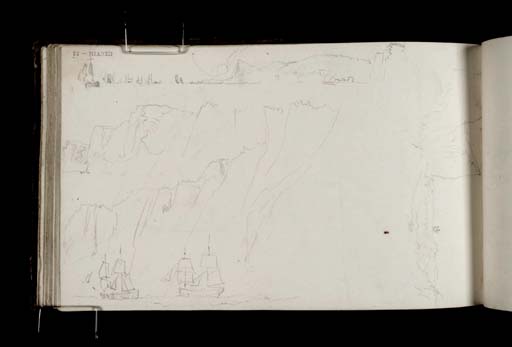
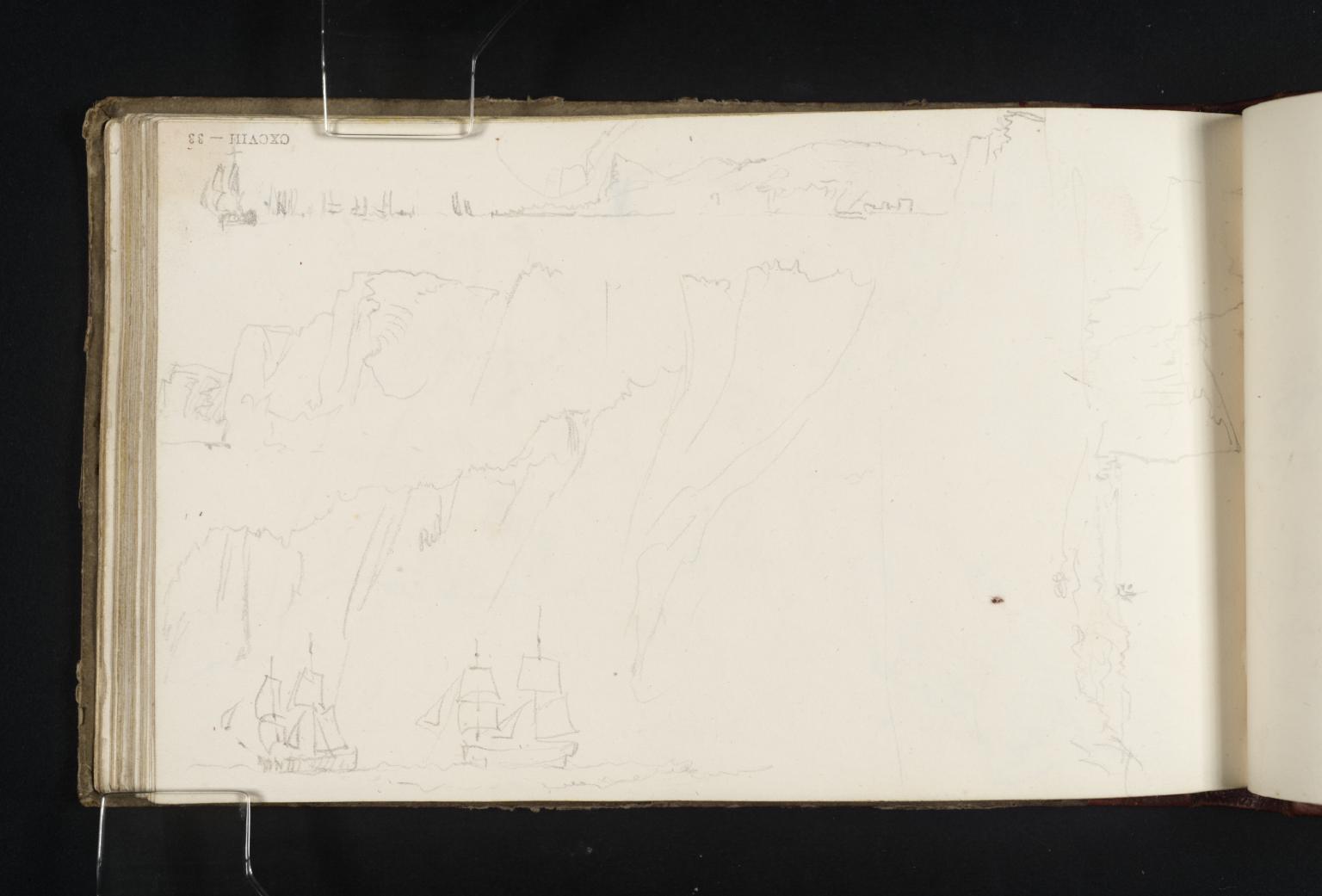
Turner is occupied here with a set of towering cliffs along the coast and the various vessels which sail past them.1 The largest drawing on the page starts in the bottom left hand corner and sweeps up in a diagonal composition, through the centre, and on towards the top right. It describes the cliffs as viewed from the sea at fairly close proximity so as to be dwarfed by the imposing height of the rock face. Two ships are captured as they progress through choppy but not vastly turbulent waters along this jagged coastline. The boats are an impressive sight with their sails unfurled, and demonstrate quick, sure, and accurate handling from Turner.
Above this a second sketch of coastal cliffs is rendered from a similar perspective. A succession of hastily arched lines appears to denote tufts of fine, loose turf that spill down and hang from their roots onto lower parts of the sharply descending slope. At the very top of the page is a more expansive, panoramic view of cliffs. Again these are observed from the sea, pointing to the fact that Turner made these drawings from the deck of a boat which itself was navigating choppy waters in the English Channel. This drawing reveals a great number of buoyant vessels to the left. One of these is markedly more detailed than the others, its sails individually delineated in their unfurled glory in the foreground. The rest of the ships float anonymously at a distance from the artist, but all are distinguished by tall masts. Towards the centre, at the top of the page, a small additional sketch is cordoned off. This appears also to be a minute rendering of coastal cliffs but is difficult definitively to identify.
The final drawing on this page has been made with the sketchbook turned vertically. It sits very close to the gutter with a faint straight line marking it off from the rest of the sheet which starts on the right and peters out towards the left. The sketch describes where a particularly sharp section of cliff meets the water. A tight collection of dark markings on the horizon perhaps denotes a vessel in full sail.
Eric Shanes correlates this page of drawings with the 1828 engraving Straits of Dover (no Tate impression; see 1863 version: T06618),2 made as part of the Picturesque Views in England and Wales series. The original watercolour is now lost;3 nonetheless, it is interesting to note with regard to the engraving Shanes’s observation that ‘[the] composition is subtly structured: the downward diagonal of the cliffs meets the upward diagonal of shadow upon the sea, and the upward line of the cliff beyond the castle is repeated by the line of light descending diagonally from the clouds’.4 The main drawing on this page builds a cliff-face completely from parallel diagonal lines, and, as noted above, the composition ends up cutting diagonally across the page. It seems possible to suggest, then, that as well as inspiring the later rendering of Dover’s topography, this page of sketches also influenced its tendency towards the diagonal.
Technical notes:
A small, dark brown spot marks this page, towards bottom left.
Maud Whatley
January 2016
How to cite
Maud Whatley, ‘Sailing Vessels off the Coast c.1821–2 by Joseph Mallord William Turner’, catalogue entry, January 2016, in David Blayney Brown (ed.), J.M.W. Turner: Sketchbooks, Drawings and Watercolours, Tate Research Publication, February 2017, https://www