Finberg later annotated his 1909
Inventory entry (‘Distant buildings’): ‘from a gondola’.
1 The Turner scholar C.F. Bell marked another copy in the same way.
2 The page’s title was amended by Ian Warrell to ‘Studies on the Giudecca Canal from near Santi Biagio e Cataldo, with Santa Maria della Visitazione and the Gesuati on the Zattere’ in 2003, in connection with his concurrent
Turner and Venice exhibition at Tate Britain.
3 The page was used horizontally both ways, and also vertically inverted relative to the sketchbook’s foliation for an incidental study of a small boat.
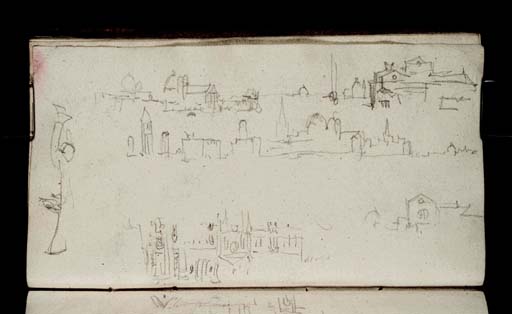
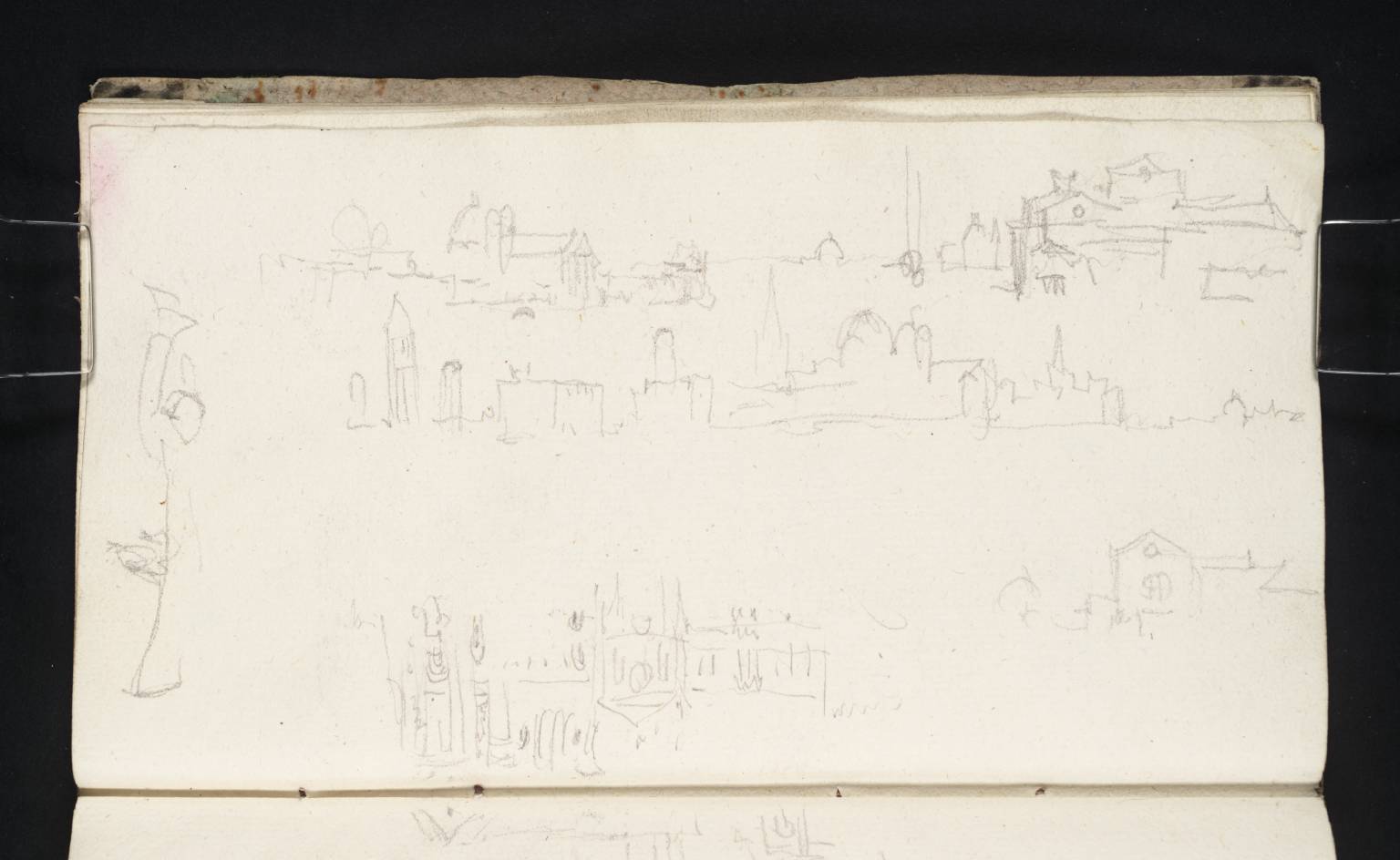
With the outer edge at the top, there are two bands showing aspects of the view eastwards along the Canale della Giudecca, from off what was then the end of the Isola della Giudecca (since extended west of the Canale dei Lauranesi, which marks the original waterfront). The main feature on the left along the top is the western flank of the Gesuati church, with its clustered dome and twin campanili; to its left is the fainter outline of Santa Maria della Salute at the end of the canal. The domes on the right are on the Giudecca itself, with the Zitelle to the left of the masts, and the nearer Redentore to their right.
In the right foreground is the lost convent of Santi Biagio e Cataldo, on the site of the Molino Stucky mill and factory complex (now a hotel);
4 it may also be shown on folio 20 recto (
D31964), and is repeated here in a separate study at the bottom right. Turner made pencil studies of the convent again in 1840, in the
Venice and Botzen sketchbook (Tate
D31854; Turner Bequest CCCXIII 33); see also watercolours of that year in the
Grand Canal and Giudecca sketchbook (Tate
D32127–D32129; Turner Bequest CCCXV 11, 12, 13) showing this end of the canal, particularly
D32128, where the gable end of the convent is shown from a similar angle.
Immediately below, the prospect left of the masts in the first view is reprised and extended in the foreground; the viewpoint appears to be a little further west, about level with Santa Marta on the north side of the canal, with the relative remoteness from the centre of the city affording unusual alignments. This unfamiliarity may have caused Turner some difficulty, possibly owing to being in motion on the broad waters where the canal and Lagoon meet. In the upper view, the Salute and Gesuati both present similar profiles from this angle, whereas here only one church is shown at the centre, possibly conflated from the domes of the first and the nave of the second, with its pedimented canal front cursorily repeated. The inconspicuous spire to the right is likely that of San Giorgio Maggiore, which is just visible in the distance between the two from this range, but it also seems to have been included over-emphatically to the left of the single cluster of domes, making them in that sense those of the Gesuati.
In any event, next left comes the blunter tower of San Trovaso. Of the three campanili which happen to be closely aligned along an extended east-north-east axis and thus shown somewhat deceptively side-by-side to the left again, the right-hand one is the Ognissanti’s (the nearest of all) and the left-hand Santo Stefano’s, almost as far off as the Salute from here. These very slight outlines frame the profile of the furthest, San Marco’s (St Mark’s), well beyond the Salute; in attending to this familiar element in relative detail, Turner has exaggerated its prominence, as the three appear much the same height from this remote viewpoint.
By the time he made the last drawing this page, the other way up at the gutter, the artist had travelled eastwards half-way along the canal until he was almost level with the Renaissance façade of the church of Santa Maria della Visitazione, somewhat overshadowed by its larger Baroque neighbour, the Gesuati (Santa Maria del Rosario), shown obliquely to the north-east. The latter’s pediment, dome and twin campanile are continued upwards onto folio 22 recto opposite (
D31968), where there is also a two-part panorama looking east along the canal from nearby, with both churches in the middle distance.
The present sketches fall within what was perhaps a single waterborne excursion (folios 10 verso–24 recto;
D31945–D31972) out towards the Giardini Pubblici at the eastern end of Venice and then westwards across the Lagoon along the southern shores of the islands of San Giorgio Maggiore and the Giudecca, before turning back for the Bacino at the heart of the city along the Canale della Giudecca. For this sketchbook’s somewhat convoluted general sequence, see its Introduction.
Warrell has noted of the canal and island of the Giudecca, away from the more familiar and immediately picturesque Bacino: ‘It was not until his final [1840] visit that Turner really assimilated the area as one of direct relevance to his art’, albeit, following on from a few 1819 views, ‘his more adventurous circuit of the western edge of the city in 1833 resulted in various dutiful sketches of campaniles and domes, including those of the island of San Giorgio in Alga, halfway to Fusina’
5 (see folios 19 recto and 21 recto;
D31962,
D31966); see also folios 19 verso–20 verso, 22 recto–23 verso and 38 verso–40 verso (
D31963–D31965,
D31968–D31971,
D32000–D32004).
6