Joseph Mallord William Turner The Cascata delle Marmore and the Valley of the Nar, from the Belvedere Superiore 1819
Image 1 of 2
Joseph Mallord William Turner,
The Cascata delle Marmore and the Valley of the Nar, from the Belvedere Superiore
1819
Joseph Mallord William Turner 1775–1851
Folio 46 Recto:
The Cascata delle Marmore and the Valley of the Nar, from the Belvedere Superiore 1819
D14742
Turner Bequest CLXXVII 46
Pencil on white wove paper, 110 x 186 mm
Inscribed by John Ruskin in red ink ‘46’ bottom right
Stamped in black ‘CLXXVII 46’ bottom right
Inscribed by John Ruskin in red ink ‘46’ bottom right
Stamped in black ‘CLXXVII 46’ bottom right
Accepted by the nation as part of the Turner Bequest 1856
References
1909
A.J. Finberg, A Complete Inventory of the Drawings of the Turner Bequest, London 1909, vol.I, p.522, as ‘Among the hills, near Terni’.
1984
Cecilia Powell, ‘Turner on Classic Ground: His Visits to Central and Southern Italy and Related Paintings and Drawings’, unpublished Ph.D thesis, Courtauld Institute of Art, University of London 1984, pp. 101, 469 note 143.
1987
Cecilia Powell, Turner in the South: Rome, Naples, Florence, New Haven and London 1987, p.34.
At Terni, Turner made a short detour from his route in order to visit the nearby Falls, one of the main highlights of the journey between Ancona and Rome. An entirely man-made phenomenon, this impressive waterfall was created by the ancient Romans who diverted the course of the River Velino so that the waters descended into the Nera valley below in three successive stages. The whiteness of the resulting spray led to the popular appellation the ‘Cascata delle Marmore’, or Waterfall of Marble. During the eighteenth and nineteenth centuries the Falls represented one of the most popular tourist destinations in Italy outside of Rome. 1 For a full discussion see folio 55 verso (D14760).
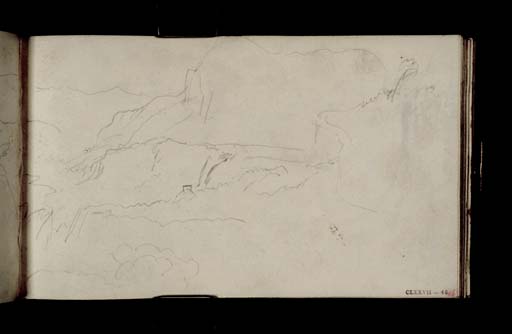
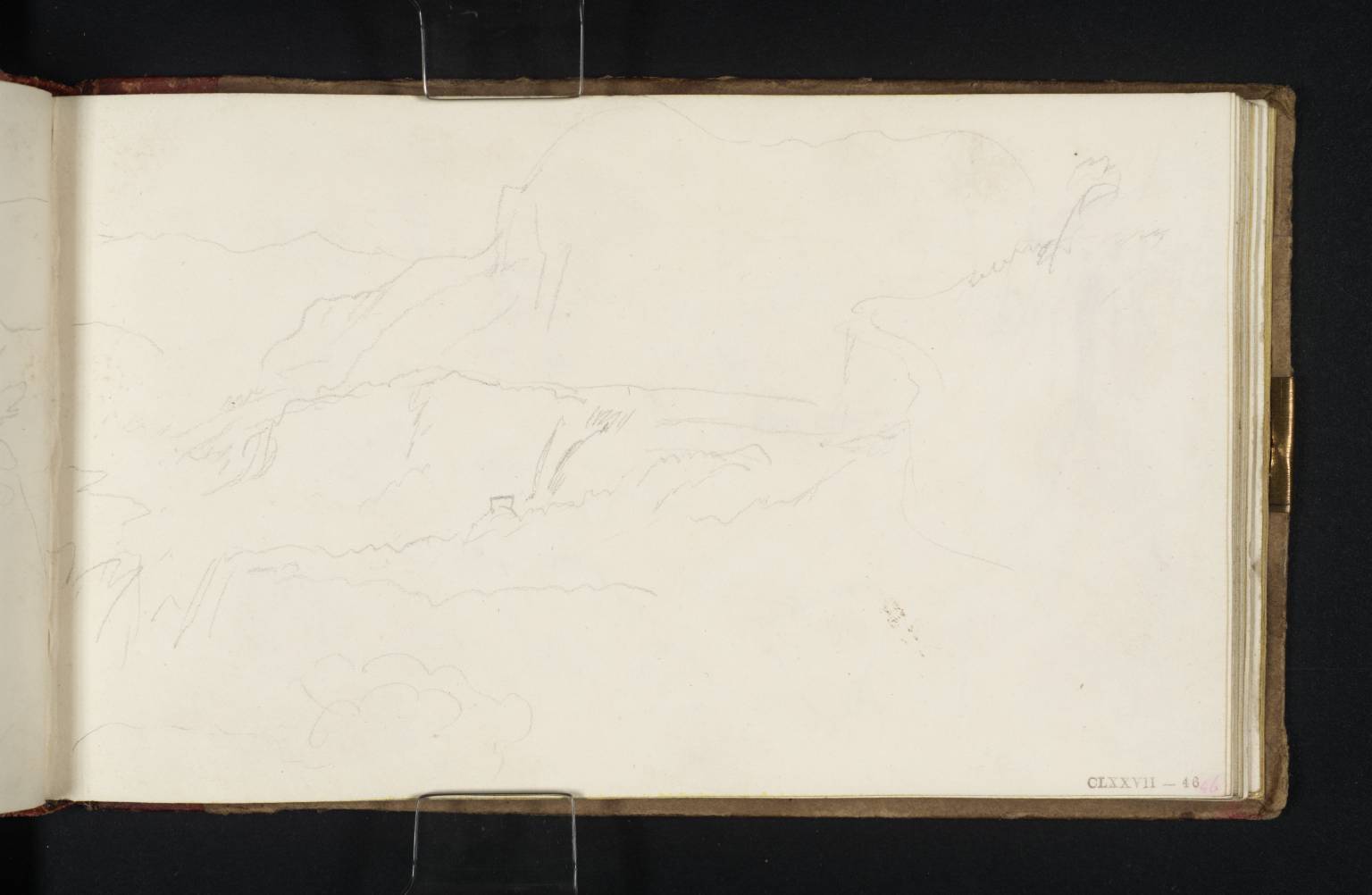
The cascading waters could be viewed from several different locations. This sketch, continued on the opposite sheet of the double-page spread, see folio 45 verso (D14741), depicts the top of the waterfall, a viewpoint was known as the Belvedere Superiore. In 1781, Pope Pius VI built a small stone hut on a projecting spur of rock almost level with the brink of the summit to facilitate the viewing experience for the increasing numbers of tourists. The hut can be seen in the middle foreground. The panorama continues on the opposite side with the view looking north-east down the Valley of the Nar. Further drawings can be found on folios 46 verso (D14743), 50 verso–51 (D14751–2) and 51 verso (D14753).
Nicola Moorby
November 2008
Today the waters are diverted for use in a hydroelectric power plant and so the falls are only ‘turned on’ intermittently for the benefit of tourists, see http://www.marmore.it/document.php?id=14 , accessed November 2008.
How to cite
Nicola Moorby, ‘The Cascata delle Marmore and the Valley of the Nar, from the Belvedere Superiore 1819 by Joseph Mallord William Turner’, catalogue entry, November 2008, in David Blayney Brown (ed.), J.M.W. Turner: Sketchbooks, Drawings and Watercolours, Tate Research Publication, December 2012, https://www