
Joseph Mallord William Turner The Forum, Rome, with the Temples of Vespasian and Saturn 1819
Joseph Mallord William Turner,
The Forum, Rome, with the Temples of Vespasian and Saturn
1819
Joseph Mallord William Turner 1775–1851
Folio 23 Recto:
The Forum, Rome, with the Temples of Vespasian and Saturn 1819
D16397
Turner Bequest CXC 3
Pencil, watercolour and gouache and grey watercolour wash on white wove paper, 130 x 255 mm
Stamped in black ‘CXC 3’ bottom right
Accepted by the nation as part of the Turner Bequest 1856
Exhibition history
1869
Second Loan Collection selected from the Turner Bequest, various venues and dates, 1869–1931 (no catalogue but numbered 110a [35]).
References
1909
A.J. Finberg, A Complete Inventory of the Drawings of the Turner Bequest, London 1909, vol.I, p.565, as ‘Campo Vaccino. Sepia and white on grey. Second Loan Collection, No.110a (35).’.
1984
Cecilia Powell, ‘Turner on Classic Ground: His Visits to Central and Southern Italy and Related Paintings and Drawings’, unpublished Ph.D thesis, Courtauld Institute of Art, University of London 1984, p.119, reproduced pl.63, as ‘The north end of the Forum’.
1987
Cecilia Powell, Turner in the South: Rome, Naples, Florence, New Haven and London 1987, pp.44, 197, reproduced p.46 pl.53, as ‘The north end of the Forum’.
1991
Ian Warrell, ‘R.N. Wornum and the First Three Loan Collections: A History of the Early Display of the Turner Bequest Outside London’, Turner Studies, vol.11, no.1, Summer 1991, p.45, no.110a (35).
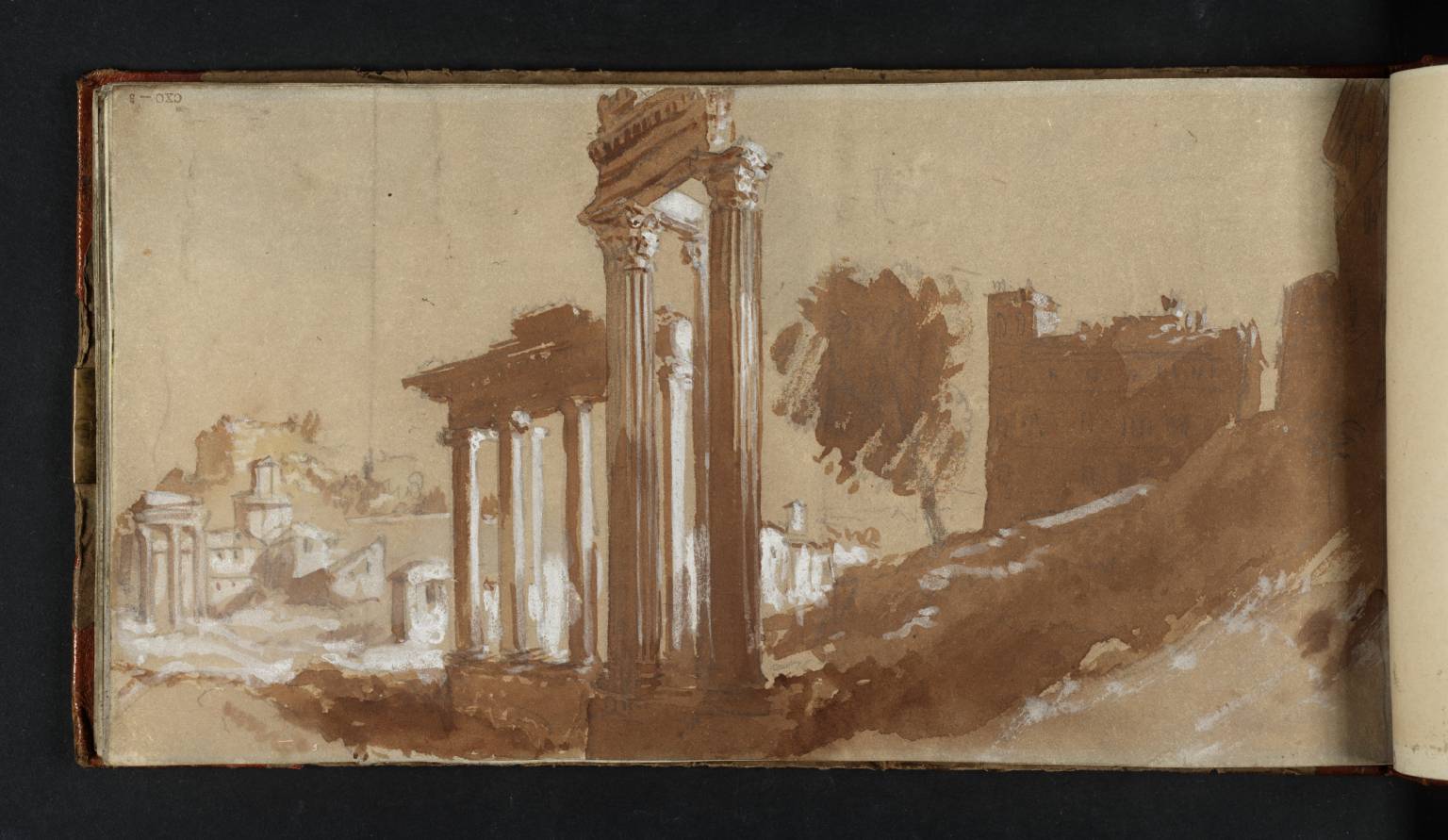
This sketch is one of a number of studies Turner made in and around the Forum in Rome. The view is taken from a point near the bottom of the Capitoline Hill looking across towards the three remaining columns of the Temple of Vespasian and the ruined Temple of Saturn beyond. Like many drawings within this sketchbook, the composition has been executed over a washed grey background and Turner has created dramatic tonal contrasts by adding dark brown watercolour wash and white gouache highlights. Cecilia Powell has argued that this technique represents the nearest Turner came in Rome to drawing in the style of the seventeenth-century French artist, Claude Lorrain (circa 1600–82).1 The latter made many images of Italian views executed in sepia tones using a combination of media.2 Turner’s decision to experiment with this manner of working may have been inspired by the choice of subject matter, the ‘Campo Vaccino’, as the Forum was familiarly known. In particular, the French master had favoured the Temple of Castor and Pollux, visible on the far left-hand side of Turner’s study, leading Samuel Palmer to describe the ancient monument as ‘Claude’s three columns’.3
Turner appears to have referred to this sketch for the composition of a later oil painting, Modern Rome – Campo Vaccino exhibited 1839 (Rosebery Collection, on loan to the National Gallery of Scotland, Edinburgh).4 The picture represents a fabricated view of the Forum but elements such as the angle of the Temple of Vespasian with the Temple of Saturn behind, and the spatial relationship between the Temple of Castor and Pollux and the nearby Church of Santa Maria Liberatrice seem to have been derived from this study. The latter motif can also be seen within Turner’s earlier watercolour, Roman Forum, from the Capitol circa 1816 (Whitworth Art Gallery, Manchester),5 published for James Hakewill’s Picturesque Views in Italy, published 1818.6
Unfortunately, in common with many of the sketches and watercolours chosen for display during the late nineteenth and early twentieth centuries, this page has suffered from overexposure to light and the paper has become irreversibly faded and discoloured.
Verso:
Blank
Inscribed by an unknown hand in pencil ‘CXC 3’ top left, inverted
Blank
Inscribed by an unknown hand in pencil ‘CXC 3’ top left, inverted
Nicola Moorby
June 2009
How to cite
Nicola Moorby, ‘The Forum, Rome, with the Temples of Vespasian and Saturn 1819 by Joseph Mallord William Turner’, catalogue entry, June 2009, in David Blayney Brown (ed.), J.M.W. Turner: Sketchbooks, Drawings and Watercolours, Tate Research Publication, December 2012, https://www
