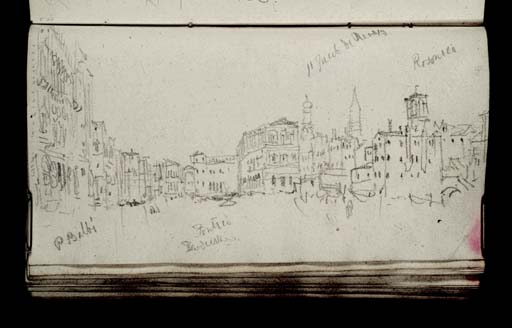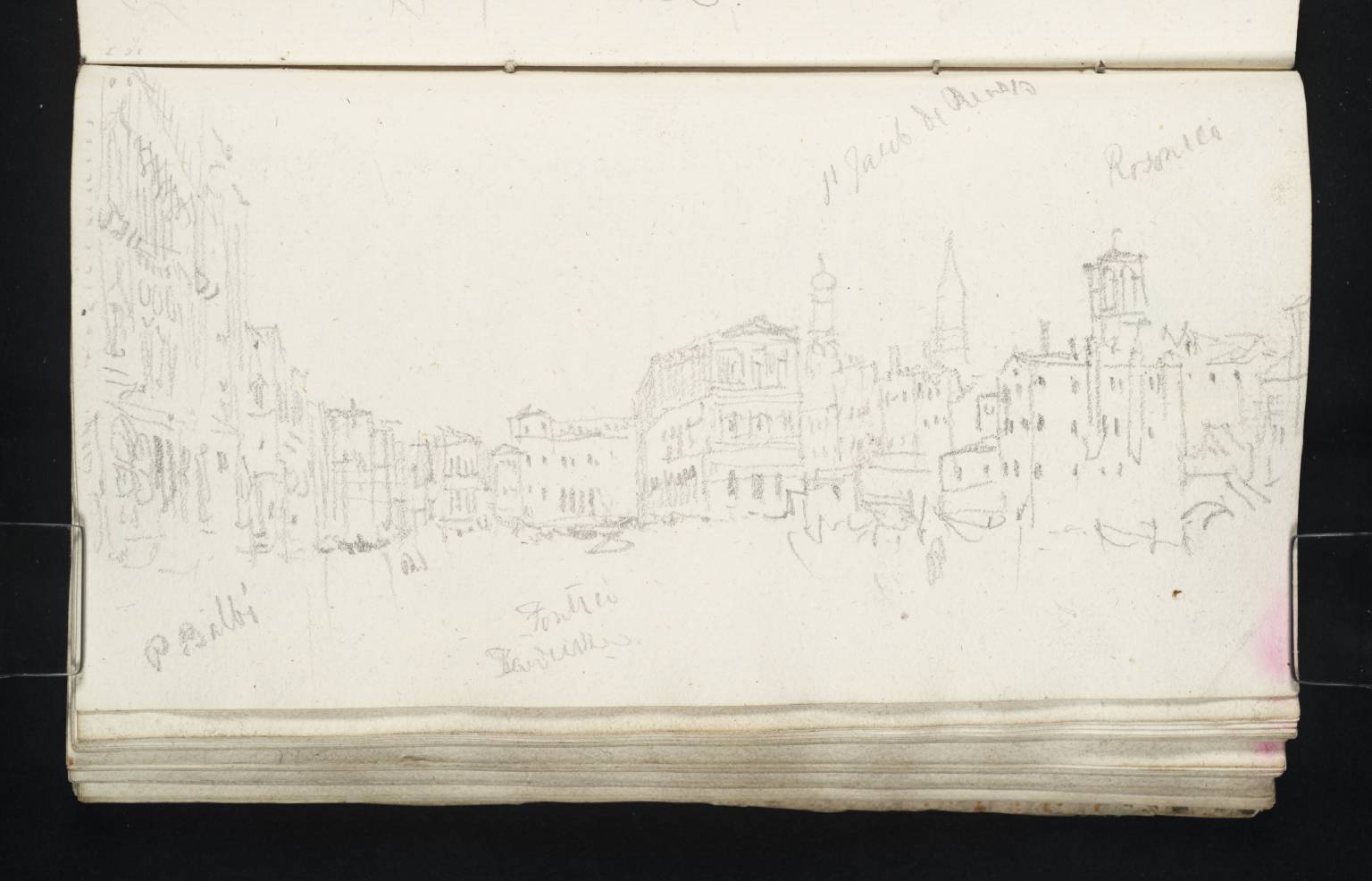
Joseph Mallord William Turner The Grand Canal towards the Rialto, Venice, from the Ca' d'Oro, with the Campanili of San Bartolomeo, San Marco (St Mark's) and San Giovanni Elemosinario 1833
Image 1 of 2
-
Joseph Mallord William Turner, The Grand Canal towards the Rialto, Venice, from the Ca' d'Oro, with the Campanili of San Bartolomeo, San Marco (St Mark's) and San Giovanni Elemosinario 1833 -
Joseph Mallord William Turner, The Grand Canal towards the Rialto, Venice, from the Ca' d'Oro, with the Campanili of San Bartolomeo, San Marco (St Mark's) and San Giovanni Elemosinario 1833 (Enhanced image)Enhanced image
Joseph Mallord William Turner,
The Grand Canal towards the Rialto, Venice, from the Ca' d'Oro, with the Campanili of San Bartolomeo, San Marco (St Mark's) and San Giovanni Elemosinario
1833
Joseph Mallord William Turner 1775–1851
Folio 82 Verso:
The Grand Canal towards the Rialto, Venice, from the Ca’ d’Oro, with the Campanili of San Bartolomeo, San Marco (St Mark’s) and San Giovanni Elemosinario 1833
D32082
Turner Bequest CCCXIV 82a
Pencil on white laid paper, 109 x 203 mm
Inscribed by Turner in pencil ‘St Jacob de Rialto’ and ‘Rosonico’ towards top right, ‘P Balbi’ bottom left, and ‘Rd’ and ‘Fontico | Tardes[...]’ bottom centre
Accepted by the nation as part of the Turner Bequest 1856
References
1909
A.J. Finberg, A Complete Inventory of the Drawings of the Turner Bequest, London 1909, vol.II, p.1015, CCCXIV 82a, as ‘On the Grand Canal. – “P. Balbi,” “Rezzonico,” “San Jacopo di Rialto,” &c.’.
1984
Hardy George, ‘Turner in Europe in 1833’, Turner Studies, vol.4, no.1, Summer 1984, p.14.
2003
Ian Warrell in Warrell, David Laven, Jan Morris and others, Turner and Venice, exhibition catalogue, Tate Britain, London 2003, pp.150, 264 note 7.
Finberg later annotated his 1909 Inventory entry (‘On the Grand Canal. – “P. Balbi,” “Rezzonico,” “San Jacopo di Rialto,” &c.’), crossing out ‘“Rezzonico”’, remarking ‘no’ and adding: ‘F dei Tedeschi in distance’.1 The Turner scholar C.F. Bell marked another copy in much the same way.2 He also noted in a copy of Finberg’s 1930 book In Venice with Turner: ‘The Palazzo Rezzonico is not visible, Fondaco dei Tedeschi in distance’.3 The drawing was made with the page turned horizontally.
The view is to the south-east, towards the sharp bend to the right at the Rialto, with the bridge just out of sight from this angle. In the immediate left foreground, the elaborate Gothic façade of the Ca’ d’Oro is seen obliquely, with indications of features including the balconies flanking the delicate tracery of the windows, and hints of the diamond pattern of interlocking quatrefoil motifs over the arches on the top storey and the more rounded ones on the floor below. Turner drew tiny thumbnail studies of its elevation when he returned in 1840, in the Venice and Botzen sketchbook (Tate D31859; Turner Bequest CCCXIII 35a) and the Venice; Passau to Würzburg book (D31303; CCCX 14).
It is possible that the palace was the initial viewpoint for the similar prospect otherwise from a little further back on folio 77 verso (D32072), since incongruent Gothic details appear in its left foreground. That drawing includes the Palazzi Boldù a San Felice and Fontana Rezzonico, just behind the present viewpoint on the left, possibly accounting for two of Turner’s typically scrambled annotations, ‘P Balbi’ and ‘Rosonico’. Compare also the prospect on folio 59 recto (D32041), under which comparable views of 1819 and 1840 are noted.4
Just to the left of centre is the Fondaco dei Tedeschi (‘Fontico | Tardes[...]’), with the Fabbriche Nouve advancing on the right-hand side to the Pescaria, now overlooked by a large neo-Gothic market building. This addition obscures the view of the three campanili towards the right: San Bartolomeo, with its onion dome; San Marco (St Mark’s), much further off, with the scale of its conspicuous spire somewhat exaggerated; and San Giovanni Elemosinario, with a single large opening to the belfry on each side, seen here on the diagonal. Only the upper part of the latter remains readily visible from this point.
As Ian Warrell has observed,5 ‘St Jacob de Rialto’, above the first two, must refer to the small church of San Giacomo di Rialto (San Giacometto), near the north end of the Rialto Bridge, aligned with San Bartolomeo but hidden by waterfront buildings and lacking a free-standing campanile.6 Turner must have passed in on foot along the narrow Ruga dei Oresi towards the bridge (folios 51 recto, 52 recto; D32025, D32027), but presumably he simply misinterpreted or was misinformed by his boatman, who likely also gave him the names of the palaces in passing. See under folio 74 verso (D32066), for the long series of Grand Canal views in this part of the sketchbook; for its somewhat convoluted general sequence, including Hardy George’s broad overview,7 see the Introduction.
Matthew Imms
May 2019
Undated MS note by Finberg (died 1939) in interleaved copy of Finberg 1909, Prints and Drawings Room, Tate Britain, II, p.1015.
Undated MS note by Bell (died 1966) in copy of Finberg 1909, Prints and Drawings Room, Tate Britain, II, p.1015.
Undated MS note by Bell in copy of A.J. Finberg, In Venice with Turner, London 1930, Study Room, British Museum, London, opposite p.169, as transcribed by Ian Warrell (Tate cataloguing files, as ‘before 1936’).
See Jeff Cotton, ‘San Giacometto’, The Churches of Venice, accessed 11 March 2019, https://www.churchesofvenice.co.uk/sanpolo.htm#sangiac .
How to cite
Matthew Imms, ‘The Grand Canal towards the Rialto, Venice, from the Ca’ d’Oro, with the Campanili of San Bartolomeo, San Marco (St Mark’s) and San Giovanni Elemosinario 1833 by Joseph Mallord William Turner’, catalogue entry, May 2019, in David Blayney Brown (ed.), J.M.W. Turner: Sketchbooks, Drawings and Watercolours, Tate Research Publication, March 2023, https://www