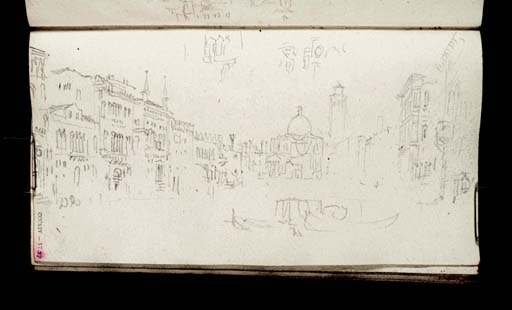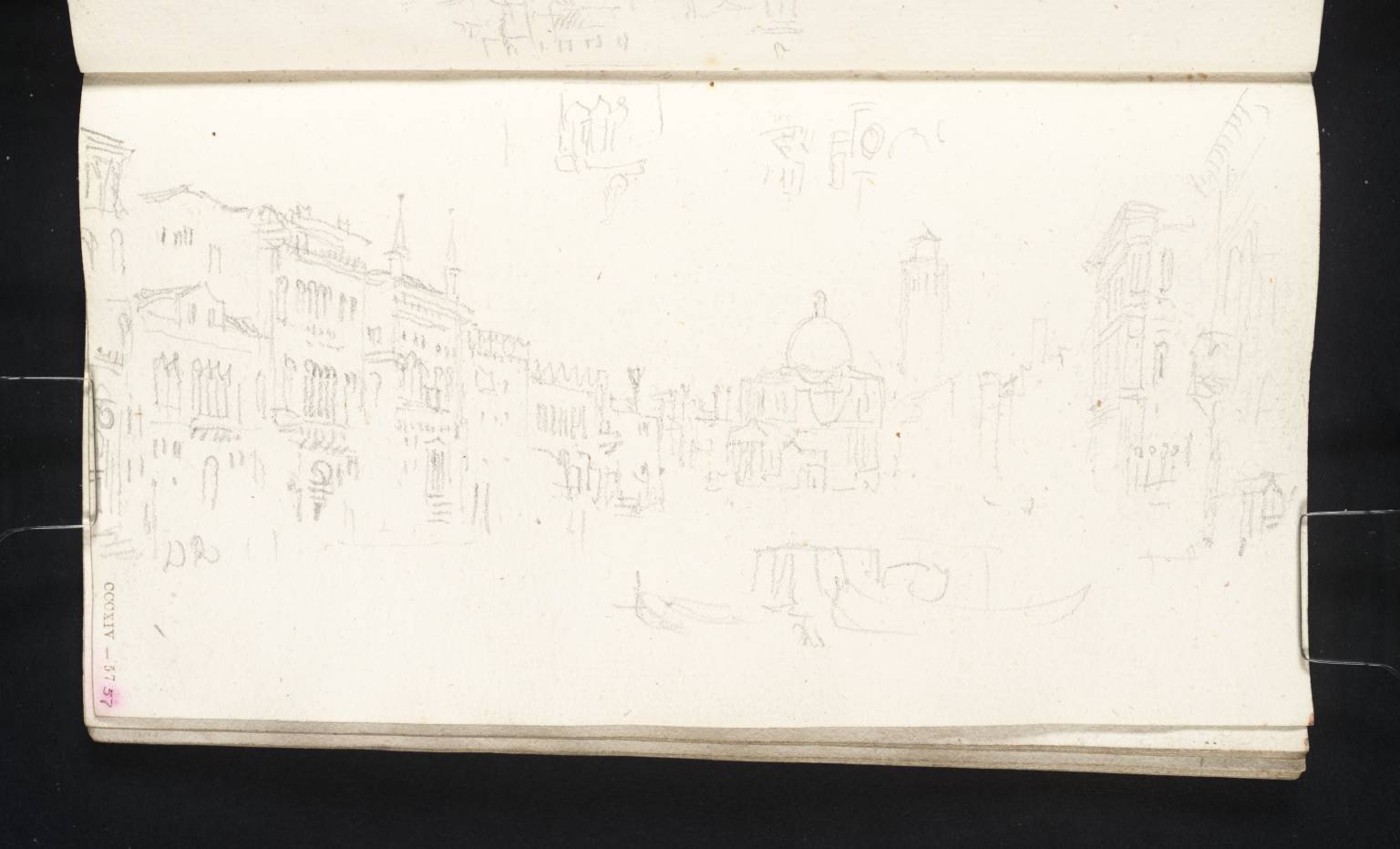
Joseph Mallord William Turner The Grand Canal, Venice, with Palaces towards the Church and Campanile of San Geremia, from near San Stae 1833
Image 1 of 2
-
Joseph Mallord William Turner, The Grand Canal, Venice, with Palaces towards the Church and Campanile of San Geremia, from near San Stae 1833 -
Joseph Mallord William Turner, The Grand Canal, Venice, with Palaces towards the Church and Campanile of San Geremia, from near San Stae 1833 (Enhanced image)Enhanced image
Joseph Mallord William Turner,
The Grand Canal, Venice, with Palaces towards the Church and Campanile of San Geremia, from near San Stae
1833
Joseph Mallord William Turner 1775–1851
Folio 57 Recto:
The Grand Canal, Venice, with Palaces towards the Church and Campanile of San Geremia, from near San Stae 1833
D32037
Turner Bequest CCCXIV 57
Pencil on white laid paper, 109 x 203 mm
Partial watermark ‘C G’ (countermark)
Inscribed by Turner ‘DR’ towards bottom left
Inscribed by C.F. Bell in black ink ‘57’ bottom left, descending vertically
Stamped in black ‘CCCXIV – 57’ bottom left, descending vertically
Partial watermark ‘C G’ (countermark)
Inscribed by Turner ‘DR’ towards bottom left
Inscribed by C.F. Bell in black ink ‘57’ bottom left, descending vertically
Stamped in black ‘CCCXIV – 57’ bottom left, descending vertically
Accepted by the nation as part of the Turner Bequest 1856
References
1909
A.J. Finberg, A Complete Inventory of the Drawings of the Turner Bequest, London 1909, vol.II, p.1014, CCCXIV 57, as ‘View on Grand Canal (?)’.
1930
A.J. Finberg, In Venice with Turner, London 1930, p.169, as ‘On the Grand Canal, with tower of the Frari’.
Finberg later annotated his 1909 Inventory entry (‘View on Grand Canal (?)’): ‘Grand Canal. Tower of Frari’.1 The Turner scholar C.F. Bell marked another copy: ‘looking South from below the Rialto’.2 He made a similar note in a copy of Finberg’s 1930 book In Venice with Turner.3 The drawing was made with the page turned horizontally.
Finberg and Bell were incorrect in this instance, albeit the distant campanile is somewhat similar to the Frari’s (compare folios 86 recto and verso; D32088–D32089); the actual subject was identified by Ian Warrell.4 Seen to the west from off the Grand Canal church of San Stae, the tower belongs to the distinctive domed building at the centre, the Baroque church of San Geremia, which stands at the northernmost point of the Grand Canal, on the far side of a gradual bend to the left. Compare a view from a little nearer the church on folio 82 recto (D32081); it is also shown directly opposite on folio 81 recto (D32079). In terms of the present view’s immediate context, folios 56 verso–59 recto (D32036–D32041), except for folio 58 verso (D32040), all show aspects of the canal’s north-eastern reaches; for this sketchbook’s somewhat convoluted general sequence, see its Introduction.
San Stae appears in the right foreground of the view to the south-east from the same point on D32036 opposite, where the buildings immediately to its west are shown in a brief continuation underneath, in turn carried down a little way over the gutter to the present page: the Gothic windows of the Palazzo Priuli Bon’s first floor and fragmentary features of its Renaissance neighbour, the Palazzo Contarini, seemingly floating free at the top centre. A bay or two of the Contarini appear at the left-hand edge here; destroyed by fire in the nineteenth century, leaving a gap in the otherwise continuous run of canal-front facades, it is shown in detail in a painting of The Grand Canal with a View of the Church of San Stae by Michele Marieschi (1710–1744; private collection).5
Turner’s carefully rendered prospect otherwise corresponds closely with the scene as it remains today, continuing with the Gothic Palazzo Duodo (marked ‘DR’, perhaps for dark red), the Renaissance Ca’ Tron (similar in many respects to the lost Contarini), the Palazzo Belloni Battagia with its twin obelisks, the plainer Fondaco del Megio, and the Fondaco dei Turchi with its zig-zag gables. Advancing on the right, the sequence of less remarkable frontages east of the church is only lightly indicated, before an oblique view of the imposing Ca’ Vendramin Calergi (now housing the Casino) opposite the Belloni Battagia, with the balcony of the Palazzo Marcello in the foreground. There is a view back in this direction from off the Fondaco dei Turchi on folio 58 recto (D32039).
There are similar complementary views from about the same point near San Stae on a single page of the 1840 Venice and Botzen sketchbook (Tate D31857; Turner Bequest CCCXIII 34a).
Matthew Imms
May 2019
Undated MS note by Finberg (died 1939) in interleaved copy of Finberg 1909, Prints and Drawings Room, Tate Britain, II, opposite p.1014.
Undated MS note by Bell (died 1966) in copy of Finberg 1909, Prints and Drawings Room, Tate Britain, II, p.1014.
Undated MS note by Bell in copy of A.J. Finberg, In Venice with Turner, London 1930, Study Room, British Museum, London, opposite p.169, as transcribed by Ian Warrell (Tate cataloguing files, as ‘before 1936’).
Entry and image, Robilant+Voena, accessed 22 February 2019, https://www.robilantvoena.com/artists/53-michele-marieschi/works/326/ .
How to cite
Matthew Imms, ‘The Grand Canal, Venice, with Palaces towards the Church and Campanile of San Geremia, from near San Stae 1833 by Joseph Mallord William Turner’, catalogue entry, May 2019, in David Blayney Brown (ed.), J.M.W. Turner: Sketchbooks, Drawings and Watercolours, Tate Research Publication, March 2023, https://www