Joseph Mallord William Turner The Marienburg, Looking Downstream 1824
Image 1 of 2
Joseph Mallord William Turner,
The Marienburg, Looking Downstream
1824
Joseph Mallord William Turner 1775–1851
Folio 114 Verso:
The Marienburg, Looking Downstream 1824
D19773
Turner Bequest CCXVI 112 a
Pencil on white wove paper, 118 x 78 mm
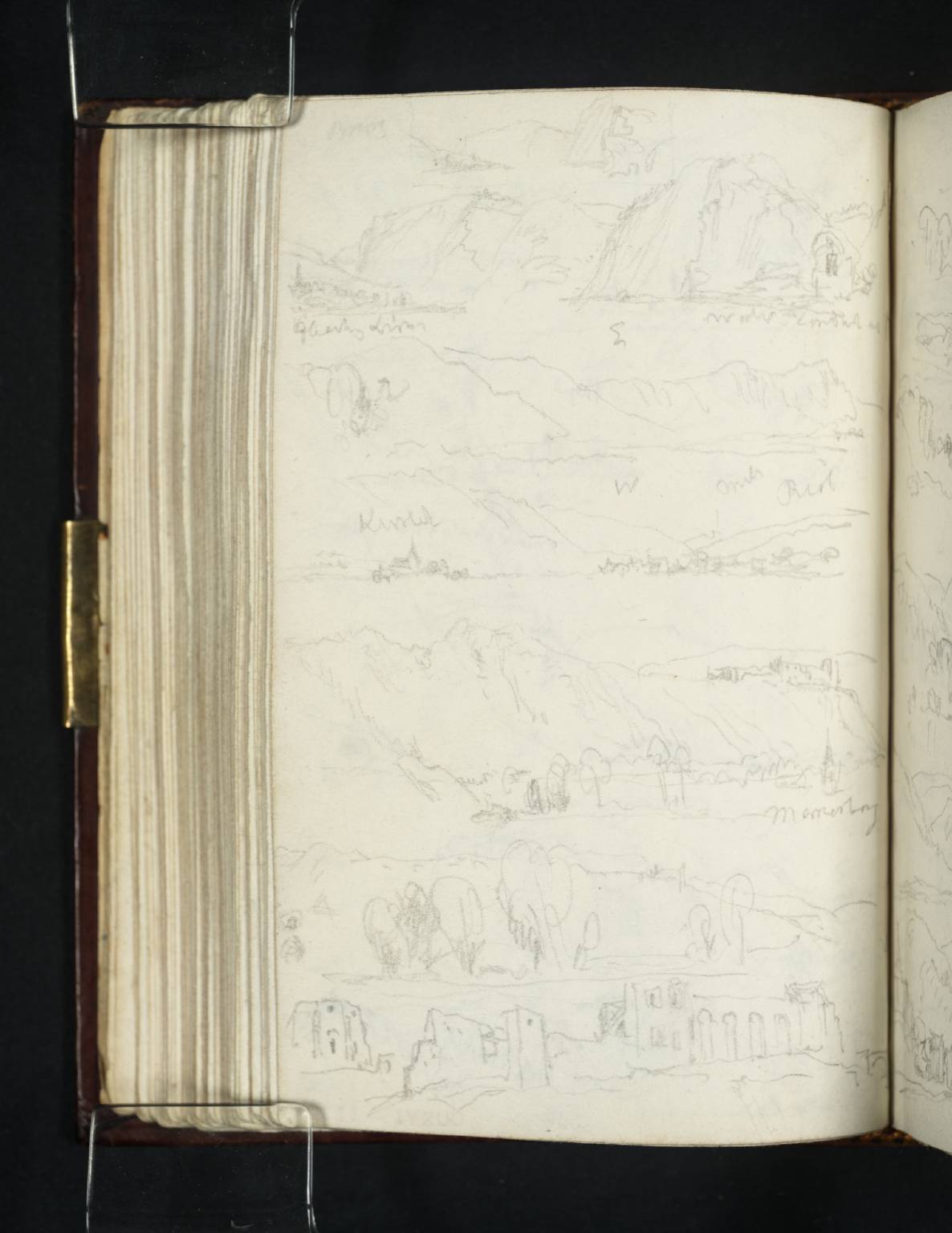
Inscribed in pencil by Turner ‘Burg’ top left; ‘Bleaching Linen’ top left; ‘E’ top centre; ‘Water Conduit and’ top right; ‘Kirch’ centre left’; ‘W’ centre; ‘Mill’ | ‘Riol’ centre right; ‘Marienburg’ centre right towards bottom
Accepted by the nation as part of the Turner Bequest 1856
References
1909
A.J. Finberg, A Complete Inventory of the Drawings of the Turner Bequest, London 1909, vol.II, p.673, as ‘Views on Moselle. “Burg”, “Reil”, “Marienburg”’.
1991
Cecilia Powell, Turner’s Rivers of Europe: The Rhine, Meuse and Mosel, exhibition catalogue, Tate Gallery, London 1991, p.43 note 27 [p.60].
1995
Cecilia Powell, Turner in Germany, exhibition catalogue, Tate Gallery, London 1995, p.32 note 12 [p.77].
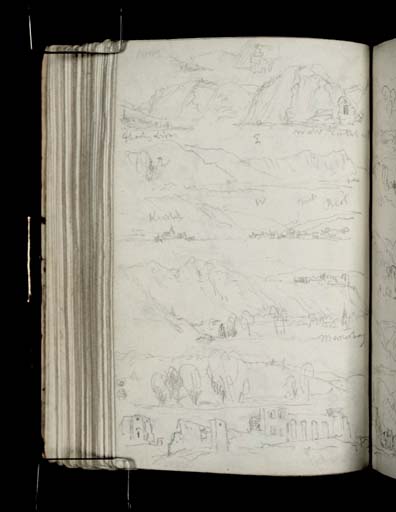
In this series of sketches Turner pictures the villages of Burg, Reil and the Marienburg, the ruins of a medieval Augustinian convent overlooking the Moselle. The Victorian travel writer Michael Joseph Quin states that the Marienburg cloisters were ‘occupied for a while by twelve canonesses of noble descent; but the position was found of so much importance in times of war, that it was frequently occupied by troops’ and the nuns were forced to leave ‘their holy retreat’.1
The Marienburg is recorded again on Tate D19774–D19775, D19779; Turner Bequest CCXVI 113–113a, 114a in the Moselle (or Rhine) sketchbook of 1824 (Tate D20163–D20164, D20187; Turner Bequest CCXIX 2–3, 26). See also later drawings of 1839: Tate D28299, D28378– D28380; Turner Bequest CCLXXXIX 5, CCXC 14a–15a.
Burg and Reil are depicted in the uppermost and central sketches respectively. In the picture of Burg, Turner makes note of a ‘water conduit’ and the ‘bleaching’ of ‘linen’ at the river front; while at Reil (inscribed ‘Riol’), seen at right, he notes the ‘Mill’ and at left, the ‘kirche’ on the opposite side of the Moselle to the actual town. During the middle ages a church (‘Kirche’ in German) was erected on this side of the Moselle on the foundations of a Gallo-Roman temple, and subsequently an important pilgrimage site called Reilkirch was established.2 However, the church depicted in Turner’s drawing was destroyed in the later decades of the nineteenth century, being positioned so impractically far away from its own congregation.3
Alice Rylance-Watson
May 2014
How to cite
Alice Rylance-Watson, ‘The Marienburg, Looking Downstream 1824 by Joseph Mallord William Turner’, catalogue entry, May 2014, in David Blayney Brown (ed.), J.M.W. Turner: Sketchbooks, Drawings and Watercolours, Tate Research Publication, April 2015, https://www