Joseph Mallord William Turner 1775–1851
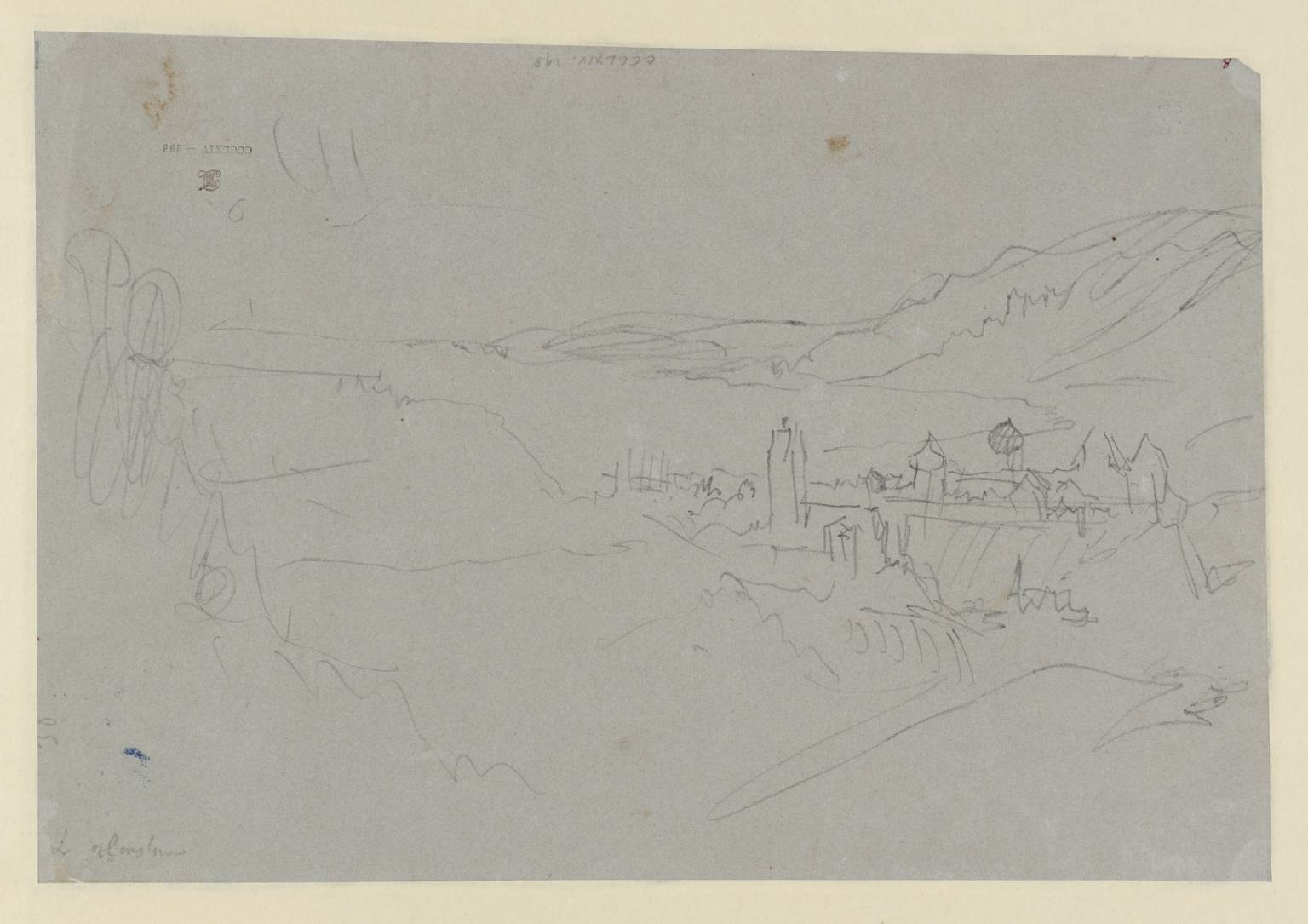
The Oberstadt at Bregenz with Lake Constance (the Bodensee) Beyond, from the Gebhardsberg 1840
Pencil on grey wove paper, 194 x 279 mm
Inscribed by Turner in pencil ‘L of Constance’ bottom left
Inscribed by ?John Ruskin in black ink ‘8’ top right, upside down
Inscribed in pencil ‘CCCLXIV. 298’ top centre, upside down
Stamped in black with Turner Bequest monogram above ‘CCCLXIV – 298’ top left, upside down
Accepted by the nation as part of the Turner Bequest 1856
This pencil sketch shows the view north over Bregenz, the capital of the Vorarlberg region of western Austria to the shores of Lake Constance (the Bodensee), and is indeed labelled by Turner ‘L of Constance’; the tower of St Gallus’s Church is right of centre, with the gables and domes of the Oberstadt complex beyond. The drawing is on the verso of D36155 (Turner Bequest CCCLXIV 298) one of three gouache and watercolour studies of the Torrente Talvera near Bolzano (Bozen) in northern Italy. The subjects on the two sides are inverted relative to each other, and are from separate stages of Turner’s long journey to Venice in 1840.
The Bregenz drawing would have been made first, complementing a sequence of smaller sketches in the Rotterdam to Venice book (Tate D32266; Turner Bequest CCCXX 2a), which was in use for most of the outward route (including the Bolzano area; see D32318; CCCXX 29a). The viewpoint is near Burg Hohenbregenz, on a crag up the Gebhardsberg mountain south of the city, where Turner made several quick drawings; compare in particular D32273 (CCCXX 6).
At various stages the artist also used separate sheets alongside the sketchbook, occasionally white or blue, but usually grey paper of English manufacture, as here. Four more developed studies of Bregenz in pencil, watercolour and gouache on blue sheets of similar sizes, possibly Dutch or German according to paper conservator Peter Bower,
1 are also associated with the visit (private collection;
2 Courtauld Gallery, London;
3 National Gallery of Ireland, Dublin;
4 Cooper Gallery, Barnsley
5).
6 As it was not mentioned in Finberg’s 1909
Inventory,
7 the present drawing seems not to have been noticed or associated with them, although Yardley linked its recto and related Bolzano subjects to them on technical grounds.
8