J.M.W. Turner: Sketchbooks, Drawings and Watercolours

ISBN 978-1-84976-386-8

Joseph Mallord William Turner The Spire of the Maria Himmelfahrt Church and the Fröhlichsturm at Malles Venosta (Mals) in the Tyrol Alps; Forte di Fortezza (the Franzensfeste Fortress), near Bressanone (Brixen) in the Dolomites 1840

Joseph Mallord William Turner 1775–1851
Folio 24 Verso:
The Spire of the Maria Himmelfahrt Church and the Fröhlichsturm at Malles Venosta (Mals) in the Tyrol Alps; Forte di Fortezza (the Franzensfeste Fortress), near Bressanone (Brixen) in the Dolomites 1840
D32308
Turner Bequest CCCXX 24a
Pencil on white wove paper, 89 x 149 mm
Partial watermark ‘J H’
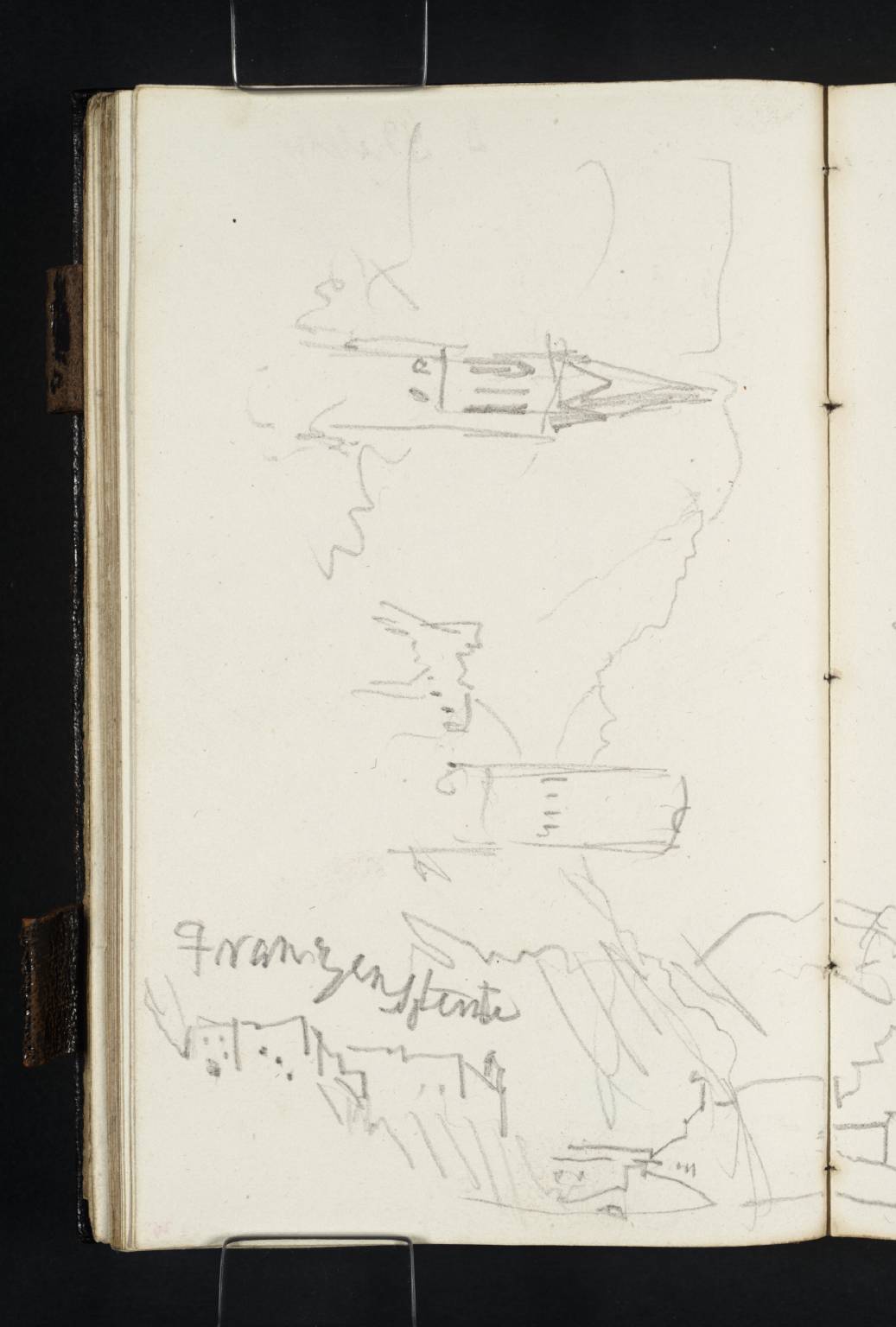
Inscribed by Turner in pencil ‘Franzensfesste’ towards bottom left
 
Accepted by the nation as part of the Turner Bequest 1856
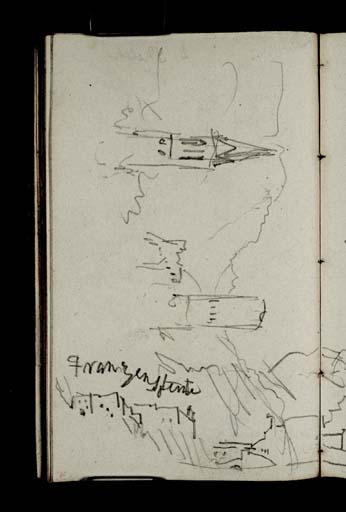
The main drawing was made with the page turned horizontally. It shows the spire of the Maria Himmelfahrt church and the ruined Fröhlichsturm at Malles Venosta (Mals), south of the Passo di Resia (Reschenpass), about half way between Landeck (see under folio 16 verso; D32294) and Merano (Meran; see under folio 31 verso; D32322), one of the clear indications that Turner took that route rather than the Brenner Pass further east, as discussed in the sketchbook’s Introduction.
Today the church and tower can be seen to the south beyond trees on Peter-Glückh-Platz, or the nearby car-park. Turner did not pause nearby to record the more ancient church towers of St Benedict and St John.
Below, apparently superimposed somewhat randomly somewhat later in the journey, is a view of the newly completed Franzensfeste fortress (Forte di Fortezza), clearly labelled by Turner; it continues across folio 25 recto opposite (D32209). Built by the Austrians between 1833 and 1838, the massive complex runs along the west side of the Iscaro (Eisack) Valley north of Bressanone (Brixen) in the Dolomites (see folio 31 recto; D32321), and south of the Brenner Pass ‘between Innsbruck and Botzen’ (otherwise Bozen or Bolzano; see folio 29 verso; D32318), as Finberg noted.1 In recent years it has been opened to the public and hosts arts events.2 Turner presumably sketched it as he travelled north-east from Bressanone to Brunico (Bruneck; see folios 34 verso–35 verso; D32328–D32330).
A long sequence of sketches, mostly characterised as ‘Mountains’ by Finberg (with occasional identifications and transcriptions of the place names marked by the artist), lies between folios 7 recto and 76 recto (D32275–D32411).3 See the book’s Introduction for the likely overall route between Bregenz and Venice.4

Matthew Imms
September 2018

1
Finberg 1909, II, p.1020.
2
See ‘Franzensfeste Fortress’, Eisacktal: Valle Iscaro: Valley of Trails, accessed 7 August 2018, https://www.valleisarco.info/en/holiday-areas/bressanone-brixen-and-environs/bressanone-brixen-and-environs/franzensfeste-fortress/.
3
See Finberg 1909, II, pp.1030–2.
4
See also Cecilia Powell, Turner in Germany, exhibition catalogue, Tate Gallery, London 1995, pp.65, 81 note 9.

How to cite

Matthew Imms, ‘The Spire of the Maria Himmelfahrt Church and the Fröhlichsturm at Malles Venosta (Mals) in the Tyrol Alps; Forte di Fortezza (the Franzensfeste Fortress), near Bressanone (Brixen) in the Dolomites 1840 by Joseph Mallord William Turner’, catalogue entry, September 2018, in David Blayney Brown (ed.), J.M.W. Turner: Sketchbooks, Drawings and Watercolours, Tate Research Publication, December 2019, https://www.tate.org.uk/art/research-publications/jmw-turner/joseph-mallord-william-turner-the-spire-of-the-maria-himmelfahrt-church-and-the-r1196542, accessed 05 April 2026.