
Joseph Mallord William Turner Loreto, from the North 1829
Joseph Mallord William Turner,
Loreto, from the North
1829
Folio 33 Recto:
Loreto, from the North 1829
D14889
Turner Bequest CLXXVIII 33
Pencil on white laid paper, 97 x 132 mm
Inscribed in pencil by Turner ‘[?sea]’ towards top centre
Inscribed in red ink ‘33’ bottom right
Stamped in black ‘CLXXVIII – 33’ bottom right
Inscribed in pencil by Turner ‘[?sea]’ towards top centre
Inscribed in red ink ‘33’ bottom right
Stamped in black ‘CLXXVIII – 33’ bottom right
Accepted by the nation as part of the Turner Bequest 1856
References
1909
A.J. Finberg, A Complete Inventory of the Drawings of the Turner Bequest, London 1909, vol.I, p.525, CLXXVIII 33, as ‘Town on hill’.
1984
Martin Butlin and Evelyn Joll, The Paintings of J.M.W. Turner, revised ed., New Haven and London 1984, p.185 under no.331.
1984
Cecilia Powell, ‘Turner on Classic Ground: His Visits to Central and Southern Italy and Related Paintings and Drawings’, unpublished Ph.D thesis, Courtauld Institute of Art, University of London 1984, pp.98, 342 note 176, 440, 468 note 130, reproduced pl.33, as ‘Loreto from the Ancona road’.
1987
Cecilia Powell, Turner in the South: Rome, Naples, Florence, New Haven and London 1987, p.32, reproduced p.[33], pl.29, as ‘Loreto from the Ancona road’.
Having departed from Rome, Turner journeyed north-east during the first week of January 1829, crossing the Apennine Mountains in Umbria and reaching the Marche region on the east coast. Among the hilltop towns he sketched as he approached Ancona were Macerata, Recanati, Loreto and Osimo.
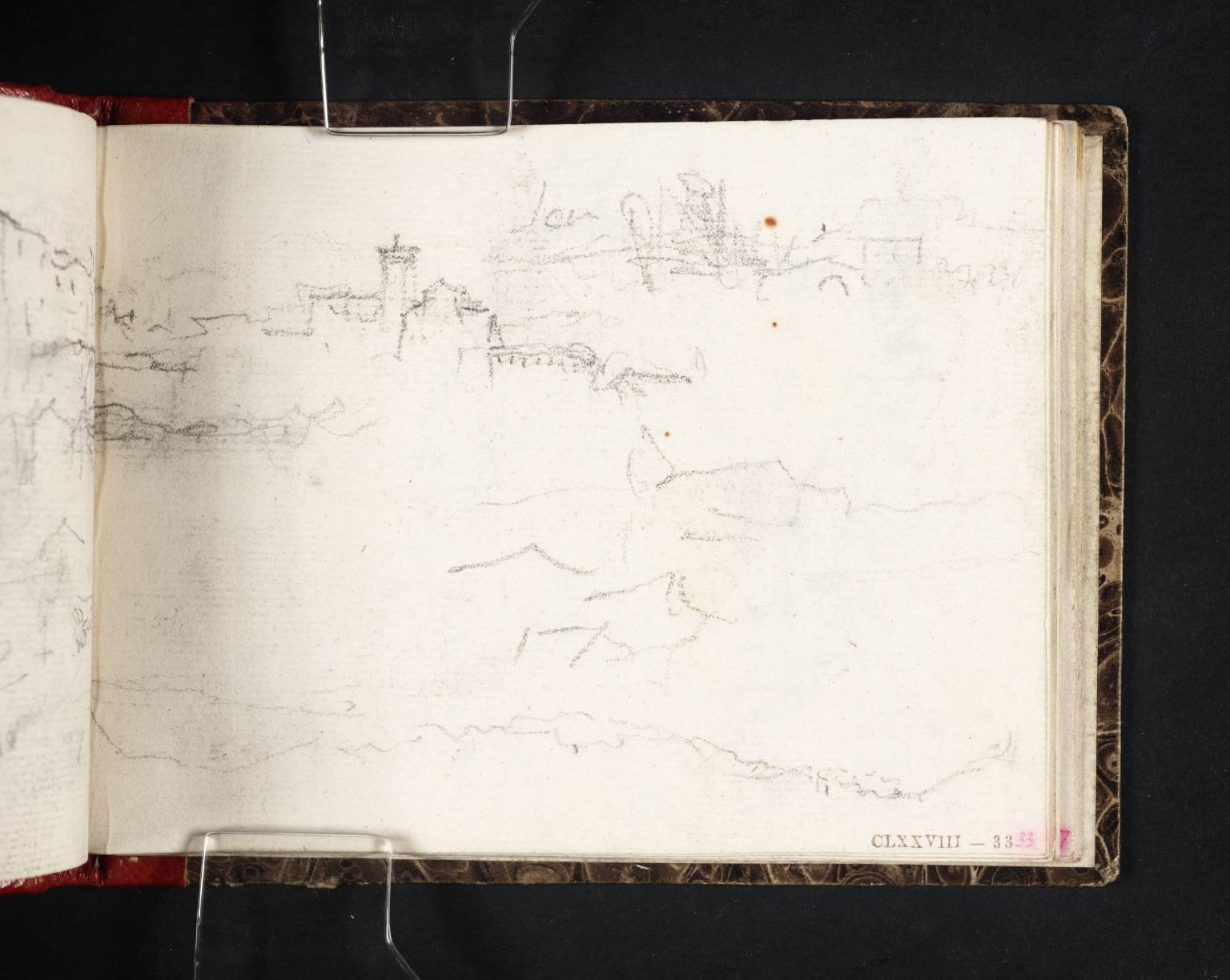
The view of buildings and towers in the upper-left section of this page appears to extend the vista on folio 32 verso opposite (D14888), which depicts the hilltop Sanctuary of Santa Casa in Loreto. As noted by Cecilia Powell, Turner’s vantage point is from the road to Ancona to the north of the town, looking southwards towards the Sanctuary.1
Shortly after returning to London in February 1829, Turner set to work on an oil painting depicting the Sanctuary of Santa Casa in Loreto, The Loretto Necklace (Tate N00509), the erroneous spelling his own.2 With the hilltop basilica in the distance, seen from the north, the composition bears similarities to the present sketch, albeit with the addition of a large tree in the foreground. The necklace of the title was thought to refer to the rosary and the cult of the Madonna at Loreto. The finished picture was prepared for the Royal Academy’s annual exhibition that year, which opened in early May, Turner having accurately predicted that the paintings he completed in Rome would not be shipped to London in time.
For further studies of Loreto in the present sketchbook, see folios 21 recto, 32 verso and 41 verso (D14869, D14888, D14903). Turner sketched Loreto extensively during his first major tour of Italy in 1819–20; see Nicola Moorby’s entries in the present catalogue for the Ancona to Rome sketchbook (Tate D14653–D14655, D14657, D14662, D14664, D14670–D14680, D14685, D14708; Turner Bequest CLXXVII 1–3, 5a, 6a, 9a–14a, 17, 29).
In the top-right corner is a rough outline of an unidentified bridge, presumably near the Adriatic coast; Turner’s inscription appears to read ‘sea’. The markings beneath and the lower study, inverted relative to the sketchbook’s foliation, are difficult to identify.
Hannah Kaspar
November 2024
How to cite
Hannah Kaspar, ‘Loreto, from the North 1829’, catalogue entry, November 2024, in David Blayney Brown (ed.), J.M.W. Turner: Sketchbooks, Drawings and Watercolours, Tate Research Publication, February 2025, https://www
