
J.M.W. Turner
Joseph Mallord William Turner Petworth House: Morning Light through the Windows 1827
Joseph Mallord William Turner,
Petworth House: Morning Light through the Windows
1827
Petworth House: Morning Light through the Windows 1827
D22774
Turner Bequest CCXLIV 112
Turner Bequest CCXLIV 112
Gouache and watercolour on blue wove paper, 140 x 191 mm
Stamped in black ‘CCXLIV 112’ bottom right
Stamped in black ‘CCXLIV 112’ bottom right
Accepted by the nation as part of the Turner Bequest 1856
Exhibition history
1962
English Drawings and Water Colors from British Collections, National Gallery of Art, Washington, February–April 1962, Metropolitan Museum of Art, New York, April–June 1962 (87).
1934
Four Screens, British Museum, London, July 1934–July 1935 (no catalogue, as ‘At Petworth’).
1938
[Display of Watercolours], National Gallery, London, December 1938–September 1939 (no catalogue), as one of ‘Three Interiors at Petworth’.
1964
Loan of Turner Watercolours from the British Museum, Graves Art Gallery, Sheffield, December 1964–January 1965, University of Nottingham Art Gallery January–March(no catalogue, as ‘At Petworth’).
1966
Turner: Imagination and Reality, Museum of Modern Art, New York, March–May [June] 1966 (61).
1978
Watercolours from the Turner Bequest, Lent by the British Museum, Tate Gallery, London, January–June 1978 (no catalogue, as ‘Petworth’).
2005
Turner at Petworth, Tate Gallery, London, October 2005–April 2006 (no catalogue).
2009
Turner / Rothko, Tate Britain, London, March–July 2009 (no catalogue).
References
1909
A.J. Finberg, A Complete Inventory of the Drawings of the Turner Bequest, London 1909, vol.II, p.746, CCXLIV 112, as ‘At Petworth’.
1962
Jonathan Mayne and John Woodward, An Exhibition of English Drawings and Water Colors from British Collections, Sponsored by the English-Speaking Unions of the United States and the British Commonwealth, exhibition catalogue, National Gallery of Art, Washington 1962, no. (87), as ‘At Petworth’.
1966
Lawrence Gowing, Turner: Imagination and Reality, exhibition catalogue, Museum of Modern Art, New York 1966, no.61 as ‘Interior at Petworth’.
1968
Martin Butlin, Aquarelle aus dem Turner-Nachlass: Les aquarelles du Legs Turner: Watercolours from the Turner Bequest 1819–1845, London 1968, pl.10.
1971
William Gaunt, Turner, Oxford 1971, p.33 reproduced.
1975
Gerald Wilkinson, Turner’s Colour Sketches 1820–34, London 1975, p.59 reproduced.
1981
William Gaunt and Robin Hamlyn, Turner, revised ed., Oxford 1981, pp.13, [70], [71] pl.20.
1989
Martin Butlin, Mollie Luther and Ian Warrell, Turner at Petworth: Painter and Patron, London 1989, pp.146, 147, 216 pl.66.
1990
Martin Butlin, Mollie Luther and Ian Warrell, Turner: Les Années Egremont: Chefs d’oeuvre inédits, trans. Tamara Préaud, Paris 1990, pl.66.
1991
Michael Bockemühl, J.M.W. Turner 1775–1851: Die Welt des Lichts und der Farbe, Cologne 1991, pp.52 reproduced, 64, 65.
1993
Michael Bockemühl, J.M.W. Turner 1775–1851: The World of Light and Colour, trans. Michael Claridge, Cologne 1993, pp.52 reproduced, 64, 65.
1994
William Gaunt and Robin Hamlyn, Turner, London 1994, pp.12, 70, 71 pl.20.
1999
Garry Fabian Miller: Tracing Light, A PhotoWorks In-Site Project, exhibition catalogue, PhotoWorks and National Trust, Petworth [1999].
2001
David Alan Mellor and Garry Fabian Miller, Tracing Light: A PhotoWorks In-Site Project: Petworth House, West Sussex, 1999–2000, Maidstone 2001, pp.[3] reproduced (detail), 168 reproduced.
2002
Christopher Rowell, Ian Warrell and David Blayney Brown, Turner at Petworth, exhibition catalogue, Petworth House, Petworth 2002, p.163, as ‘BLW 66’.
Technique and condition
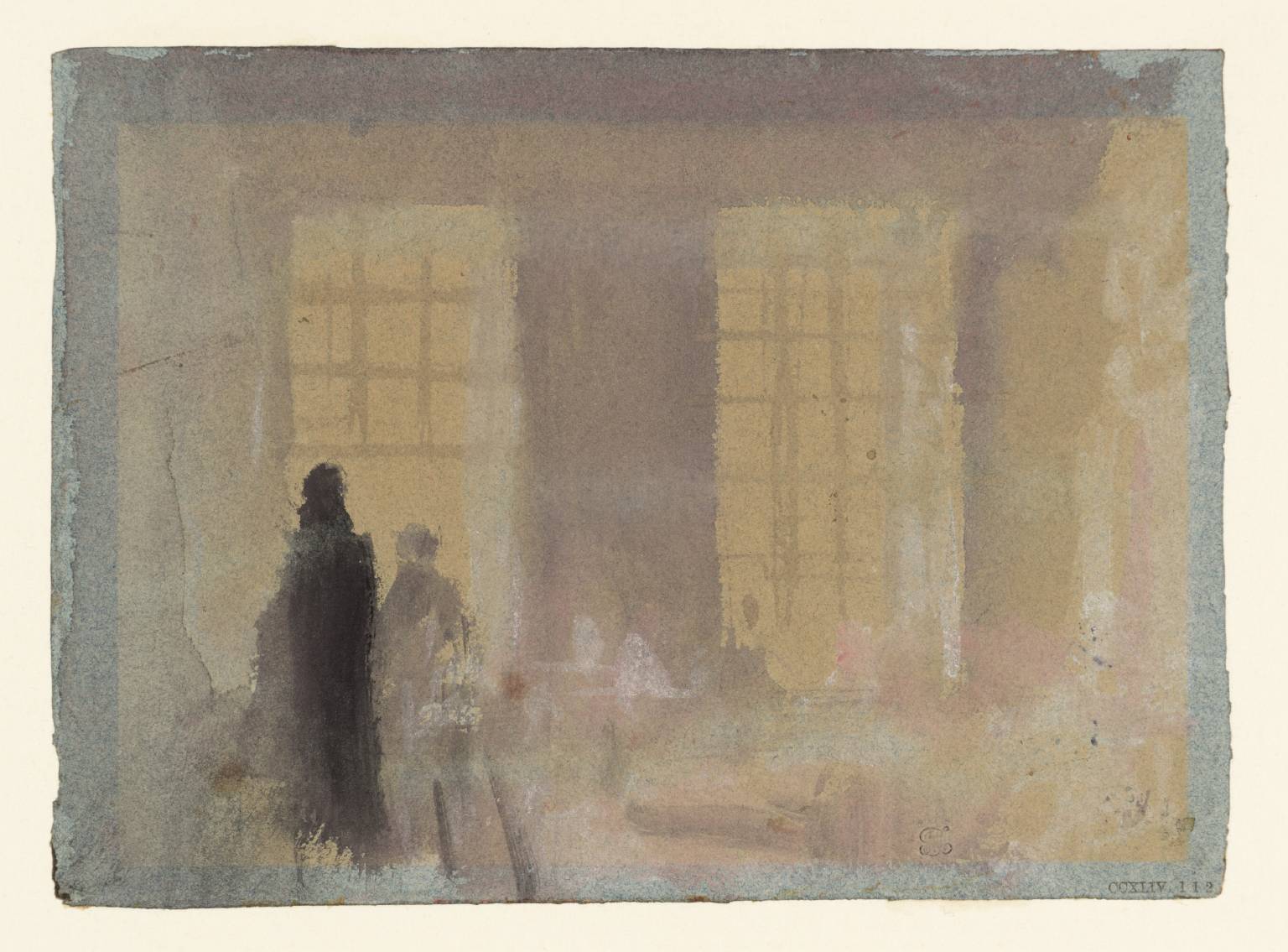
This study is on a blue wove paper, typical of those used by Turner in his middle years, which has in the past been covered by a window mount and exposed to too much light. This has not only faded out the blue component of the paper, but has caused the rest to turn yellow. This irreversible change affects the appearance of the reddish pigment applied over the paper as transparent wash, making it look more pink even though the pigment itself has not been faded.
This paper is made from a majority of uncoloured flax fibres derived from linen rags, and a minority of blue-dyed linen and hemp fibres made from blue fabrics ultimately discarded as rags. Some papers such as that in The Billiard Players (Tate D22778; Turner Bequest CCXLIV 116) include blue-dyed cotton fibres of different thicknesses, and little or no hemp, with the colourless flax fibres. Still other blue papers used by Turner include a few red-dyed fibres as well. The paper-maker would have combined the treated and beaten rags to give a consistent – or occasionally interesting and unique – set of papers for sale. Hemp fibres age and discolour faster than cotton and linen ones, so different papers have inherently different stability to light, although this is unknown to the artist who uses them. All the fibre colours are visible when the sheet is viewed on a table at x20 to x40 magnification, and fibre types can be identified with reasonable certainty if a tiny sample is separated from the sheet, teased out, and viewed in transmitted light with a research microscope at x100 to x250. The paper-making process involves harsh and lengthy chemical treatment, beating and stirring of the fibres, so they are always more difficult to identify than younger fibres in cloth that has not yet been discarded and made into paper. The paper-making process in Turner’s era is discussed in much greater detail by Bower,1 who has noted that Turner usually used good quality papers that had been carefully selected for their absorbency and tactile qualities as well as their colour.
This freely coloured and rapidly-painted colour impression perhaps transcends the severe colour change better than some subjects could: the mauve paint was made from vermilion applied thinly to the blue paper to create an ‘optical purple’ which now looks more pink. It is not possible to tell if any of the pinkish red lake pigment mixed with white and used in the foreground was mixed in with the vermilion and has been faded now. In the foreground itself this red lake pigment may not have altered much or at all, but there is none used in the protected edges, to enable a comparison. Examination in ultraviolet light suggests it is not based on madder, as many of Turner's red lake pigments were, and does not give any evidence for colour loss either. The black pigment mixed to form a grey gouache will not have altered, since all the likely black materials are stable in light. The most dramatic change is to the windows which were left unpainted, and now ‘read’ as discoloured paper instead of naturalistic blue sky represented by blue paper.
Helen Evans
October 2008
Revised by Joyce Townsend
March 2011
Peter Bower, Turner’s Papers: A Study of the Manufacture, Selection and Use of his Drawing Papers 1787–1820, exhibition catalogue, Tate Gallery, London 1990; Peter Bower, Turner’s Later Papers: A Study of the Manufacture, Selection and Use of his Drawing Papers 1820–1851, exhibition catalogue, Tate Gallery, London 1999.
How to cite
Helen Evans, 'Technique and Condition', October 2008, revised by Joyce Townsend, March 2011, in Elizabeth Jacklin, ‘Petworth House: Morning Light through the Windows 1827’, catalogue entry, February 2019, in David Blayney Brown (ed.), J.M.W. Turner: Sketchbooks, Drawings and Watercolours, Tate Research Publication, November 2024, https://wwwThis is one of a large group of separate studies, most of which were made in gouache and watercolour on blue paper, associated with a visit to Petworth House in West Sussex, the home of the third Earl of Egremont. For more information, see the Introduction to this section.
Ian Warrell and others have identified this luminous study as showing one of Petworth’s bedrooms.1 Turner made numerous gouache studies of the bedrooms at Petworth during his 1827 visit; for more information and a list, see the entry for Tate D22677 (Turner Bequest CCXLIV 15). However, while several of Turner’s bedroom studies are intimate, evening scenes including identifiable items of furniture, the subject of this indistinct interior study is primarily the morning light streaming seen through two large windows. Turner’s palette is soft, the daylight portrayed in warm pinkish hues with white gouache highlights; the light is golden, but it is important to note that the blue paper support has evidently been subject to some yellowing (see technical notes below). Two figures are seen as silhouettes: their focus appears to be the view outside.
Technical notes:
The blue wove paper support shows signs of light damage and is faded and discoloured around the image; this has been limited to an area previously displayed in a window mount that does not quite encompass all of Turner’s marks.
Verso:
Blank, save for inscriptions: inscribed in pencil ‘43 | l’ near centre and ‘ccxliv 112’ bottom centre; stamped in black with Turner Bequest monogram and ‘CCXLIV 112’ bottom left.
Elizabeth Jacklin
February 2019
How to cite
Elizabeth Jacklin, ‘Petworth House: Morning Light through the Windows 1827’, catalogue entry, February 2019, in David Blayney Brown (ed.), J.M.W. Turner: Sketchbooks, Drawings and Watercolours, Tate Research Publication, November 2024, https://www