J.M.W. Turner: Sketchbooks, Drawings and Watercolours

ISBN 978-1-84976-386-8

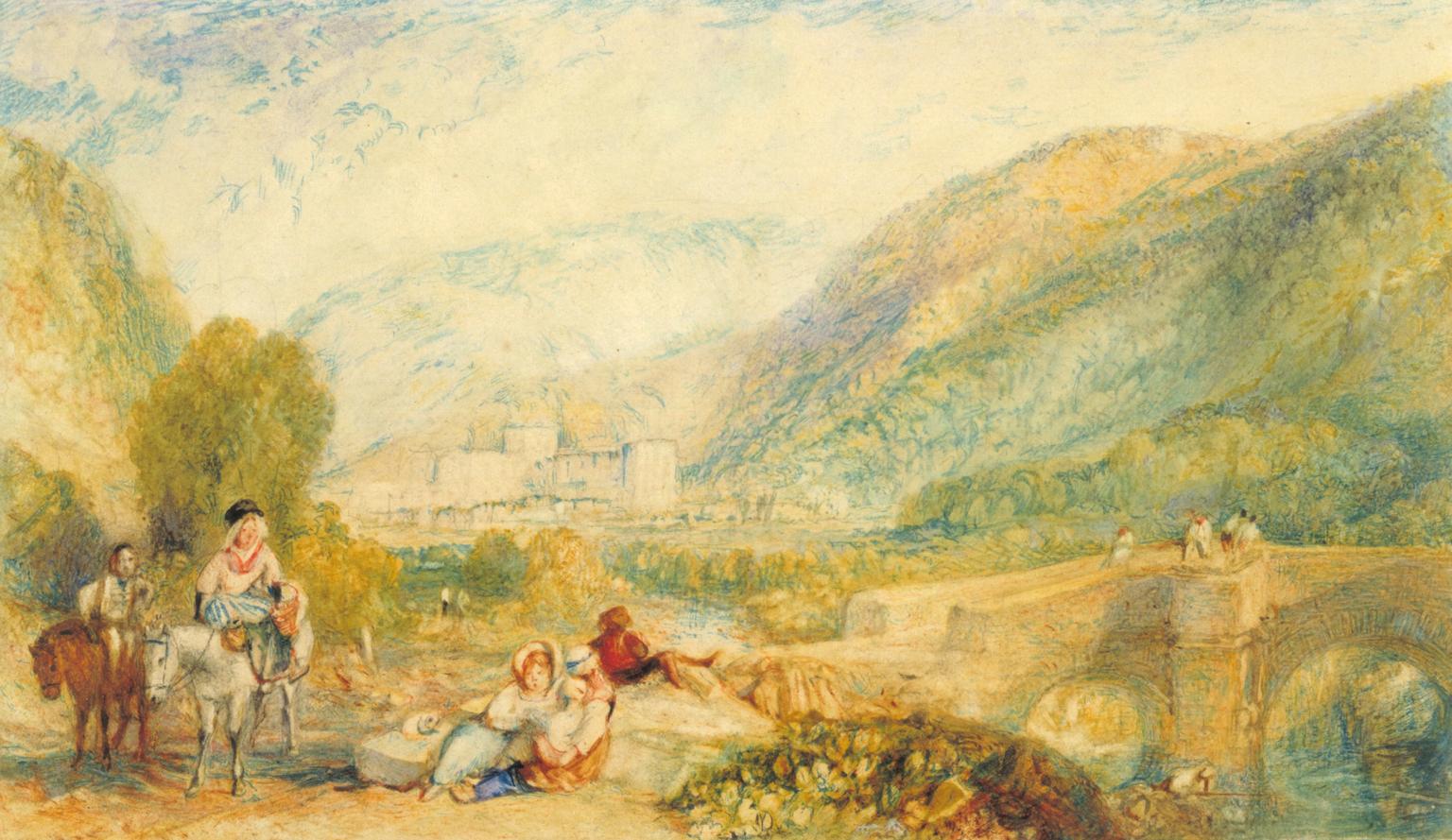
Joseph Mallord William Turner Rievaulx Abbey c.1834-6

Rievaulx Abbey c.1834–6
N05615
Watercolour on white wove paper, 121 x 206 mm
Bequeathed by Travers Buxton 1945
Provenance:
?Commissioned by London publishers Simpkin and Marshall, c.1834–6; ...; Mrs F. Hughes; ...; Travers Buxton (1865–1945), by whom bequeathed to the Tate Gallery
Engraved:
Engraving by J.C. Bentley, ‘RIEVAULX ABBEY, Yorkshire’, published 1836
This small watercolour shows Rievaulx Abbey, which is situated near Helmsley in North Yorkshire. Founded in 1131, the site was once considered one of England’s great abbeys, until it was seized as part of Henry VIII’s dissolution campaign in 1538. Its ruins are today in the care of English Heritage.
Rievaulx was a familiar subject for Turner, and depictions of the Abbey feature in two of the artist’s most celebrated projects, the Liber Studiorum and the Picturesque Views in England and Wales. See Matthew Imms’s detailed discussion of Turner and Rievaulx, including a list of related views, under Tate D09853 (Turner Bequest CXXXIV 55).
Here, the Abbey is hardly the focus of the composition: depicted in the middle distance, nestled at the foot of wooded hills, its architectural detail has been overlooked in favour of a hazy impression of the ruins in their wider setting. A group of figures, some on horseback, are prominent in the foreground. On the right is a stone bridge, which is absent from the earlier published views and associated sketches, although it was included in one study within the Devonshire Rivers, No.3, and Wharfedale sketchbook (D09877; Turner Bequest CXXXIV 75a), suggesting a possible direct connection between that design and the development of the present work.
Although originally published as an engraving in the Gallery of Modern British Artists with the explicit declaration that ‘Mr. Turner has furnished us with [this design] expressly for this work’, this sheet has repeatedly been associated with the artist’s various illustrations for Sir Walter Scott (1771–1832).1 There is particular stylistic resemblance between the present work and Turner’s view of Dryburgh Abbey (Tate N05241),2 for example, which was produced as an illustration for Scott’s Poetical Works around 1832.3 For an overview of the artist’s commissions for Scott, see Thomas Ardill’s section on the ‘Tour of Scotland for Scott’s Poetical Works 1831’ in this catalogue; and see the Introduction to the present single-work section for a general discussion of the Gallery of Modern British Artists publication, and the related dating of the present work.
The work’s full provenance remains to be confirmed. Andrew Wilton’s standard catalogue of Turner’s watercolours names only ‘Mrs. F. Hughes’ as an owner before its bequest to Tate in 1945 by Travers Buston,4 presumably the British anti-slavery campaigner and writer (1865–1945). Any link between the two owners and the dates of early transactions are as yet unclear.
1
See Wilton 1979, p.436 and Imms 2008, p.140 under no.51, for example.
2
Wilton 1979, p.428 no.1078, reproduced.
3
Lyles and Perkins, 1989, p.75 no.78.
4
Wilton 1979, p.436.
Verso:
Presumed blank; not examined out of frame.

Hayley Flynn
September 2025

How to cite

Hayley Flynn, ‘Rievaulx Abbey c.1834–6’, catalogue entry, September 2025, in David Blayney Brown (ed.), J.M.W. Turner: Sketchbooks, Drawings and Watercolours, Tate Research Publication, July 2026, https://www.tate.org.uk/art/research-publications/jmw-turner/rievaulx-abbey-r1214142, accessed 31 July 2026.