J.M.W. Turner: Sketchbooks, Drawings and Watercolours

ISBN 978-1-84976-386-8

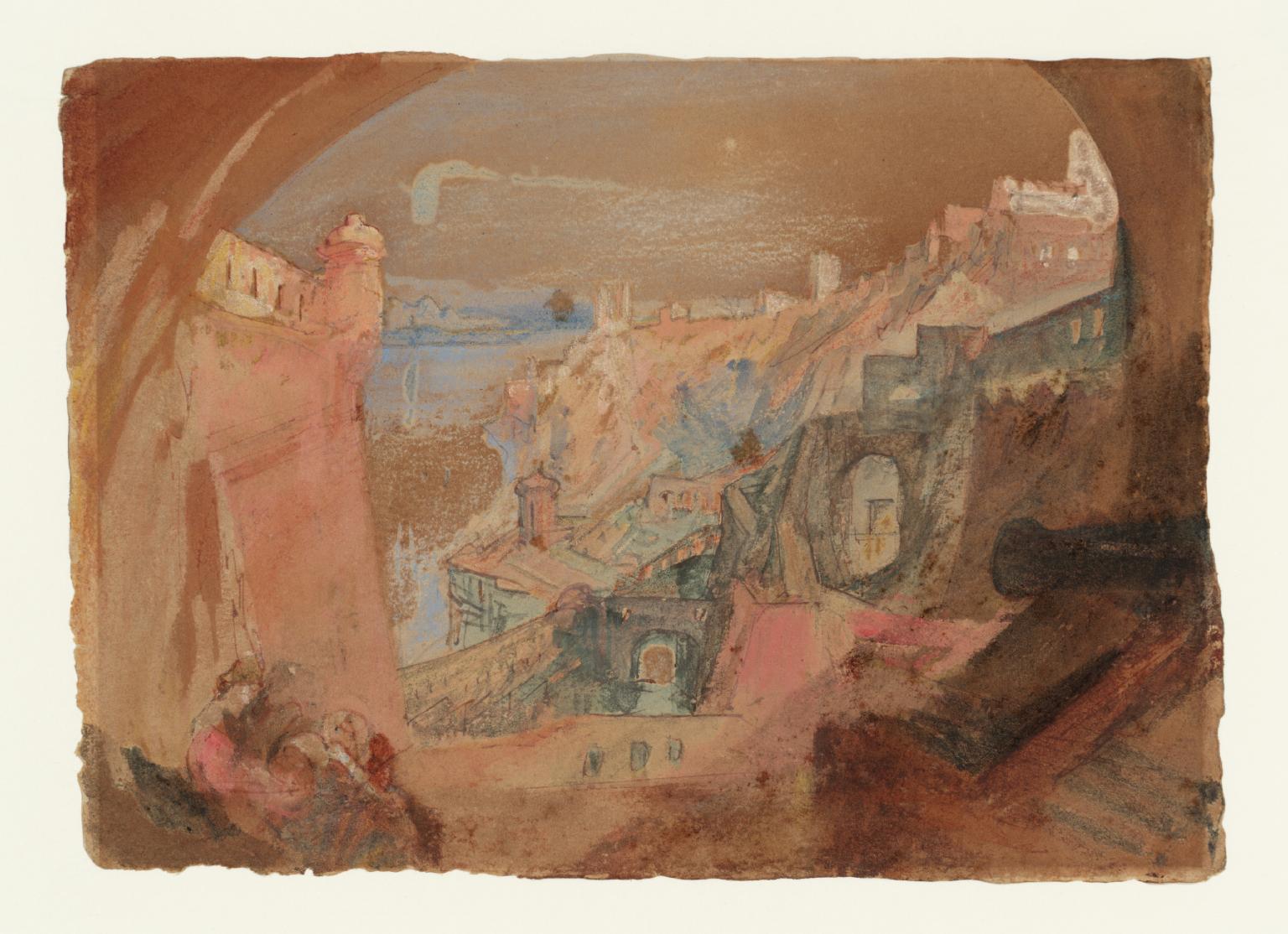
Joseph Mallord William Turner Sisteron: View from the Hilltop Ramparts 1838

Sisteron: View from the Hilltop Ramparts 1838
N05237
Watercolour on grey wove paper, 137 x 187 mm
Bequeathed by Beresford Rimington Heaton 1940
Provenance:
...; John Ruskin; bought by Ellen Heaton (1816–1894) through Vokins the art dealers at Ruskin’s sale, Christie’s, London, 15 April 1869 (23), auction price £60 18 shillings, or through Ruskin’s publisher George Allen; inherited by Heaton’s nephew Beresford Rimington Heaton (1863–1940)
This watercolour has traditionally been considered to show a view in Luxembourg, but, as Turner scholar Cecelia Powell stated in 1991, it ‘clearly depicts some other European city’.1 Confirming this, Turner scholar Ian Warrell has since identified the subject as Sisteron.2
The view appears to have been taken within the town’s hilltop complex of narrow streets and ramparts, with the citadel visible towards the top right of the composition. In the foreground on the left, a woman is seated, perhaps taking a moment to admire the view. The vivid colouring of this design, with its luminous pink and red tones juxtaposed against the pearly blue of the distant river, is consistent with several other colour studies associated with the 1838 tour (see, for example, the study of a coastal town, probably near Monaco, Tate D24707; Turner Bequest CCLIX 142).
The early history of the sheet, which is not part of the Turner Bequest, is yet to be firmly established. It was bequeathed to the Tate Gallery in 1940 by Beresford Rimington Heaton, a Yorkshire solicitor born in Leeds in 1863, along with seven other watercolours by Turner (see under N05239 for a list). B.R. Heaton was the nephew of Ellen Heaton (1816–1894), a well–known patron of the Pre–Raphaelites and friend to John Ruskin. It is recorded that amongst the numerous works by Turner that Ellen Heaton acquired, she bought ‘two sketches of Luxembourg’ (logically, and by the process of elimination, these would appear to be the present work under its former title, and N05240, which does indeed depict a view of Luxembourg); one of these was ‘bought (through [dealers] Vokins who paid £60 18s[hillings] for it) at Ruskin’s sale at Christie’s in April 1869’, and the other likely through Ruskin’s publisher ‘George Allen at some unknown date.’3
In his 1979 compilation of Turner’s watercolours, where Ellen Heaton is not mentioned, Andrew Wilton tentatively suggested that the present work may have belonged to the artist and collector Myles Birket Foster;4 however, as Cecilia Powell has observed: ‘it is evident from Edward Yardley’s 1988 account of Foster’s collection of Turner watercolours that this is not the case’.5 Powell concludes that the provenance cannot be traced back further than Beresford Rimington Heaton. However, in consideration of the aforementioned reference to Ellen Heaton’s purchase of the two Luxembourg designs, it is perhaps most likely that Beresford Rimington Heaton simply inherited his Turners from his aunt.
1
Powell 1991, p.183 note 127.
2
Note in Tate catalogue files 2011.
3
Surtees 1972, p.147; for one or the other, see Christie’s 1869, p.5 no.23.
4
Wilton 1979, p.421 no.1021.
5
Powell 1991, p.183 under no.127.
Technical notes:
The paint has been thickly applied in places, causing patches of water damage visible on the verso. The design has yellowed commensurately from prolonged early display except where the edges were protected by a mount.
Verso:
Blank

Hayley Flynn
September 2025

How to cite

Hayley Flynn, ‘Sisteron: View from the Hilltop Ramparts 1838’, catalogue entry, September 2025, in David Blayney Brown (ed.), J.M.W. Turner: Sketchbooks, Drawings and Watercolours, Tate Research Publication, July 2026, https://www.tate.org.uk/art/research-publications/jmw-turner/sisteron-view-from-the-hilltop-ramparts-r1213357, accessed 31 July 2026.