J.M.W. Turner: Sketchbooks, Drawings and Watercolours

ISBN 978-1-84976-386-8

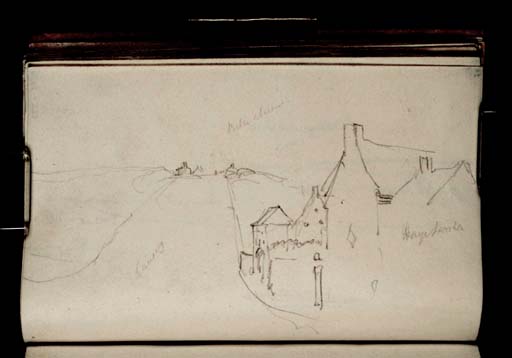
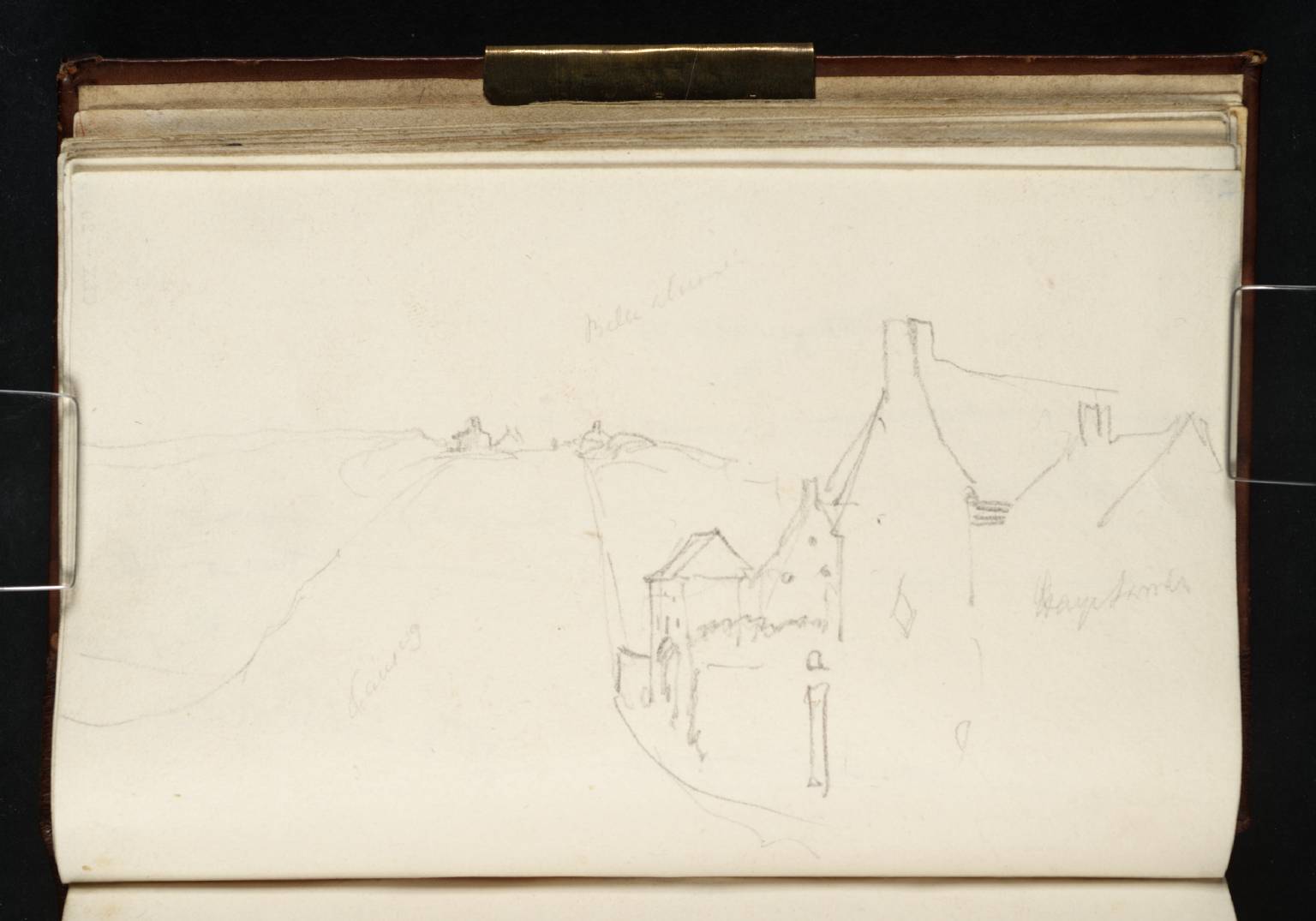
Joseph Mallord William Turner The Field of Waterloo from the North, with La Haye Sainte, and La Belle Alliance in the Distance 1817

Folio 20 Verso:
The Field of Waterloo from the North, with La Haye Sainte, and La Belle Alliance in the Distance 1817
D12739
Turner Bequest CLX 20a
Pencil on white wove paper, 150 x 94 mm
Inscribed by Turner in pencil ‘Causeway’ below left of centre ascending diagonally, ‘Belle Alliance’ top centre, and ‘Haye Sainte’ at right, across buildings
 
Accepted by the nation as part of the Turner Bequest 1856
For Turner at Waterloo in 1817 see Introduction to this sketchbook and notes to folio 16 verso (D12731).
This view, drawn with the page turned horizontally and looking south along the road across the field, takes in two buildings that played pivotal roles in the battle in 1815. In the right foreground is La Haye Sainte, with its farmhouse, barn and roadside wall with a gate into its yard. Lying only about 200 yards (around 180 metres) below the British line along the ridge to the north, the farm was strategically important to both sides. Wellington entrusted its defence to a detachment of the King’s German Legion, and Napoleon ordered Marshal Ney to capture it. The Legion held out for much of the day but by evening, after repeated attacks, it was cut off, most of the men were dead and the survivors were running out of ammunition. When the French eventually took it, only thirty–nine of the original garrison of 360 were still alive. For the farm’s use afterwards as a field hospital see notes to folio 21 recto opposite (D12740), where Turner has drawn the buildings from the opposite direction, looking north.
In the distance on the horizon is the inn, La Belle Alliance. The French had advanced northwards from this direction and Napoleon had observed the British lines from near the inn during the morning and later in the day. In the early afternoon, seventy–four French guns positioned in front of it had launched a simultaneous cannonade on Wellington’s army – devastating, but not the knockout blow Napoleon had intended. After the allied victory, when Wellington and the Prussian commander Gebhard von Blücher met there, Blücher suggested naming the battle after the inn (called La Belle Alliance following its owner’s profitable marriage) to celebrate their own collaboration. Wellington preferred Waterloo, while at least one subsequent depiction of the inn shows its sign with the additional flattering name ‘Wellington Hotel’.1 For a closer view of the inn, see folio 22 verso (D12743).

David Blayney Brown
June 2025

1
George Cruikshank, Historical Account of the Battle of Waterloo, London 1817.

How to cite

David Blayney Brown, ‘The Field of Waterloo from the North, with La Haye Sainte, and La Belle Alliance in the Distance 1817’, catalogue entry, June 2025, in David Blayney Brown (ed.), J.M.W. Turner: Sketchbooks, Drawings and Watercolours, Tate Research Publication, June 2026, https://www.tate.org.uk/art/research-publications/jmw-turner/the-field-of-waterloo-from-the-north-with-la-haye-sainte-and-la-belle-alliance-in-the-r1212107, accessed 01 August 2026.