J.M.W. Turner: Sketchbooks, Drawings and Watercolours

ISBN 978-1-84976-386-8

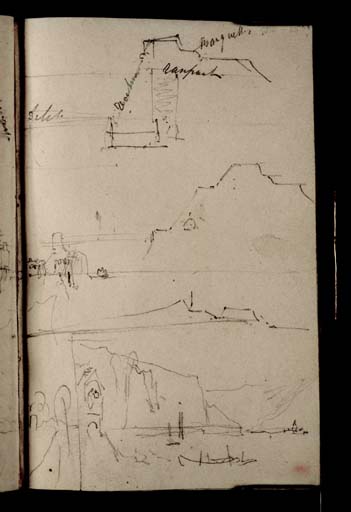
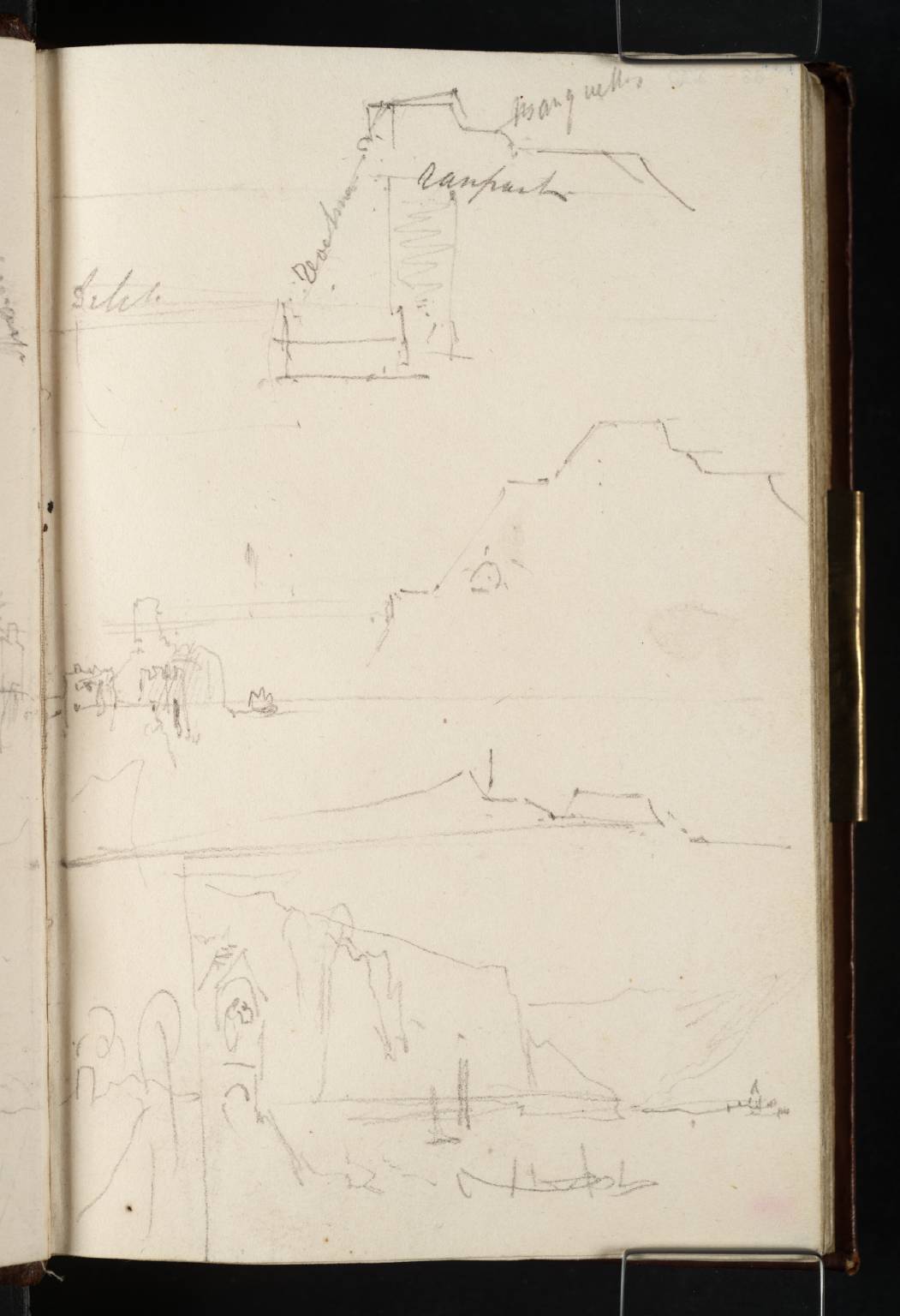
Joseph Mallord William Turner Two Cross-Sections of Fortifications; 'The Brothers'; Continuation of a Village Street (?Oberwesel); the Rhine Riverside, with a Wayside Shrine 1817

Folio 91 Verso:
Two Cross–Sections of Fortifications; ‘The Brothers’; Continuation of a Village Street (?Oberwesel); the Rhine Riverside, with a Wayside Shrine 1817
D12875
Turner Bequest CLX 89a
Pencil on white wove paper, 150 x 94 mm
Inscribed by Turner in pencil (see main catalogue entry)
 
Accepted by the nation as part of the Turner Bequest 1856
These sketches of various subjects, seemingly drawn at different times with the page inverted relative to the sketchbook’s foliation and not all precisely identifiable, extend across folio 92 recto opposite (D12876; Turner Bequest CLX 90).
Most problematic are the fortifications at the top, presumably the same as those shown in a ground–plan on folio 93 verso (D12879; Turner Bequest CLX 91a). Cecilia Powell described them as ‘illustrating the art of fortification’ rather than representing any specific castle or site, and categorically dismissed them as ‘not by Turner’.1 This assertion seems questionable as annotations to the ground–plan appear to be in his hand. Powell rightly stated that the reference on the verso of the opposite page (D12877; Turner Bequest CXL 90a) to Alois Schreiber’s newly–published guidebook to the Rhineland is not written by Turner. Presumably someone Turner met while sketching or where he was staying helpfully wrote down the details in German. But it is hard to imagine him allowing anyone to draw in his sketchbook.
If these sections and ground–plans are by Turner, the question arises as to whether he was drawing on–site or, at some point, copying from an illustrated manual on fortification so he could understand the defences of the castles he saw along the Rhine. James Hamilton, who accepted these drawings as autograph, saw them as examples of Turner’s longstanding interests in architecture and technology, so carefully drawn on the spot as to risk arrest as a spy.2
Unfortunately, there is nowhere on the Rhine called ‘Laurenstein’, Hamilton’s preferred reading, taken from Finberg, of Turner’s inscriptions ‘Lavenstein’ on D12876 opposite and folio 93 recto (D12879; Turner Bequest CLX 91). By these Turner means Burg Liebenstein, one of the two Bruderburgen (‘Brothers’) seen at the centre left here, extending onto D12876. Perhaps it also applies to the cross–sections here. But the castle shown three times on folio 92 verso (D12877; Turner Bequest CLX 90a), with historic buildings at Oberwesel below its ramparts, is the Schönburg, and Oberwesel itself is surrounded by defensive walls and towers.

David Blayney Brown
July 2025

1
Powell 1991, p.200.
2
James Hamilton, Turner and the Scientists, exhibition catalogue, Tate Gallery, London 1998, p.36.

How to cite

David Blayney Brown, ‘Two Cross–Sections of Fortifications; ‘The Brothers’; Continuation of a Village Street (?Oberwesel); the Rhine Riverside, with a Wayside Shrine 1817’, catalogue entry, July 2025, in David Blayney Brown (ed.), J.M.W. Turner: Sketchbooks, Drawings and Watercolours, Tate Research Publication, June 2026, https://www.tate.org.uk/art/research-publications/jmw-turner/two-cross-sections-of-fortifications-the-brothers-continuation-of-a-village-street-r1212247, accessed 31 July 2026.