J.M.W. Turner: Sketchbooks, Drawings and Watercolours

ISBN 978-1-84976-386-8

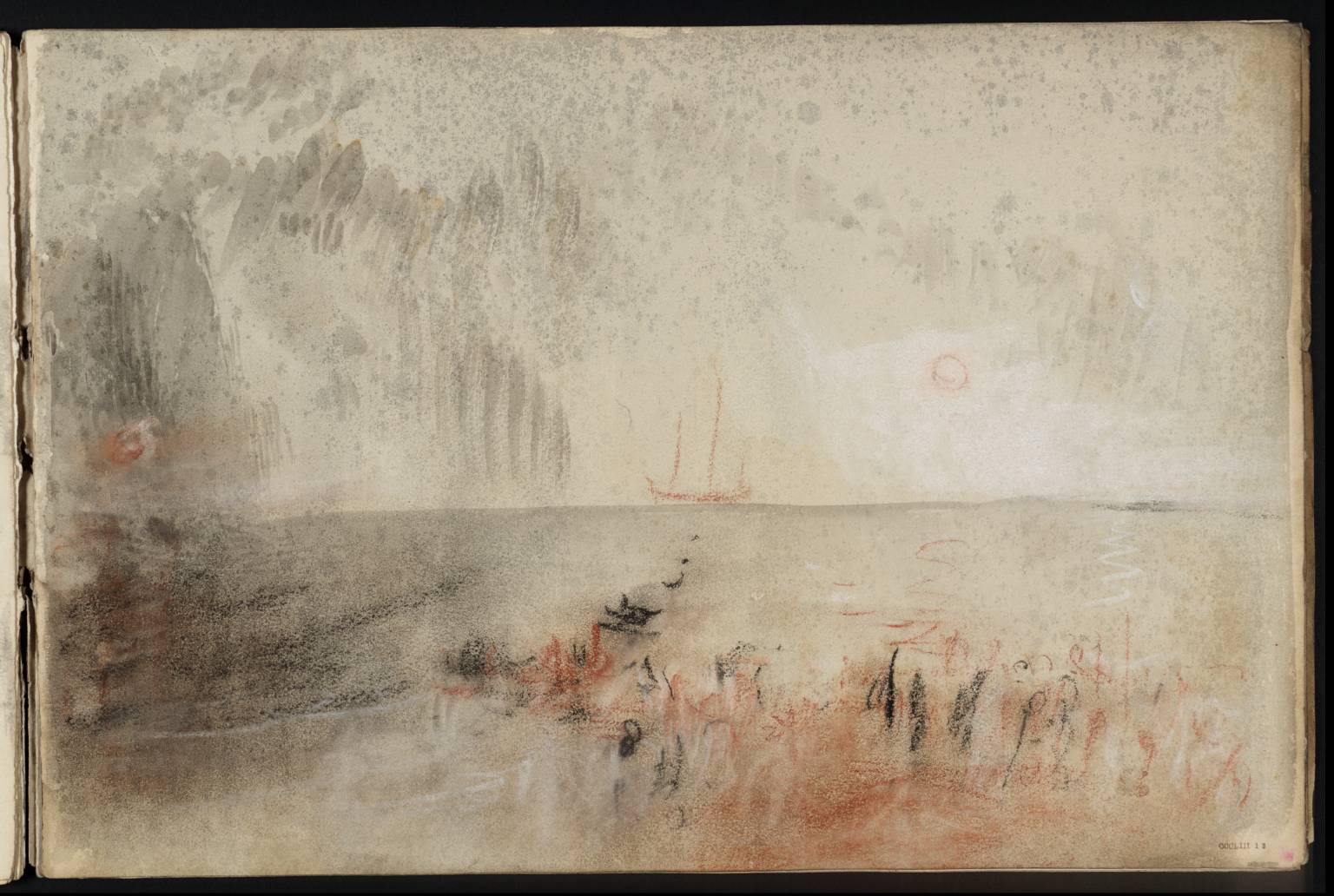
Joseph Mallord William Turner Whalers at Sea c.1845

Whalers at Sea c.1845
D35252
Turner Bequest CCCLIII 13
Chalk and watercolour on white wove paper prepared with a grey wash, 221 x 331 mm
Blind-stamped with Turner Bequest monogram bottom right
Inscribed in red ink ‘13’ bottom right (now much smudged)
Stamped in black ‘CCCLIII 13’ bottom right
Accepted by the nation as part of the Turner Bequest 1856
In this swiftly made sketch depicting a vessel at sea and a throng of figures in the foreground, Turner appears to be experimenting with the placing of the sun and moon. On the left-hand side the sun can be seen setting through dark clouds and sheets of rain while on the right, an area of white chalk hosts a circle that may also be the sun; to the right of this the small, inverted comma of white chalk might read as the moon, its reflection zigzagging on the sea below. It is clear, therefore, that Turner was envisaging the close of day, and possibly the end of a working day at sea for the figures in the foreground.
Given that several other sketches from the Whalers book are known to represent whaling scenes, these figures may well be whalers and the vertical lines their mast and oars. Barry Venning suggests that this sketch is related to the painting Hurrah! for the Whaler Erebus! Another Fish!, which Turner showed at the Royal Academy in 1846 (Tate N00546),1 and that the hurriedly drawn figures appear to be shouting ‘hurrah!’, as in the painting.2 With this interpretation in mind, it is possible that Turner intended the juxtaposition of light and dark and weather conditions to reflect the change of pace in the whaling process: the frenzied chase is over and the storm clouds departed, ushering in calmer conditions and a sense of triumph amongst the whalers at the successful chase and capture of a whale. As discussed in this sketchbook’s Introduction, Turner is known to have read accounts of whaling that describe in detail the perilous and gruesome process of hunting whales.
Robert K. Wallace has suggested that ‘among the men in the foreground are several penguins’.3
1
Butlin and Joll 1984, pp.267–8 no.423, pl.426 (colour).
2
Venning 1985, p.75; see also Hokanson 2016, p.33.
3
Wallace 1988, p.30.
Technical Notes:
In common with others in this sketchbook, the leaf is loose of its binding. Spots of the pigment used to prepare the ground have formed; this is particularly prominent in the upper area of the page and likely to be the result of damage in the Tate Gallery flood of 1928.
In the aftermath of that event, this page was carefully blotted with a sheet of white paper, leaving a faint mirror-image offset of the distant ship and some details from the foreground on Tate D40534, one of a small number of such sheets to have been preserved.
Verso:
Blank; some discolouration and offsetting in black chalk.

Amy Concannon
May 2025

How to cite

Amy Concannon, ‘Whalers at Sea c.1845’, catalogue entry, May 2025, in David Blayney Brown (ed.), J.M.W. Turner: Sketchbooks, Drawings and Watercolours, Tate Research Publication, July 2026, https://www.tate.org.uk/art/research-publications/jmw-turner/whalers-at-sea-r1214160, accessed 11 July 2026.