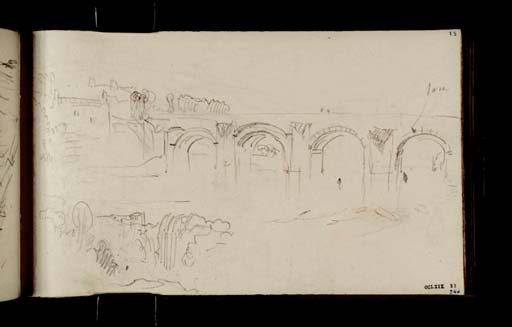
Joseph Mallord William Turner Bothwell Bridge over the River Clyde, Lanarkshire 1834
Image 1 of 2
Joseph Mallord William Turner,
Bothwell Bridge over the River Clyde, Lanarkshire
1834
Joseph Mallord William Turner 1775–1851
Folio 33 Recto:
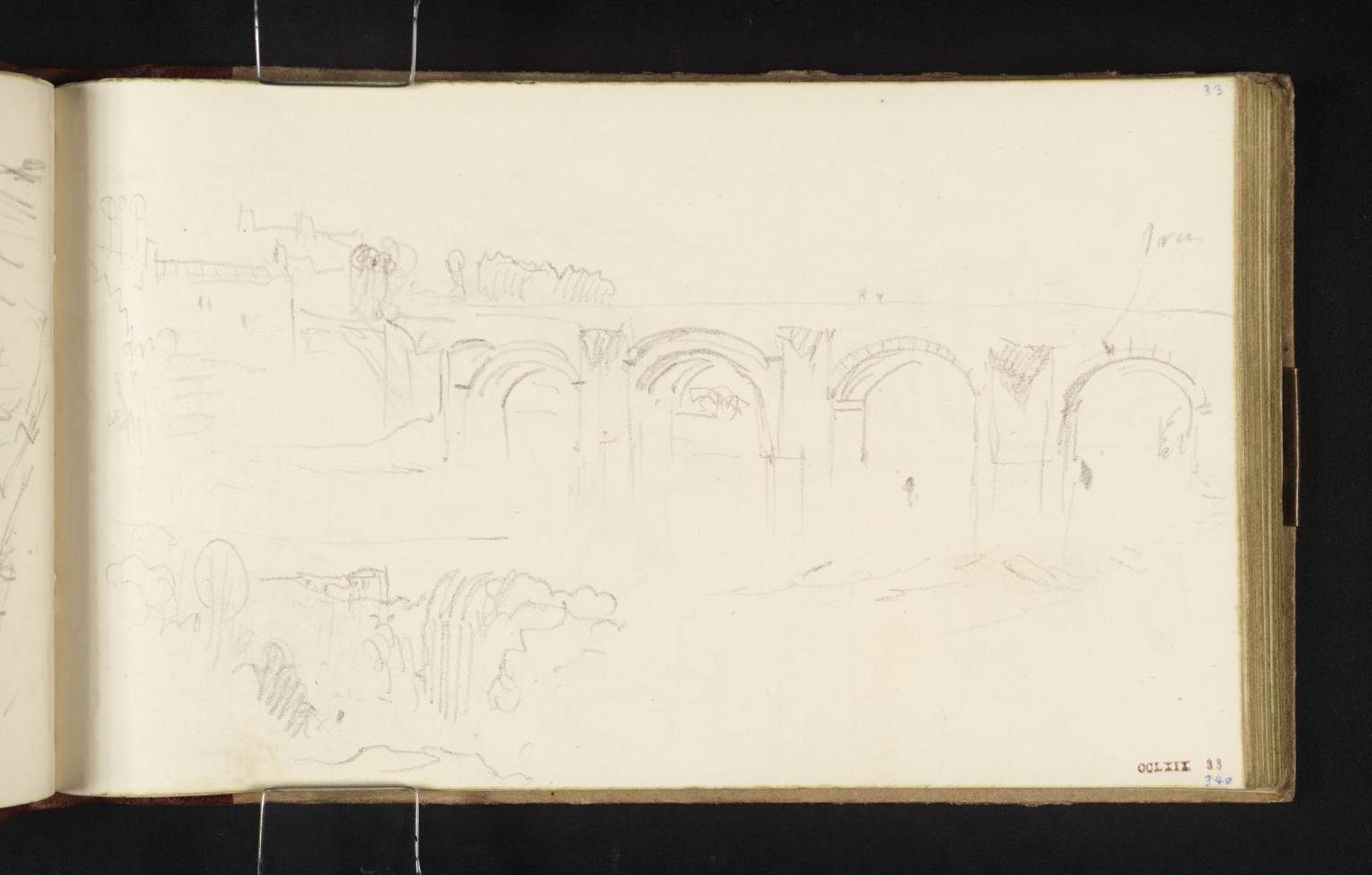
Bothwell Bridge over the River Clyde, Lanarkshire 1834
D26323
Turner Bequest CCLXIX 33
Pencil on off-white wove paper, 113 x 190 mm
Inscribed in pencil by Turner ‘Iron’ upper right
Inscribed in blue ink by John Ruskin ‘33’ top right and ‘340’ bottom right
Stamped in black ‘CCLXIX 33’ bottom right
Inscribed in pencil by Turner ‘Iron’ upper right
Inscribed in blue ink by John Ruskin ‘33’ top right and ‘340’ bottom right
Stamped in black ‘CCLXIX 33’ bottom right
Accepted by the nation as part of the Turner Bequest 1856
References
1909
A.J. Finberg, A Complete Inventory of the Drawings of the Turner Bequest, London 1909, vol.II, p.865, CCLXIX 33, as ‘Bridge.’.
1990
Dr David Wallace-Hadrill and Janet Carolan, ‘Turner’s Sketches North of Stirling’, Turner Studies: His Art and Epoch 1775 – 1851, Vol.10 No.1, Summer 1990, p.12.
From the southern bank of the River Clyde, just to the west of Bothwell Bridge, this view looks north across the water towards the four-arch bridge and the town of Bothwell. In this, his penultimate sketch of the bridge, Turner has begun to introduce human presence, indicating two insect-like figures standing on the bridge (above the second arch to the right), and a figure under each of the two right-hand arches, who are presumably, like the figures on folio 33 verso (D26324), fishing. Turner has also, in this sketch, taken more interest in visual details such as the brickwork of the arches and the triangular buttresses. An arrow with an inscription above the right-hand arch may read ‘Iron’. The bridge now has cantilevered iron parapets on both sides, but these do not seem to be present and may not have been added until the improvements in 1871.1 A modern photograph, however, also reveals an iron plate and an iron pipe at this point above the arch. It may be to one of these that the inscription refers. Further incidents of human activity and architectural details are included in Turner’s sketch of the bridge on the reverse of this page (folio 33 verso; D26324).
At the bottom left of the page is a sketch of a house above a hilly riverbank. This is probably a continuation of the left side of the view of the sketch above.
For more information about Turner’s visit to Bothwell, see folio 31 (D26319).
Thomas Ardill
October 2010
How to cite
Thomas Ardill, ‘Bothwell Bridge over the River Clyde, Lanarkshire 1834 by Joseph Mallord William Turner’, catalogue entry, October 2010, in David Blayney Brown (ed.), J.M.W. Turner: Sketchbooks, Drawings and Watercolours, Tate Research Publication, December 2012, https://www