
Joseph Mallord William Turner A View or Views of a Town 1845
Joseph Mallord William Turner,
A View or Views of a Town
1845
Folio 12 Recto:
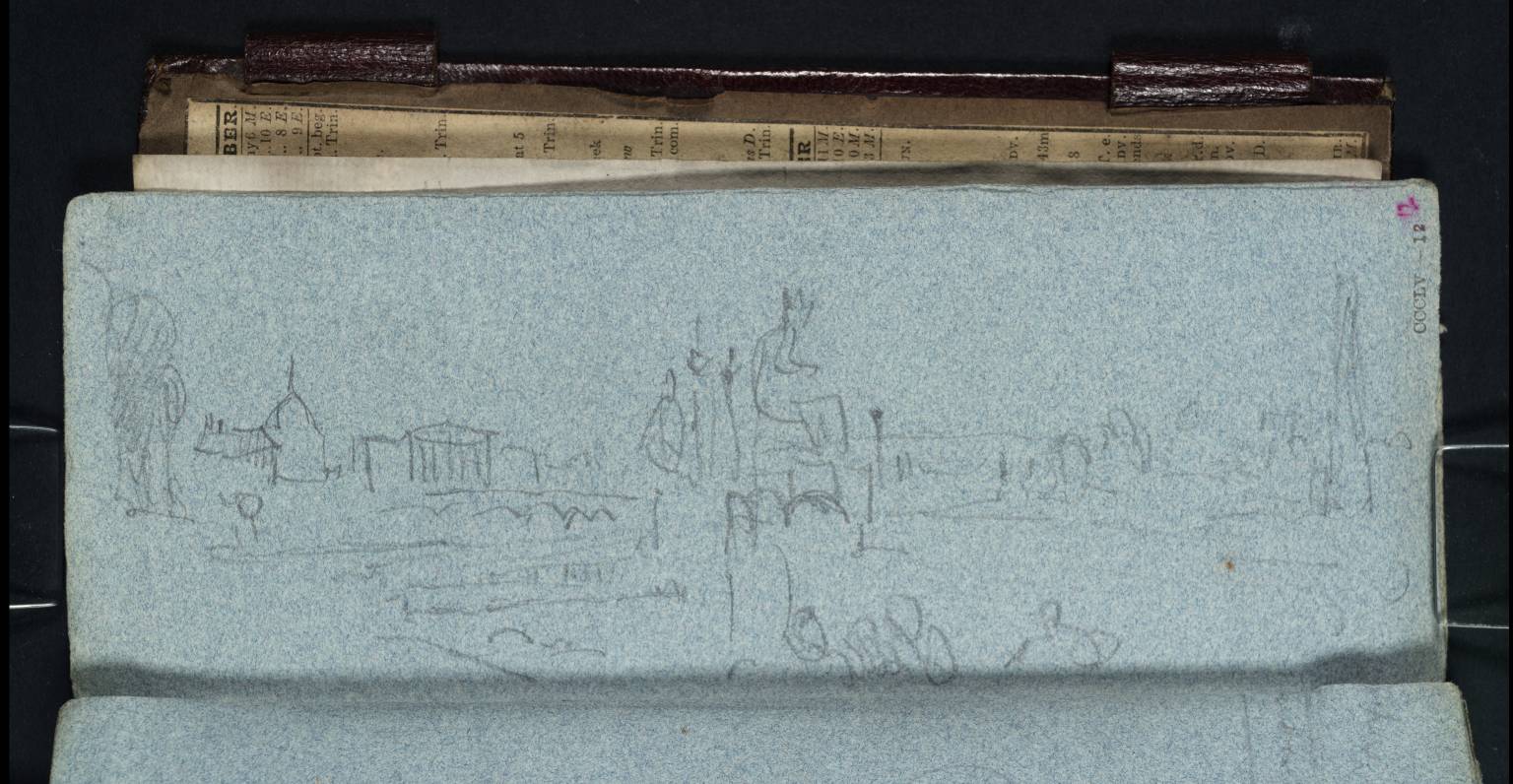
The Place de la Concorde, Paris, with the Luxor Obelisk, the Statue of Marseille in the Foreground, and the Palais Bourbon and Les Invalides across the River Seine to the South-West c.1845
D35356
Turner Bequest CCCLV 12
Chalk and pencil on blue wove paper, 70 x 186 mm
Inscribed by John Ruskin in red ink ‘12’ top right, ascending vertically
Stamped in black ‘CCCLV–12’ top right, ascending vertically
Inscribed by John Ruskin in red ink ‘12’ top right, ascending vertically
Stamped in black ‘CCCLV–12’ top right, ascending vertically
Accepted by the nation as part of the Turner Bequest 1856
References
1909
A.J. Finberg, A Complete Inventory of the Drawings of the Turner Bequest, London 1909, vol.II, p.1165, CCCLV 12, as ‘View of town’.
1838
Ian Warrell, Turner’s Sketchbooks, London 2014, p.12, as ‘The Place de la Concorde, with the Luxor Obelisk; the Assemblé Nationale and the dome of Les Invalides on the left’, from ‘the so-called Hythe and Walmer sketchbook’, c.1838–44.
The drawing has been produced with the page turned horizontally. This is a sketch of an urban view, related to the less developed sketch on folio 11 verso opposite (D35355), which may be a continuation to the right.
The sketches represent a puzzling and significant anomaly among those of coastal scenery, long identified as in Kent. Shortly after the present sketchbook was originally catalogued for online publication in 2013, Ian Warrell reproduced this page as a French subject, ‘The Place de la Concorde, with the Luxor Obelisk; the Assemblé Nationale and the dome of Les Invalides on the left’, dating it to c.1838–44 and suggesting it was ‘Turner’s last view of Paris’.1 He compared the view with one looking from the Tuileries Gardens in the 1832 Paris and Environs sketchbook (Tate D24177; Turner Bequest CCLVII 6), to which the left-hand half of the present sketch corresponds.
The Napoleonic portico of what was originally the Palais Bourbon, which housed the Chamber of Deputies in Turner’s time and now the National Assembly, overlooks the River Seine, with the dome of Les Invalides aligned a considerable distance beyond to its south-south-west. Dominating the foreground is the stone statue representing the city of Marseille, a crowned woman seated upon a freestanding pavilion. By Pierre Petitot, it is one of eight such figures representing provincial cities which were installed in the square in 1838,2 the year of the printed ‘Almanack’ pasted inside the front of this sketchbook. The loosely indicated vertical feature towards the right is likely the Luxor Obelisk, transported from Egypt as a diplomatic gift in 1833 and installed as the square’s centrepiece in 1836.3
The specific year of the current sketch and that opposite has yet to be firmly established. As set out in other sections of the present catalogue, in 1839 Turner’s second ‘Meuse-Moselle’ tour did not extend far into north-eastern France, and in 1840 his round trip to Venice did not include France at all. Apart from incidental views across the frontier along Lake Geneva, there are no identified French subjects associated with the four tours Swiss between 1841 and 1844, when Turner seems to have travelled north and south largely along the River Rhine. In 1845, he made his two brief final Continental tours, to northern France. That autumn, the identified views furthest inland were at Abbeville, only about twelve miles from the coast; see the small Dieppe and Kent sketchbook (Tate D35571, D35586; Turner Bequest CCCLXI 48, 56a). A scrawled note elsewhere in that book (D35530; CCCLXI 25) may include the crossed-out word ‘Paris’, and such an excursion may have been beyond him as his health faltered at the age of seventy.
In 1838, however, Turner was still undertaking lengthy, arduous expeditions The recently established tour to the South of France in that year is addressed in this catalogue by Hayley Flynn. It appears to have begun in earnest in Paris, albeit the only evidence is a brief itinerary between there and Marseille, transcribed in A.J. Finberg’s Inventory of the Turner Bequest from the original rear paste-down of the Orleans to Marseilles sketchbook (Tate D41000),4 but apparently lost or pasted over in the wake of the 1928 Tate Gallery flood.
It is unclear whether it was by accident or design that Turner drew the brand-new symbolic statue of Marseille as he set out from Paris for the south (the return route has yet to be fully established). Pending detailed research to confirm the circumstances of the two drawings here and the implications for dating others in this sketchbook, they remain placed at around 1845, so as not to disrupt the book’s established chronological place within the present catalogue.
Alice Rylance-Watson
February 2013
Revised by Matthew Imms
September 2025
See ‘Marseille, Statue en pierre Place de la Concorde, France’, around.us, accessed 4 September 2025, https://fr.aroundus.com/p/7459633-marseille .
‘The Luxor Obelisk, Paris’, World in Paris, accessed 4 September 2025, https://worldinparis.com/the-luxor-obelisk-in-paris .
How to cite
Alice Rylance-Watson, ‘The Place de la Concorde, Paris, with the Luxor Obelisk, the Statue of Marseille in the Foreground, and the Palais Bourbon and Les Invalides across the River Seine to the South-West c.1845’, catalogue entry, February 2013, revised by Matthew Imms, September 2025, in David Blayney Brown (ed.), J.M.W. Turner: Sketchbooks, Drawings and Watercolours, Tate Research Publication, June 2013, https://www
