Joseph Mallord William Turner Boats Moored off the Bollwerk and Great St Martin Church, Cologne, from the Rhine Riverfront near the Kostgassen- or Trankgassentor; Deutz Abbey on the Opposite Bank; the Overall View Upstream 1825
Image 1 of 2
-
Joseph Mallord William Turner, Boats Moored off the Bollwerk and Great St Martin Church, Cologne, from the Rhine Riverfront near the Kostgassen- or Trankgassentor; Deutz Abbey on the Opposite Bank; the Overall View Upstream 1825 -
Joseph Mallord William Turner, Boats Moored off the Bollwerk and Great St Martin Church, Cologne, from the Rhine Riverfront near the Kostgassen- or Trankgassentor; Deutz Abbey on the Opposite Bank; the Overall View Upstream 1825 (Enhanced image)Enhanced image
Joseph Mallord William Turner,
Boats Moored off the Bollwerk and Great St Martin Church, Cologne, from the Rhine Riverfront near the Kostgassen- or Trankgassentor; Deutz Abbey on the Opposite Bank; the Overall View Upstream
1825
Joseph Mallord William Turner 1775–1851
Folio 164 Verso:
Boats Moored off the Bollwerk and Great St Martin Church, Cologne, from the Rhine Riverfront near the Kostgassen- or Trankgassentor; Deutz Abbey on the Opposite Bank; the Overall View Upstream 1825
D19165
Turner Bequest CCXIV 164a
Pencil on white wove paper, 95 x 155 mm
Inscribed by Turner in pencil ‘[S...]’ top right
Accepted by the nation as part of the Turner Bequest 1856
References
1909
A.J. Finberg, A Complete Inventory of the Drawings of the Turner Bequest, London 1909, vol.II, p.657, CCXIV 164a, as ‘Do.’ (i.e. ditto: ‘Various buildings, &c.’).
1991
Cecilia Powell, Turner’s Rivers of Europe: The Rhine, Meuse and Mosel, exhibition catalogue, Tate Gallery, London 1991, pp.45, 61 note 38.
1995
Cecilia Powell, Turner in Germany, exhibition catalogue, Tate Gallery, London 1995, pp.34, 77 note 20, 78 note 23.
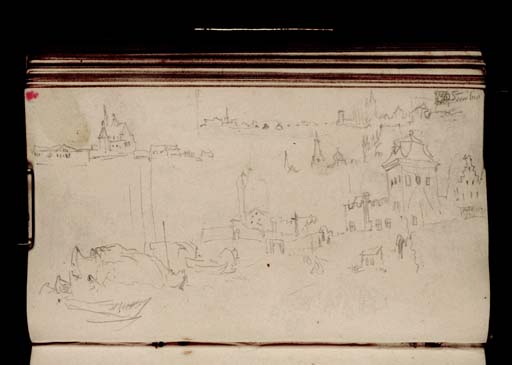
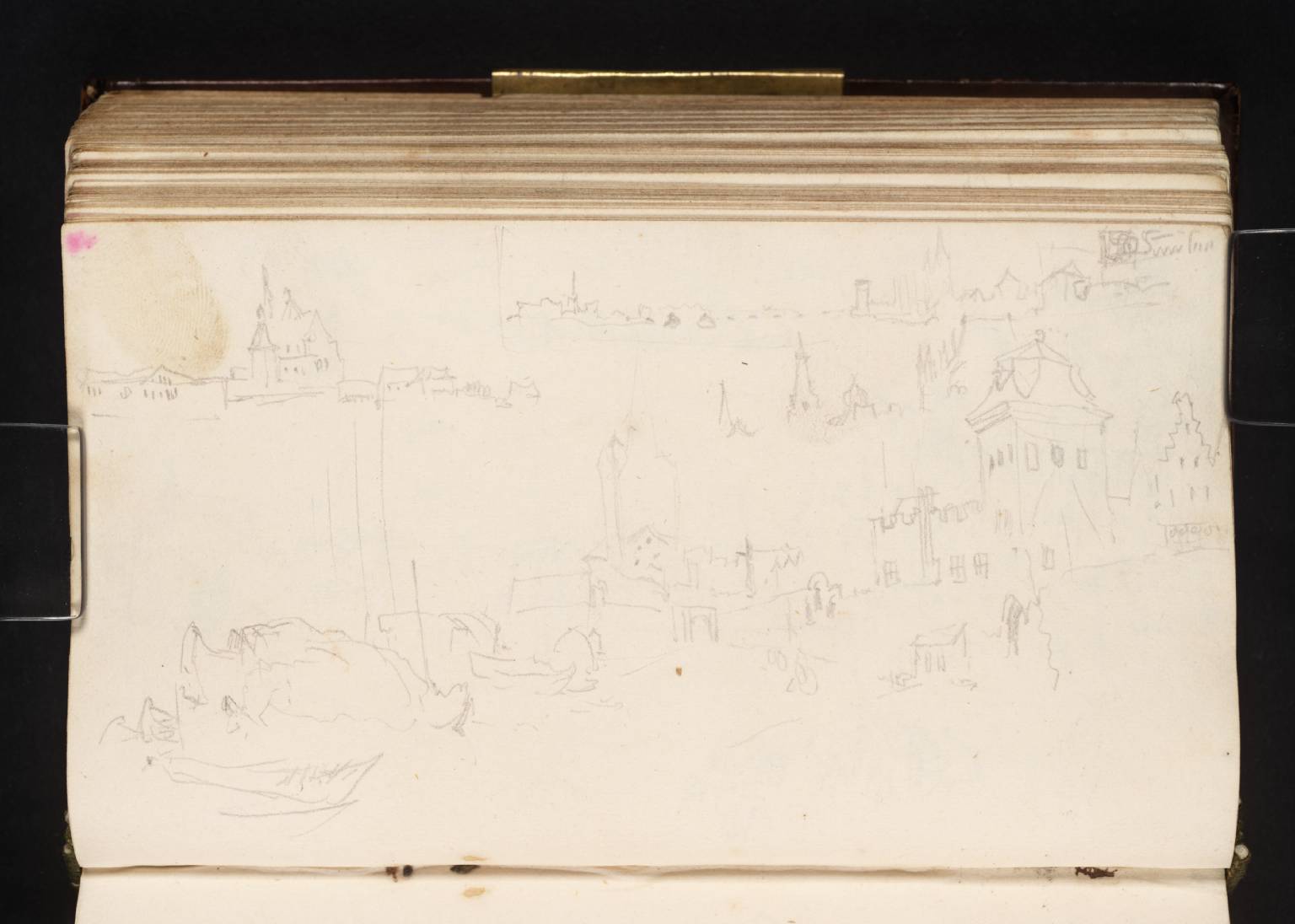
With the page turned horizontally, there are four interrelated sketches, looking south along the west bank of the River Rhine at Cologne towards the spire and pinnacles of the Great St Martin Church. Falling within a long sequence subsequently made at Liège (see under folio 155 verso; D19147), and several leaves on from the main run of Cologne views in this sketchbook (see under folio 141 recto; D19118), the subject was overlooked by Finberg1 and later scholars, until Cecilia Powell2 linked it to the large oil painting Cologne, the Arrival of a Packet Boat. Evening, exhibited at the Royal Academy in 1826 (Frick Collection, New York).3 The relationship is close, albeit with a crowded passenger vessel taking the place of the largest cargo craft on the left here.
Powell observed that the painting was ‘based – both in its general plan and some of its specific details – upon recent sketches of that city’ in this sketchbook;4 see also folios 142 verso and 143 recto (D19121–D19122), respectively a study of moored boats and two variant views, and folio 149 recto (D19134), which relates to the central part of the composition. She noted that ‘they do not, however, include such a detailed depiction of the buildings on the far right as one of Turner’s large sketches of 1817 ([Rhine sketchbook: Tate D12983; Turner Bequest] CLXI 54r) which he must surely have consulted.’5 The tower with the distinctive mansard roof in the foreground here is a lost gateway east of Cologne Cathedral (out of sight to the right). It was identified by Butlin and Joll6 as ‘the Kostgassepforte gate’ (or Kostgassentor in some sources) in relation to the painting, where it again appears towards the foreground. Other sources place it immediately north of the Frankenturm, as seen in old engravings, referring to it as the Trankgassentor, Kostgasse and Trankgasse being neighbouring streets between the cathedral and the river.7 It is seen across the Rhine in the contemporary Holland, Rhine and Cologne sketchbook (Tate D19508; Turner Bequest CCXV 65a).
The Frankenturm itself had been largely demolished in 1823, as noted in the caption inscribed below a detailed 1822 watercolour elevation of the tower by Heinrich Oedenthal (Rheinisches Bildarchiv, Cologne). Nevertheless, in Turner’s 1826 painting, it rises prominently between the church and the nearer tower. The main view here includes three statues in niches rising just clear of the top of the adjacent walls, corresponding with those shown on the river frontage of the intact tower in Oedenthal’s watercolour. Powell’s supposition about Turner’s referring to D12983, the heavily stained 1817 drawing, while working on the painting is thus evidently correct, not only in terms of the greater detail it furnished but also the range of buildings it shows as they had then stood; presumably he nevertheless included the picturesque Frankenturm as an echo of the soaring church tower.
At the top left, looking east over the Rhine from the same point, Deutz Abbey is seen. It was reached by the bridge of boats which was then the only crossing; see under folio 154 verso (D19145). The narrow sketch at the top (outer) edge reprises the whole scene, bringing both banks into their overall spatial relationship as seen in the painting, and linked by a row of short dashes to indicate the bridge. The slender Bayenturm tower is shown upriver at the centre of this thumbnail composition, just as it is, albeit less conspicuously, in the painting; below is a detail of spires and roofs.
The defensive Rheinmauer walls and most of the remaining towers were demolished later in the nineteenth century. The section towards the church is marked on maps of the time as the Bollwerk, with a large, turreted bastion on a shallow half-hexagon plan jutting out into the river on the near side of the church, as seen at the centre of the main view. Butlin and Joll described the adjacent rusticated Baroque archway as at ‘the entrance to the Zollstrasse’,8 no longer extant but noted in old guidebooks as leading west to the Alter Markt. It is unclear from earlier maps whether it had a specific name; Turner made a written note of various gateways and wharves on folio 140 verso (D19117). See under D19122 for further discussion of the painting and its composition.
Despite nineteenth-century redevelopment, substantial damage during the Second World War and later bridges, some features of Cologne’s main river prospects, including St Martin’s, remain recognisable, but this one is otherwise totally changed. The walls and gate survived long enough, with further renovations and alterations, to be the subject of a stereoscopic photograph by William England from a similar viewpoint, Tour de l’Eglise St. Martin à Cologne, from an 1867–8 series of Views of the Rhine and its Vicinity / Der Rhein und seine Umgebungen.9
Martin Butlin and Evelyn Joll, The Paintings of J.M.W. Turner, revised ed., New Haven and London 1984, pp.141–3 no.232, pl.235 (colour), pp.141–3 no.232, pl.235 (colour).
See notes and paintings reconstructing various fortifications lined to interactive map of ‘Köln – Große Stadtmauer 1180 bis 1881’, Siegfried Glos, Das alte Köln, accessed 17 June 2020, https://www.das-alte-koeln.de/online-fuhrung.html .
One of various subjects from the series in the Rijksmuseum, Amsterdam, Rijksmuseum, accessed 23 June 2020, https://www.rijksmuseum.nl/nl/collectie/RP-F-F13650 .
Technical notes:
There is a prominent oily finger print at the top left corner, doubtless evidence of this page’s being referred to in relation to the painting discussed above; there is some offsetting to folio 165 recto opposite (D19166).
Matthew Imms
September 2020
How to cite
Matthew Imms, ‘Boats Moored off the Bollwerk and Great St Martin Church, Cologne, from the Rhine Riverfront near the Kostgassen- or Trankgassentor; Deutz Abbey on the Opposite Bank; the Overall View Upstream 1825 by Joseph Mallord William Turner’, catalogue entry, September 2020, in David Blayney Brown (ed.), J.M.W. Turner: Sketchbooks, Drawings and Watercolours, Tate Research Publication, March 2023, https://www