J.M.W. Turner
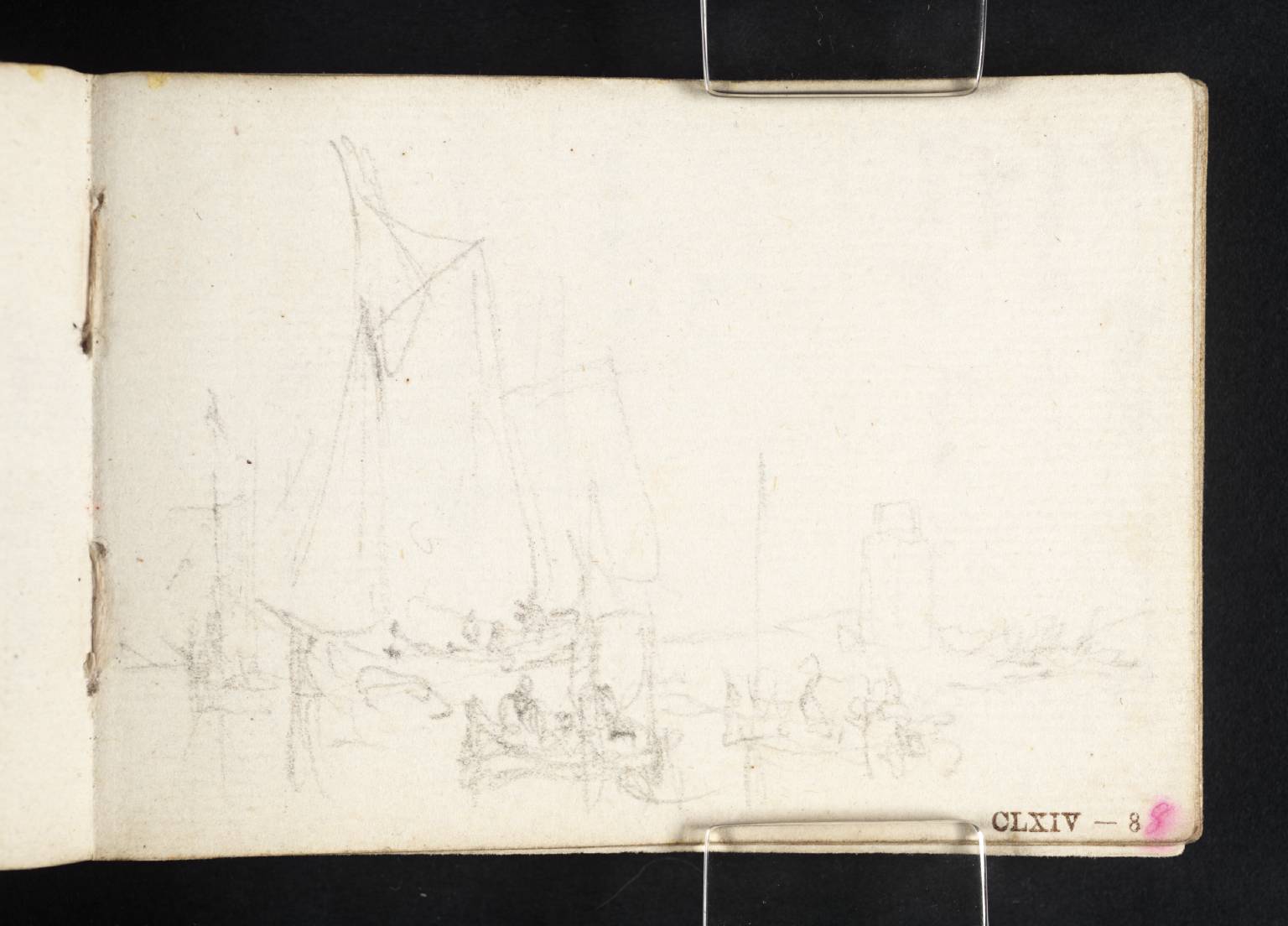
Joseph Mallord William Turner Study for 'Dort, or Dordrecht. The Dort Packet-Boat from Rotterdam becalmed' 1817‒18 c.1817-18
Image 1 of 2
Joseph Mallord William Turner,
Study for 'Dort, or Dordrecht. The Dort Packet-Boat from Rotterdam becalmed' 1817‒18
c.1817-18
Folio 8 Recto:
Study for ‘Dort, or Dordrecht. The Dort Packet–Boat from Rotterdam becalmed’ 1817‒18
D13253
Turner Bequest CLXIV 8
Pencil on white wove paper, 69 x 103 mm
Inscribed in red ink ‘8’ bottom right
Stamped in black ‘CLXIV 8’ bottom right
Inscribed in red ink ‘8’ bottom right
Stamped in black ‘CLXIV 8’ bottom right
References
1909
A.J. Finberg, A Complete Inventory of the Drawings of the Turner Bequest, London 1909, vol.I, p.476, CLXIV 8, as ‘Design for “Dort.”’.
1974
A. [‘Fred’] G.H. Bachrach, Turner and Rotterdam: 1817 – 1825 – 1841, Netherlands [1974], p.18, reproduced.
1981
A.G.H. Bachrach, ‘Turner, Ruisdael and the Dutch’, Turner Studies, vol.1, no.1, [Summer 1981], pp.26, 30 note 25.
1984
Martin Butlin and Evelyn Joll, The Paintings of J.M.W. Turner, revised ed., New Haven and London 1984, p.103.
1994
Fred G.H. Bachrach, Turner’s Holland, exhibition catalogue, Tate Gallery, London 1994, pp.42–3.
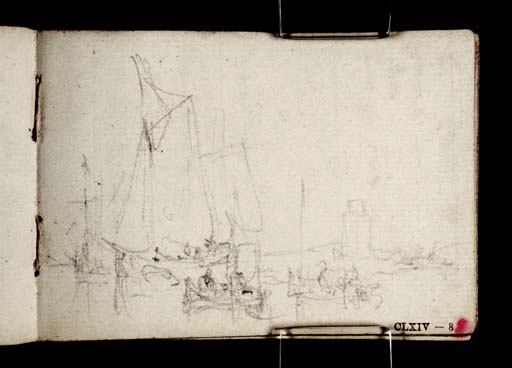
This wide view of Dordrecht across water, with boats in the foreground and the Grote Kerk in the distance to the right, is one of two composition studies Turner used for his painting Dort, or Dordrecht. The Dort Packet–Boat from Rotterdam becalmed (Yale Center for British Art, New Haven).1 A closely related study, perhaps slightly more finished and likely to have been made back in England, is in Turner’s Itinerary Rhine Tour pocketbook, used before, during and after his tour of the Netherlands and Middle Rhine in 1817 (Tate D12604; Turner Bequest CLIX 50).
Exhibited at the Royal Academy in 1818, the picture was bought by Turner’s friend and patron Walter Fawkes, who had already bought a series of Rhine watercolours by Turner the previous year. Although the painting shows a greater expanse of water in the foreground and Dordrecht further in the distance, the composition – especially the main group of boats – is well established in this drawing. Like that in Itinerary Rhine Tour, it may have been made back in England as he reviewed the material he had brought home from the Continent.
Turner visited Dordrecht while on his way back from the Rhineland in early September 1817. He was there for a day and a half and made many drawings. Among other sources for the picture, another possible design is in the Dort sketchbook (Tate D12155; Turner Bequest CLXII 84a) together with various related notes and sketches (D13142, D13143, D13158–D13159; CLXII 77, 77a, 86, 87)2 and there are more in the Liber Notes (2) sketchbook, in use over a longer period (D12220, D12223; Turner Bequest CLIV 67a, 69). Turner seems to refer to the packet–boat De Zwaan (The Swan), that ran regularly between Dordrecht and Rotterdam, in colour notes on folio 4 recto of the present book (D13248).
Turner’s numerous sketches and extensive notes on this subject made while in Dordrecht suggest he was already planning a painting. In the Royal Academy exhibition in 1816, he had admired The Entrance to the Pool of London (Bowood House) by his friend and near contemporary, Augustus Wall Callcott (1779–1844). Callcott’s similarly large picture was a prototype of the modern ‘tranquil marine’, reinventing the tradition of earlier works such as The Maas at Dordrecht (National Gallery, Washington) by the Dordrecht master Aelbert Cuyp (1620‒1691), lent to the British Institution in 1815.3 An immense success at the time and much praised by Turner, Callcott’s picture prompted a commission from the 2nd Earl Grey for a view of Rotterdam on the same large scale, which Callcott completed after some delay for the Academy in 1819 (private collection).4
Turner’s Dort was his own combined tribute and competitive contribution to British Cuyp mania in the intervening year, and his extended title describing a becalmed Dordrecht packet boat may have concealed a private joke about Callcott, as rival importer of a Cuypish style, not yet finishing his Rotterdam.5 Within Turner’s own work, Dort presented a luminous and uplifting contrast to his nocturnal Field of Waterloo, also exhibited in 1818 (Tate N00500),6 celebrating the transition from war to peace. For A.G.H. Bachrach, the pictures were a contrasted pair, Waterloo symbolising the Sublime and Dort the Beautiful in Edmund Burke’s formulation, ‘or, in [John] Ruskin’s terminology: “Turner’s two strengths in Terror and Repose”’.7
See also Bachrach 1994, pp 42–3; Bachrach 1981, p.26; David Blayney Brown, Augustus Wall Callcott, exhibition catalogue, Tate Gallery,London 1981, pp.78–9.
Verso:
Blank
Quirine van der Meer Mohr
December 2013
David Blayney Brown
September 2025
How to cite
Quirine van der Meer Mohr and David Blayney Brown, ‘Study for ‘Dort, or Dordrecht. The Dort Packet–Boat from Rotterdam becalmed’ 1817‒18’, catalogue entry, September 2025, in David Blayney Brown (ed.), J.M.W. Turner: Sketchbooks, Drawings and Watercolours, Tate Research Publication, June 2026, https://www